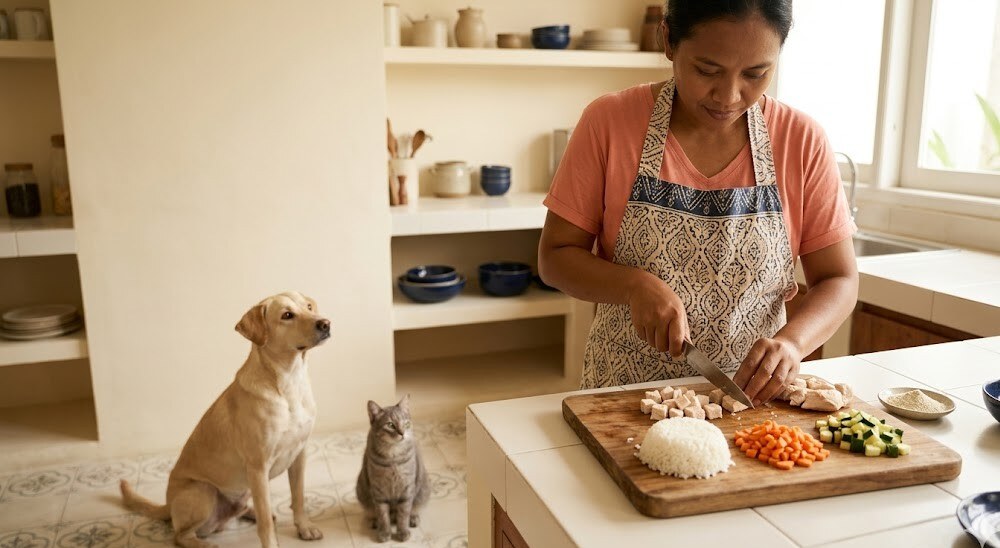

"I heard BARF is more natural for dogs and I want to try it, but they say there's a bacteria risk. What's the truth?" Or: "My cat has been on raw food for 2 years, and her coat is genuinely better. But the vet recommends stopping. Why?" Questions about the raw food diet, most often called BARF (Biologically Appropriate Raw Food), come into our team almost weekly. The topic is sensitive because many owners already committed to BARF read an article like this as an attack on their choice.
This article is not a lifestyle judgment, but an evidence-based presentation of the consensus position of international veterinary associations. We lay out the pro side (which is often the reason owners switch to BARF), the con side (the real risks the BARF community often does not emphasize), the official position of AVMA + FDA + WSAVA + AAHA + AAFP, and safer alternatives if you still want to feed something "more natural" than commercial kibble.
What is BARF and the supporting philosophy
BARF stands for Biologically Appropriate Raw Food (or the earlier version, Bones and Raw Food), a term popularized by the Australian veterinarian Ian Billinghurst in the 1990s. The basic concept: dogs and cats evolved as carnivores that ate fresh prey (muscle, organs, bones, the prey's stomach contents), not the 20th-century industrial kibble high in carbohydrates.
The composition of traditional BARF is generally:
- 60-70% raw muscle meat, chicken, beef, turkey, fish
- 10-15% raw soft bone, chicken necks, wings, RMB (raw meaty bones)
- 5-10% organs, liver, kidney, heart
- 5-15% vegetables and fruit, carrot, broccoli, blueberry (for dogs, cats generally skip)
- Supplementation sometimes added, raw eggs, fish oil, kefir, herbs
Popular variants: Whole Prey Model (whole prey, mice, small chickens), Frankenprey (composition managed part-by-part manually), commercial frozen raw (Stella & Chewy's, Primal, Steve's Real Food, already in Indonesia via certain online stores).
Pro side: claims that are often the reason for switching to BARF
Here are claims often perceived by owners or promoted by the BARF community. Some have an observational basis, some are not yet sufficiently supported by controlled studies:
- Shinier coat and healthier skin, many owners report this after switching to BARF. Likely related to increased fatty acids (fresh animal fat, organs), not an exclusive property of raw, high-quality kibble with omega-3 often gives a similar effect.
- Smaller, drier stools, a real effect because BARF is low in carbohydrate filler. Smaller stools = less undigested residue. But this can also indicate dehydration or excess calcium from bone.
- Less periodontal disease / cleaner teeth, chewing bone and raw meat has a mechanical cleaning effect. Small observational studies support this, but with a tradeoff of tooth fracture risk (see con section).
- Increased energy and vitality, anecdotal, hard to separate from the owner's placebo effect and attention bias.
- "Mimicking the ancestral diet", a philosophical argument. Counter-argument: the domestic dog is not a wolf, after 15,000-30,000 years of co-evolution with humans, there is a genetic adaptation to digest starch (the AMY2B amylase gene) that wolves do not have. Cats are indeed genetically closer to their wild ancestors, but exposure to fresh prey in a modern home environment still carries risks that do not exist in the wild habitat.
- Better digestion for cats with IBD/sensitivities, some owners report this. Possibly because of pure protein without filler/grain. But hydrolyzed protein or novel protein kibble diets also often give a similar effect without the risk of raw.
Important: many benefits promoted for BARF can be achieved with safer alternative diets (premium high-meat kibble, fresh-cooked diet, balanced wet food). There is no strong controlled study showing that raw provides a benefit that cannot be achieved with a cooked equivalent.
Con side: risks that are often not emphasized
This section is not meant to scare, but it is important to understand before a diet decision. The main risks are based on the consensus position of international veterinary organizations and field studies:
1. Pathogenic bacterial contamination
Commercial raw meat, even that sold for human consumption, has a significant prevalence of pathogenic bacterial contamination. Per the study Freeman LM et al, "Current knowledge about the risks and benefits of raw meat-based diets" JAVMA 2013 + multiple FDA surveys:
- Salmonella, prevalence of 7-20% in commercial raw meat pet food products (vs 0-1% in extruded kibble)
- Campylobacter jejuni, most common in raw chicken, a leading cause of bacterial diarrhea in animals and humans
- Escherichia coli (including shiga-toxin-producing strains), a real risk in ground meat
- Listeria monocytogenes, can survive at refrigerator temperatures, fatal in the immunocompromised
- Clostridium perfringens, a cause of acute enteritis
Healthy adult dogs and cats can tolerate low exposure to Salmonella without symptoms (they are more resistant than humans), but they still shed pathogenic bacteria in their stool, contaminate the environment, and become a source of zoonosis for the family.
2. Parasites
Raw meat, especially if not from a verified source, can carry parasites:
- Toxoplasma gondii, a particular risk from raw meat that has not been properly frozen. Dogs/cats can shed oocysts → environmental contamination → human infection (very dangerous for pregnant women, risk of miscarriage and congenital defects)
- Trichinella spiralis, from raw pork or wild game
- Sarcocystis, cysts in livestock muscle, can infect carnivores that consume it
- Echinococcus, a tapeworm from consuming ruminant organs (a serious zoonosis risk)
Freezing meat at -20°C for a minimum of 3 days kills most parasites (but not all bacteria). Many household freezers do not reach -20°C consistently, most operate at -15 to -18°C.
3. Bone-related risks
The "B" component in BARF (bones) is one of the most underrated sources of risk:
- Tooth fracture, especially the premolar and molar teeth from biting weight-bearing bone (beef femur, large knuckle bone). Slab and crown fractures often require extraction or a root canal.
- Choking and esophageal obstruction, bone fragments swallowed whole
- GI tract perforation, sharp bone fragments piercing the stomach or intestinal wall → peritonitis (fatal)
- Intestinal obstruction, a lodged bone fragment
- Severe constipation, excess calcium from bone makes stools dry and hard like cement
- Cooked bones are very dangerous, cooked bone becomes brittle and sharp when it breaks; NEVER give cooked chicken bones to a dog
The "boneless raw" variant reduces this risk, but then requires calcium supplementation from another source (Ca powder, eggshell, etc.), which is often not done properly in home-prepared BARF.
4. Nutritional imbalance
A home-prepared BARF diet not formulated by a veterinary nutritionist is generally not complete and balanced. Per multiple studies (Dillitzer 2011, Freeman 2013, Stockman 2013) that evaluated online BARF recipes:
- 60-95% of recipes do not meet the AAFCO or FEDIAF standard for one or more nutrients
- The most common deficiencies: calcium (if no bones / no supplementation), vitamin D, vitamin E, zinc, copper, iodine, taurine (for cats, risk of cardiomyopathy)
- The most common excesses: vitamin A (too much liver), calcium (too much bone), phosphorus
- The Ca:P ratio is often off, outside the 1.1-1.4:1 range needed for normal bone growth (especially risky for puppies)
For puppy growth, this is not a theoretical problem, a nutritional deficit in the critical period can cause permanent abnormalities (rickets, nutritional hyperparathyroidism, growth disorders).
5. Zoonosis: risk to the human family
This is the risk that is often most underrated. Raw meat in contact with kitchen surfaces, an animal that just ate raw food then licks a child/human, stool that sheds pathogenic bacteria, all become routes of zoonotic exposure. Per the CDC + AAHA Position Statement on Raw Diets, the highest risk is in populations:
- Infants and children <5 years, immature immune systems, often putting hands in their mouths
- Elderly >65 years, declining immunity
- Pregnant women, significant Salmonella + Toxoplasma risk to the fetus
- Immunocompromised patients, cancer, transplant, HIV, autoimmune on biologics, long-term corticosteroids
Documented cases: a Salmonella outbreak in a family that just switched their pet to raw food, hospitalization of a toddler due to E. coli traced to raw pet food, contamination of multiple kitchen surfaces with Listeria.
Consensus position of international veterinary organizations
Major international veterinary associations have relatively uniform official positions, all discourage raw meat-based diets for pet dogs and cats:
- AVMA (American Veterinary Medical Association), Policy on Raw or Undercooked Animal-Source Protein in Cat and Dog Diets: "AVMA discourages the feeding to cats and dogs of any animal-source protein that has not first been subjected to a process to eliminate pathogens, because of the risk of illness to cats and dogs as well as humans."
- FDA, Guidance for Industry: Raw Pet Food: documentation of the Salmonella + Listeria risk position, a recommendation of heat treatment or HPP (high-pressure processing) for manufacturers
- AAHA (American Animal Hospital Association), Position Statement on Raw Diets: "AAHA does not advocate or endorse feeding pets any raw or undercooked animal-source protein"
- WSAVA Global Nutrition Committee, Statement on Raw Diets: highlights the risk to immunocompromised families, states that the claimed benefits are not supported by strong evidence
- AAFP (American Association of Feline Practitioners), co-signs with the AAHA position, plus highlights taurine deficiency in home-prepared raw cat food
- CDC (Centers for Disease Control), recommends against raw pet food especially in households with children/elderly/immunocompromised
Important to note: this consensus position is not a ban, owners still have the right to choose. But the institutional veterinary position sends a signal that, based on the evidence available at present, the risk of a raw diet generally exceeds the validated benefit.
What if the owner still wants to use BARF?
Realistically, some owners will still choose raw after weighing the trade-offs. If that is your choice, there are harm reduction steps you can take:
1. Use commercial frozen raw, not home-prepared from a wet market
Premium commercial raw food manufacturers (Stella & Chewy's, Primal, Steve's Real Food, some local Indonesian brands) generally perform HPP (high-pressure processing) or freeze-drying that significantly reduces the pathogenic bacterial load. This is safer than wet-market raw meat with minimal control.
2. Formulation by a veterinary nutritionist, not an internet recipe
If you insist on home-prepared, use the services of a board-certified veterinary nutritionist (ACVN / ECVCN) for the recipe formulation. Online services are available (BalanceIT, PetDiets) with a consultation fee comparable to the long-term diet investment. A "generic BARF" recipe from a Facebook group is almost certainly not balanced.
3. Avoid weight-bearing bones
Avoid beef femurs, large knuckle bones, and stewed beef bones. If using RMB (raw meaty bones), choose soft ones proportional to the animal's size (chicken necks for small dogs, chicken wings, rabbit RMB). Consult a veterinary dentist for dogs with a history of tooth fracture.
4. Strict handling hygiene
- A dedicated cutting board and utensils for raw pet food, separate from human food preparation
- Sanitize with disinfectant after handling (not just dish soap)
- Wash hands with soap + hot water after preparation and after handling the bowl
- Wash the animal's bowl after every meal with hot water + soap
- Do not let toddlers come into contact with the feeding area or an animal that just ate raw food for 30 minutes
- Pick up stool promptly, do not leave it in the yard / litter box for days
5. Monitor stool culture and health
Some veterinary nutritionists recommend periodic stool cultures (every 6 months) for animals consuming raw food, especially if there is an infant/elderly person at home. Plus monitor BCS, coat, energy, and GI red flags (chronic diarrhea, vomiting).
6. DO NOT feed raw food to:
- Puppies < 1 year (especially large/giant breeds), risk of a growth-phase nutritional deficit
- Kittens
- Immunocompromised animals (cancer, long-term corticosteroids, diabetes)
- Animals with active IBD or pancreatitis
- Animals in a household with an infant/toddler, elderly, pregnant women, or an immunocompromised patient
Safer alternatives with similar benefits
If you are interested in BARF because you want something "more natural" than commercial kibble, there are several alternatives that offer high quality without the raw risk:
1. Premium high-meat-content kibble
Premium brands with a high animal-meat content (Orijen, Acana, Purina Pro Plan, Royal Canin Veterinary line) have 30-40% protein from animal sources, omega-3 from fish oil, and an AAFCO-compliant formulation. Extruded kibble is cooked during production so the pathogenic bacteria risk is minimal. Not "natural" philosophically, but nutritionally balanced and safe.
2. Premium wet food / canned food
Complete-and-balanced wet food with high moisture content (70-80%) approaching prey moisture content. Suitable for cats that need extra hydration. Sterilized during canning, so it is safe from pathogenic bacteria.
3. Fresh-cooked diet (gently cooked)
One of the best compromises. Brands like The Farmer's Dog, NomNomNow (in the US, starting to appear in Asia) prepare fresh meals that are gently cooked, protein and vegetables lightly cooked to eliminate pathogenic bacteria but still less processed than extruded kibble. Can be made at home with a recipe from a veterinary nutritionist + brief cooking (an internal temperature >70°C for 1 minute is enough to kill most pathogenic bacteria).
4. Mixed feeding: kibble + fresh topper
A practical approach: a base of complete-and-balanced premium kibble + a fresh-cooked or wet food topper for variety and palatability. Take the convenience benefit of kibble + the freshness of the topper, while maintaining nutritional balance.
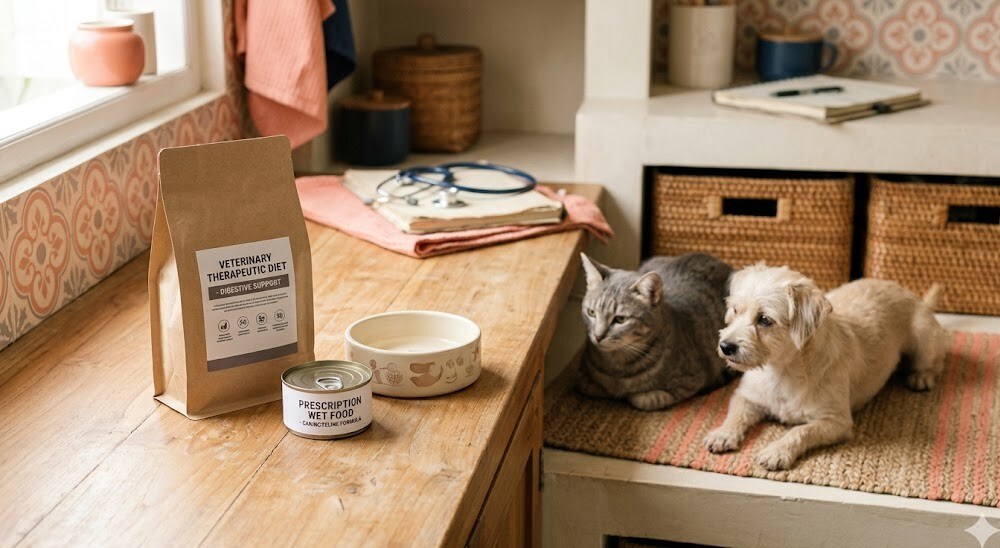
5. Limited-ingredient diet for animals with food sensitivity
If the reason for switching to BARF is suspected food allergy, the more predictable cooked options are: a prescription hydrolyzed protein diet (Royal Canin Anallergenic, Hill's z/d), or a limited-ingredient kibble with a novel protein (duck, venison, rabbit). A vet can set up a proper 8-12 week food elimination trial.
When to consult a vet before/after a diet switch
- Before switching to raw food, discuss the risk-benefit specific to your animal and household
- Before stopping raw food, a gradual transition to avoid GI upset
- After switching to raw, if there is diarrhea, vomiting, or signs of zoonosis in a family member
- For formulating a home-prepared diet (raw or cooked), a veterinary nutritionist's input is essential
- If you are immunocompromised or there is an infant/elderly person at home and the animal consumes raw
- For animals with medical conditions (CKD, IBD, diabetes, pancreatitis), the diet must be re-evaluated
If you are in the Greater Jakarta area and need a nutrition consultation without the hassle of bringing your pet to the clinic, the Prabasa Vet pet examination at-home service can check the BCS, evaluate the current diet, discuss the risk-benefit of raw food for your specific situation, and recommend a diet plan right at home.
Raw food / BARF FAQ for dogs and cats
My dog has been on BARF for 2 years and is healthy, do I have to stop?
Not automatically. If the animal is asymptomatic, at an ideal BCS, with normal lab work, and there is no infant/elderly/immunocompromised person at home, the risk-benefit balance can differ from a new owner. What matters is periodic evaluation: BCS every 2-3 months, annual lab work (CBC, chemistry, urinalysis), periodic stool culture if there is a vulnerable household member. Consult your vet for a long-term plan specific to your situation.
If I cook the meat first before feeding, is it still BARF?
It is no longer BARF by definition (B = bones, A = raw). But the "fresh-cooked" approach is actually one of the safest alternatives while still providing the benefit of fresh ingredients. Light cooking (an internal temperature >70°C for 1 minute) eliminates pathogenic bacteria without over-processing. Make sure the recipe is formulated by a veterinary nutritionist so it stays complete-and-balanced.
My cat is a picky eater and only wants raw chicken, what do I do?
A very selective strong food preference sometimes masks an underlying problem (food aversion due to dental pain, chronic nausea, IBD). Check with a vet first to rule out a medical cause. To transition out of single-protein raw, try: (1) commercial frozen raw (if you insist on raw, it is safer), (2) premium wet food with the same chicken protein → the cat tastes something familiar, or (3) freeze-dried raw chicken as a topper on kibble. Transition gradually over 2-4 weeks.
Raw chicken bone safe vs cooked, what's the explanation?
Raw chicken bone is relatively soft and flexible, it can be chewed and digested by dogs/cats without sharp fractures. A cooked chicken bone (boiled, roasted) becomes brittle and breaks into sharp shards, a very high risk of perforating the esophagus, stomach, and intestines. NEVER give cooked chicken bones to a dog/cat. Leftover chicken bones from the family meal must be discarded in a closed trash bin. Even raw bone still carries a risk (see con section) but it is smaller than cooked.
Is dry kibble "ultra-processed" and bad?
The term "ultra-processed food" from human nutrition does not automatically apply to pet food, which is formulated differently. High-quality extruded kibble is engineered to meet all of a dog's/cat's nutritional needs per the AAFCO standard with industrial quality control, a standardized freshness window, and elimination of pathogenic bacteria. Budget kibble brands with high filler are indeed lower quality, but premium kibble from a reputable brand is a scientifically robust and safe choice.
Meat from a supermarket vs a wet market, what's the difference for raw food?
A supermarket with a proper cold chain (a consistent 0-4°C) and a controlled farm source has a lower contamination risk than a wet market. But no raw meat from any source in Indonesia is guaranteed pathogen-free, all must be treated as potentially contaminated. If you use raw, a supermarket is more advisable than a wet market, and freeze for a minimum of 3 days at -20°C if possible before feeding the animal.
Summary
The raw food diet (BARF) is a legal diet choice, and many owners report anecdotal benefits. But the consensus position of AVMA, FDA, WSAVA, AAHA, AAFP, and CDC is to discourage it based on the risk evidence:
- Microbiological risk, significant Salmonella, Campylobacter, E. coli, Listeria contamination in raw meat
- Parasite risk, Toxoplasma, Trichinella, Sarcocystis, Echinococcus
- Bone-related risk, tooth fracture, choking, GI perforation
- Nutritional imbalance, the majority of home-prepared BARF recipes do not meet the AAFCO standard
- Zoonosis, risk to infants, the elderly, pregnant women, and the immunocompromised in the household
If you are interested in BARF because you want something "more natural" than commercial kibble, there are alternatives that offer high quality without the raw risk: premium high-meat kibble, complete-and-balanced wet food, a fresh-cooked diet formulated by a veterinary nutritionist, or mixed feeding of kibble + a fresh topper.
If you still choose raw, practice harm reduction: commercial frozen raw (not home-prepared from a wet market), formulation by a veterinary nutritionist (not an internet recipe), avoid weight-bearing bones, strict handling hygiene, periodic stool culture monitoring, and DO NOT feed raw food to puppies/kittens, immunocompromised animals, or a household with vulnerable members.
Have a specific question about your dog's/cat's diet, or are you considering a switch to/from raw food? WhatsApp Prabasa Vet for a free consultation. Mention the animal type, age, health condition, current diet, and household composition (any infants/elderly?). Our team will help assess the risk-benefit for your specific situation.
Read also: Cat Nutrition by Life Stage: Kitten, Adult, Senior, Complete Guide 2026, Cat Food Allergy: Signs, Causes, and Hypoallergenic Diet Options. See also the pet care guide by Prabasa Vet.
Medical references used in this article
This article was prepared with reference to the following sources, verified per clinical statement:
- AVMA (American Veterinary Medical Association). Policy on Raw or Undercooked Animal-Source Protein in Cat and Dog Diets, official position discouraging feeding raw protein, the epidemiology and zoonosis basis
- FDA (US Food and Drug Administration). Guidance for Industry: Manufacture and Labeling of Raw Meat Foods for Companion and Captive Noncompanion Carnivores and Omnivores, Salmonella + Listeria surveillance data, HPP processing recommendation
- AAHA (American Animal Hospital Association). Position Statement on Raw Protein Diet, co-signed with AAFP, the institutional position
- WSAVA Global Nutrition Committee. Statement on Risks Associated with Feeding Raw Meat-Based Diets to Pets, evidence synthesis + practical recommendations for vets
- Freeman LM, Chandler ML, Hamper BA, Weeth LP. Current knowledge about the risks and benefits of raw meat-based diets for dogs and cats. JAVMA 2013; 243(11): 1549-1558 , comprehensive literature review, the basis for bacterial contamination prevalence
- CDC (Centers for Disease Control and Prevention). Salmonella in raw pet food and treats, outbreak documentation, public health recommendation for households with vulnerable members
- Dillitzer N, Becker N, Kienzle E. Intake of minerals, trace elements and vitamins in bone and raw food rations in adult dogs. British Journal of Nutrition 2011 , evaluation of the nutritional balance of home-prepared BARF recipes
- Stockman J, Fascetti AJ, Kass PH, Larsen JA. Evaluation of recipes of home-prepared maintenance diets for dogs. JAVMA 2013 , survey of online recipes, rate of non-compliance with the AAFCO standard
This article is a general guide based on the consensus of international veterinary organizations + peer-reviewed studies. For an evaluation of your specific animal's diet, including the household situation, medical conditions, and value preferences, consulting a vet is the right step. This article is not intended as an attack on owners' diet choices, but as an evidence-based presentation for informed decision-making.