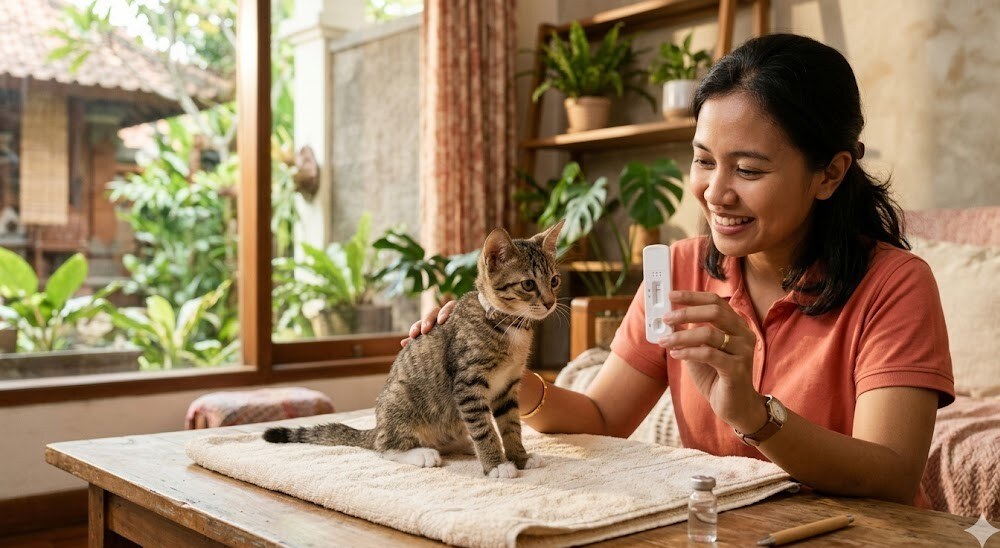

"Doc, my cat just tested on SNAP, FIV positive. Do I have to euthanize? Can it spread to me or my child?" This question almost always arrives in a panicked tone on our WhatsApp, and our answer is almost always the same, no, FIV does not infect humans, and an FIV+ cat can absolutely live a good quality of life for 10+ years with proper care. But understanding of FIV is still often mixed up with misconceptions (frequently mistaken for "cat HIV" that infects humans), so many FIV+ cats are euthanized or abandoned even though they could still live well.
This article is a complete guide for owners who have just received an FIV+ diagnosis, owners of rescue cats undergoing screening, or owners of a multi-cat household worried about transmission between cats.
What is FIV and why is it so often misunderstood?
FIV (Feline Immunodeficiency Virus) is a lentivirus from the family Retroviridae, molecularly it is indeed similar to HIV in humans (both are lentiviruses). But it is important to underline: FIV is cat-specific, this virus is host-specific, it does not infect humans, dogs, or other animals in the home.
The mechanism by which FIV causes damage is similar to HIV in humans (a helpful analogy, not a clinical equivalence):
- It attacks CD4+ T lymphocytes, immune cells that coordinate the immune response. Over time, CD4+ counts fall and the immune system gradually weakens
- Slow progression, it can take years from initial infection until signs appear. Many FIV+ cats live normally for 5-10 years or more before signs of immunodeficiency become visible
- Terminal "feline AIDS" phase, the cat eventually becomes vulnerable to opportunistic infections that are usually no problem for a healthy cat
What is often misunderstood: "FIV = cat HIV that infects humans." WRONG. There is no evidence FIV infects humans, and thousands of veterinarians and shelter workers who are in daily contact with FIV+ cats have never become an index case of transmission.
Transmission, why unneutered outdoor male cats are most at risk
FIV spreads between cats primarily via bite wounds, when cats are involved in a fight and there is a bite that penetrates the skin, the virus in the attacker's saliva enters the target's tissue/bloodstream directly.
Clinically relevant transmission routes:
- Bite wounds during fights, the main route. This is why the most at-risk profile = male, free-roaming outdoors, unneutered. Unneutered males have territorial aggression and mating fights that produce many bite wounds
- Vertical transmission (queen to kitten), possible but far rarer than with FeLV. Kittens of an FIV+ queen are sometimes transiently positive due to maternal antibody (not true infection), they need re-testing after 6 months of age for confirmation
- Blood transfusion, relevant in the medical context, which is why feline blood donors must be screened for FIV/FeLV
Importantly: FIV is NOT efficiently transmitted via casual contact, shared grooming, sharing bowls, or sharing a litter box very rarely transmits FIV (unlike FeLV, which spreads easily via grooming saliva). This has major implications for managing a multi-cat household, discussed below.
High-risk FIV cat profile:
- Adult male cats, unneutered, free-roaming outdoors (#1 risk profile)
- Cats with a history of fighting (recurring scratch/bite wounds)
- Rescue/street cats with no medical history
- Cats in feral colonies or catteries with outdoor access
FIV prevalence in Indonesia
FIV prevalence data in Indonesia is still limited, but clinical reports and surveys at shelters/rescues in major cities (Jakarta, Bandung, Surabaya, Bogor) indicate significant figures in the outdoor population, an estimate that frequently appears from various clinical surveys in Southeast Asia is 5-15% in outdoor and rescue cats, with high variation depending on area, sampling methodology, and population profile.
The combination of a large street cat population + a culture of letting house cats roam freely outdoors + a still-low sterilization rate = conditions that keep FIV circulating in Indonesia's cat community, especially among territorial males.
The 3 phases of FIV infection, and why FIV+ cats can look healthy for a long time
A characteristic of FIV that sets it apart from most infectious diseases: a very long asymptomatic carrier phase, it can last for years. Understanding the following 3 phases is important for owner consultations and prognosis expectations:
Phase 1: Acute, weeks to months after infection
After initial infection (usually via a bite wound), the cat may go through an acute phase:
- Mild to moderate fever
- Generalized lymph node enlargement (lymphadenopathy)
- Lethargy and temporary loss of appetite
- Sometimes mild diarrhea
These signs are often so mild that they go undetected by the owner, the cat looks "a bit sluggish for a week, then back to normal." Many owners never know their cat ever went through this phase.
Phase 2: Asymptomatic carrier, can last for years
After the acute phase subsides, the cat enters a carrier phase that can last for years (on average 5-10 years, some cats longer). During this phase:
- The cat appears outwardly healthy and normal
- Activity, appetite, and body weight are stable
- The virus keeps replicating slowly in lymphocytes, and the CD4+ count gradually falls
- The cat transmits to other cats only via bite wounds (not casual contact)
Many FIV+ cats are first diagnosed during this phase, tested for another reason (pre-vaccination, pre-sterilization, adoption screening) and incidentally found positive.
Phase 3: AIDS phase (advanced immunodeficiency), terminal phase
Once the CD4+ count falls low enough, the immune system can no longer protect the cat from opportunistic infections. Clinical signs that often appear in this phase:
- Recurring infections that never fully resolve, chronic upper respiratory infections, otitis, recurring skin infections/abscesses
- Chronic gingivitis and stomatitis, red inflamed gums, bad breath, the cat struggles to eat because of pain. One of the classic signs of advanced FIV
- Progressive weight loss, the cat looks thin despite eating
- Chronic diarrhea
- Intermittent fever
- Persistent lymphadenopathy
- Increased lymphoma incidence, FIV+ cats have roughly a 5× higher risk of lymphoma than FIV-negative cats
- Advanced oral disease, dental abscesses, tooth loss
- Neurological disease (rare), behavior changes, seizures, ataxia
Important: not all FIV+ cats reach phase 3 during their lifetime. Many die of other causes (old age, chronic kidney disease, non-FIV-related neoplasia) before the AIDS phase appears.
Diagnosing FIV, the SNAP combo FIV/FeLV and why young kittens are tricky
The FIV test most often used in clinics is the SNAP combo FIV/FeLV, an in-clinic cassette test that detects FIV antibodies (not the virus directly) along with FeLV antigen. Results in 10-15 minutes.
Important about interpretation in young kittens: the SNAP FIV detects antibodies, not the virus. Kittens of an FIV+ queen can inherit maternal antibodies through milk and colostrum, so the SNAP test can be positive up to around 4-6 months of age even though the kitten itself is not infected. This is why:
- Kittens under 6 months old with a positive SNAP FIV, should not be immediately declared FIV+. Re-test from 6 months of age onward to confirm true infection
- Many transiently positive kittens eventually test negative after the maternal antibody fades, a sizeable proportion
Who should be tested per AAFP (American Association of Feline Practitioners) Retrovirus Testing Guidelines:
- All newly adopted adult cats before joining other cats
- Cats recently involved in a fight with an unknown cat (re-test 60 days later because of the window period)
- Sick cats with consistent signs (chronic stomatitis, recurring infections, unexplained weight loss)
- Cats about to be sterilized (while under anesthesia, screen at the same time)
- Before blood donation
- Before being introduced to an FIV-negative cat in the home
Interpreting a positive result, confirm with a secondary test
A positive SNAP FIV result should be confirmed with a secondary method, especially for major management decisions (such as euthanasia, which should NOT be done based on a single positive SNAP):
- Western blot, the gold standard for confirming FIV serology
- PCR (proviral DNA), detects the virus directly, useful when serology interpretation is uncertain
- Re-test 60 days later, if the result is borderline or the cat was recently exposed
Discuss with your veterinarian for the right confirmation strategy for your cat's situation.
Managing an FIV positive cat, can live 10+ years with care
This is the most important part of this article: an FIV+ diagnosis is not a quick death sentence. With good lifestyle and medical management, many FIV+ cats live 10+ years with a very good quality of life. Some FIV+ cats even live beyond the average lifespan of an ordinary cat.
Lifestyle
- Indoor only, essential. Not out of fear that the FIV+ cat will infect community cats (transmission via bite wound is limited), but more to protect the FIV+ cat from environmental pathogen exposure and from stressful, wound-causing outdoor fights
- Sterilization/neutering, reduces roaming behavior and territorial aggression, and prevents vertical transmission (if the FIV+ cat is female)
- Minimize stress, a stable home, a predictable routine, avoiding stressful boarding/relocation where possible. Immunosuppressive stress accelerates disease progression
- Multi-cat household OK with conditions, an FIV+ cat can live with FIV-negative cats as long as there is no fighting (transmission via bite wound only). Ensure gradual introductions, all cats sterilized, and a harmonious social dynamic. Many modern shelters now adopt out FIV+ cats into homes with FIV-negative cats (no longer auto-isolating)
Excellent nutrition
- High-quality food, to support an immune system being suppressed by the virus
- Clean water always available
- Avoid raw food, higher risk of bacteria/parasites in an immunocompromised cat
More frequent routine check-ups
- Health check at least every 6 months, not just annually, because FIV+ cats need more frequent monitoring to catch complications early
- Routine CBC + biochemistry, monitor hematologic status, kidney function, liver function
- Routine dental checks, gingivitis/stomatitis is a common FIV complication; early intervention (scaling, extraction of problem teeth) can dramatically improve quality of life
- Quick response to any minor symptom, infections that are usually mild in a healthy cat (URI, skin infection, otitis) can become serious in an FIV+ cat. Don't wait, see the vet at the first sign
FIV vaccine, why it is not commonly used in Indonesia
Unlike FeLV, which has a core vaccine for young cats in endemic areas (per WSAVA 2024), the FIV vaccine story is more complex:
- An FIV vaccine was once available in the US (Fel-O-Vax FIV) but production was discontinued in 2017 due to two problems: (1) inconsistent protection across all FIV subtypes, (2) post-vaccination it makes the SNAP FIV test positive (because the test detects antibodies), making it hard to distinguish a vaccinated cat from a truly infected one
- In Indonesia, the FIV vaccine is not commonly available
- Primary FIV prevention = lifestyle: neutering (reduces fighting), indoor only or supervised outdoor, testing before introducing a new cat
FIV+ cats still need routine tricat (FVRCP) and rabies vaccines, an immunocompromised cat actually needs protection against other diseases. Some veterinarians choose killed/inactivated products over modified live for FIV+ cats, discuss this with your veterinarian.
FIV+ cats in a multi-cat household, practical strategy
Because FIV transmission is primarily via bite wounds (not casual contact), the multi-cat household strategy is more flexible than for FeLV:
Scenario A: 1 newly found FIV+ cat in a home with other FIV-negative cats
- Test all other cats in the home for a baseline (many are already positive without anyone knowing)
- Make sure all cats are sterilized (reduces aggression/fighting)
- Monitor the social dynamic, if it is harmonious without fighting, they can continue living together
- If there is consistent conflict between cats, separate them into different rooms for safety
- Re-test the FIV-negative cats every 6-12 months to verify their status
Scenario B: Wanting to adopt a new cat into a home with an existing FIV+ cat
- Consider adopting a cat that is also FIV+, a clean pair with no transmission risk
- If adopting an FIV-negative cat, ensure a non-aggressive personality, and introduce gradually to minimize fighting risk
- All cats must be sterilized
Scenario C: An uncontrolled outdoor cat
If the FIV+ cat used to go outdoors before diagnosis, transitioning to indoor only may need adjustment (a catio, supervised outdoor time, indoor environmental enrichment), but it is worth it for health and longevity.
FIV FAQ
Can FIV spread to me, my child, or my dog?
No. FIV spreads strictly between cats, it does not infect humans (adults or children), dogs, or other animals. Thousands of veterinarians and shelter workers in daily intensive contact with FIV+ cats have never become a transmission case. It is safe for the family.
My cat is FIV+, how long can it live?
The range is wide. Many FIV+ cats live 10+ years with good quality of life if lifestyle management is good (indoor, sterilized, excellent nutrition, routine monitoring, quick response when there is a problem). Some live close to the normal lifespan of an ordinary cat. What lowers the prognosis: continued outdoor access, prolonged stress, malnutrition, delayed treatment of secondary infections.
My 4-month-old kitten tested FIV positive, what does it mean?
It may be a false positive from maternal antibody. The SNAP FIV detects antibodies, not the virus. Kittens of an FIV+ queen can be transiently positive up to 4-6 months of age. Re-test after 6 months of age to confirm. Many initially positive kittens eventually test negative after the maternal antibody fades, don't rush into major management decisions while the kitten is young.
I have an FIV+ cat and an FIV-negative cat at home, do I have to separate them?
Not necessarily, provided: all cats are sterilized, the social dynamic is harmonious without fighting, and you are comfortable with monitoring (re-testing the FIV-negative cat every 6-12 months). Many modern shelters now adopt out FIV+ cats into homes with FIV-negative cats. The key: no bite wounds between cats.
Should an FIV+ cat be euthanized at diagnosis?
No. Euthanasia is not a decision to make at FIV+ diagnosis. Many FIV+ cats live a good quality of life for 10+ years after diagnosis. Euthanasia is an option at the end stage of disease, when quality of life has severely declined (uncontrolled recurring infections, severe stomatitis unresponsive to treatment, a condition that can no longer be managed). Diagnosis ≠ a quick death sentence.
Is the FIV vaccine available in Indonesia?
It is generally not available. The FIV vaccine (Fel-O-Vax FIV) was globally discontinued in 2017 because of inconsistent protection and because it makes the SNAP test positive post-vaccination. Primary FIV prevention in Indonesia = lifestyle (neutering, indoor or supervised outdoor, testing before introducing a new cat).
What does an FIV test cost?
The cost depends on the type of test used. The in-clinic SNAP combo FIV/FeLV is the most common initial test. Secondary confirmation such as Western blot or PCR (if needed for a major management decision) is usually sent to a reference lab and is priced differently. For an estimate that fits your needs and your area, reach out to Prabasa Vet on WhatsApp for a free consultation.
My FIV+ cat has red inflamed gums and struggles to eat, what can be done?
Chronic stomatitis is an advanced FIV complication with a significant impact on quality of life. Treatment is usually a combination: professional dental scaling + extraction of problem teeth (often full mouth extraction for severe stomatitis) + antibiotics for secondary infection + pain management + nutritional support (soft, palatable food). Many cats improve significantly after extraction of inflamed teeth. Discuss a specific plan with your veterinarian.
Summary
FIV is a cat-specific lentivirus/retrovirus, structurally similar to human HIV but does NOT infect humans. The main route of transmission is via bite wounds, which makes unneutered outdoor male cats the most at-risk profile. The 3 phases of disease: acute → long asymptomatic carrier (can last years) → final AIDS phase with opportunistic infections.
Diagnosis is via the SNAP combo FIV/FeLV, with an important caveat for young kittens (maternal antibody can cause transient positives up to 6 months of age, requiring a re-test to confirm). Confirm a positive with Western blot or PCR before any major management decision.
Most importantly: an FIV+ cat can live 10+ years with good quality of life. Diagnosis is not a quick death sentence. The pillars of management: indoor only, sterilized, excellent nutrition, stress minimization, prompt vet care for minor illness, routine 6-month check-ups, early intervention for stomatitis. A multi-cat household with FIV-negative cats is possible as long as there is no fighting (transmission via bite wound, not casual contact).
Want a SNAP FIV/FeLV test for a newly adopted cat, or to consult on managing an FIV+ cat without the stress of a carrier and a busy clinic? See the Prabasa Vet pet care guide or contact us on WhatsApp for a free consultation and a cost estimate specific to your area.
Read also: FeLV in Cats (Feline Leukemia Virus): Signs, Testing, and Vaccination, Signs of a Sick Cat That Needs a Vet.
Medical references used in this article
This article was prepared with reference to the following sources, verified per clinical statement:
- AAFP (American Association of Feline Practitioners) Feline Retrovirus Testing and Management Guidelines, FIV screening protocol, result interpretation, FIV+ cat management, multi-cat household guidance
- ABCD (European Advisory Board on Cat Diseases) FIV Guidelines, lentivirus pathogenesis, 3 phases of infection (acute/asymptomatic/AIDS), prevention strategy, combined antibody + PCR diagnostics
- ISFM (International Society of Feline Medicine) Consensus Guidelines on FeLV and FIV, lifestyle management of FIV+ cats, vaccination against other diseases in parallel, multi-cat household integration
- Hartmann K. Clinical aspects of feline retroviruses: a review. Viruses 2012 , FIV pathogenesis, multi-system clinical signs, prognosis, longevity factors
- Levy JK, Crawford PC, Hartmann K, et al. 2008 American Association of Feline Practitioners' feline retrovirus management guidelines. Journal of Feline Medicine and Surgery, testing strategy, kitten interpretation, post-bite re-test
- Plumb's Veterinary Drug Handbook, 7th edition, reference for supportive medications for secondary infections and stomatitis in immunocompromised cats
This article is general guidance based on the international AAFP, ABCD, and ISFM guidelines. For your cat's specific condition, including exposure history, test results, lifestyle, and current health status, consulting a veterinarian is the right step. Interpreting a positive FIV test result (especially in young kittens) requires confirmation via re-testing and/or a secondary method (Western blot, PCR).