
Chinchillas are often seen as "a cute little animal like a rabbit but smaller", when in fact they are Chinchilla lanigera, a mammal from the Andes mountains of South America very specifically adapted to a cold, dry climate. Many new owners in Indonesia feed their chinchilla rabbit food, put it in a small cage without AC, bathe it in plain water, and within weeks the chinchilla suffers heat stroke, GI stasis, or serious fur problems.
This article is a guide for those of you who are new to keeping a chinchilla or are considering adopting one, what a chinchilla is and why they are challenging in Indonesia's tropical climate, the right vertical multi-level cage, the strict hay-based diet, the important dust bath ritual, and the common signs of illness you must recognise. Disclaimer: this article is a general guide based on exotic small mammal medicine guidelines and is not a substitute for a direct consultation with an exotic animal vet.
What is a chinchilla?
- Species: Chinchilla lanigera (long-tailed chinchilla), the commonly kept one. There is also Chinchilla chinchilla (short-tailed), which is rare in the pet trade
- Origin: the Andes mountains of Chile/Peru/Bolivia, at 3,000-5,000 m above sea level, a cold, dry climate with extreme day-night temperature swings
- Classification: a rodent mammal (caviomorph), family Chinchillidae, a relative of the guinea pig, NOT the rabbit (although the gut physiology is similar)
- Size: 25-35 cm body length + an 8-15 cm tail, adult weight 400-800 grams
- Lifespan: 15-20 years (with optimal husbandry), very long compared with other small rodents. A long-term commitment
- Temperament: nocturnal/crepuscular (active at dusk and night), social (a pair or small group is recommended if there is enough space), agile and athletic (jumps high, runs fast), not an ideal handler-pet, chinchillas suit owners who appreciate observation more than cuddling
THE INDONESIA CHALLENGE: Tropical Climate vs Native Habitat
This is the most critical area and most often the cause of chinchilla deaths in Indonesia. Understanding their physiology is important:
Heat sensitivity, non-negotiable
- Chinchillas evolved with extremely dense fur (~60-80 hairs per follicle, the densest of any land mammal), an adaptation to the cold of the Andes
- They lack the ability to thermoregulate effectively through their skin (no sweat glands like humans, no efficient panting like dogs)
- IDEAL temperature range: 13-20°C
- Temperature above 24°C = the start of heat stress
- Temperature above 27°C = FATAL HEAT STROKE within hours, especially if the humidity is also high (Indonesia averages 70-85% humidity)
- Heat stress + Indonesian humidity = a double whammy. Stress indicators: panting, drooling, extreme lethargy, very red/hot ears, collapse
Implications for owners in Indonesia
- AC is mandatory 24/7 in the chinchilla's room, set to 20-22°C with a thermometer to monitor
- A backup plan for power outages: an ice pack/marble tile pre-chilled in the fridge (the chinchilla can lie on it to cool down), a portable fan, evacuation to the coolest room in the house
- A prolonged power outage (>2-3 hours) on a hot day is a real emergency. Consider a small UPS/generator if your area has frequent outages
- You must not keep a chinchilla in a house/apartment without AC capable of cooling to 20-22°C
- Avoid a room with direct sun exposure (a kitchen near a west-facing window = NOT SUITABLE)
- Factor in the cost of running AC 24/7 as part of the chinchilla's living cost, it is not small in a tropical climate
Why a chinchilla requires a serious commitment in Indonesia
A chinchilla that has heat stroke rarely survives even when it reaches the vet, the therapeutic window is very narrow. Many chinchillas in Indonesia die young (3-7 years out of a potential 15-20 years) because of chronic cumulative heat stress that is not acutely fatal but shortens the lifespan. Be honest with yourself before adopting: can you commit to AC 24/7 for 15-20 years?
Temperament and sociability
Nocturnal / crepuscular
- Chinchillas are most active at dusk and in the early morning, they naturally sleep in the day and deep into the night
- Interaction works best in the evening/night when they are willingly active
- Not suitable for young children who want to play during the day
Social, a pair is recommended
- In the wild, chinchillas live in colonies, a solo chinchilla at home can be lonely and stressed
- A pair is recommended, especially same-sex siblings from a young age, or an introduced pair (which needs a gradual process)
- A pair does not increase the AC bill but doubles the food cost + cage space. A trade-off worth it for welfare
- Introducing adult chinchillas that have not met: a gradual process of 2-4 weeks in a neutral cage, supervised, they can fight if forced
Handling, not an ideal lap pet
Chinchillas do not like to be cuddled for long like rabbits or guinea pigs, they prefer freedom and observation. When handling:
- Approach calmly, provide a stable platform (rather than holding them dangling in your hand)
- DO NOT grab the tail, it can cause "fur slip" (a defensive mechanism: the tail skin comes off when pulled, irreversible)
- Scoop with two hands supporting the body
- Bond through daily interaction + treats (limited to safe treats), not through prolonged holding
Fur slip, a defence mechanism
When frightened or handled roughly, a chinchilla can "shed" a patch of fur (an escape trick from a predator that bites). The result is a bald patch that takes 2-6 months to grow back. It is not an emergency but an indication of wrong handling / stress. Avoid grabbing from above, holding the tail, or stressing them in a confined corner.
The ideal cage, VERTICAL multi-level
Basic concept
Chinchillas are athletic and agile, in the wild they jump and climb between Andean rocks. The cage must reflect this:
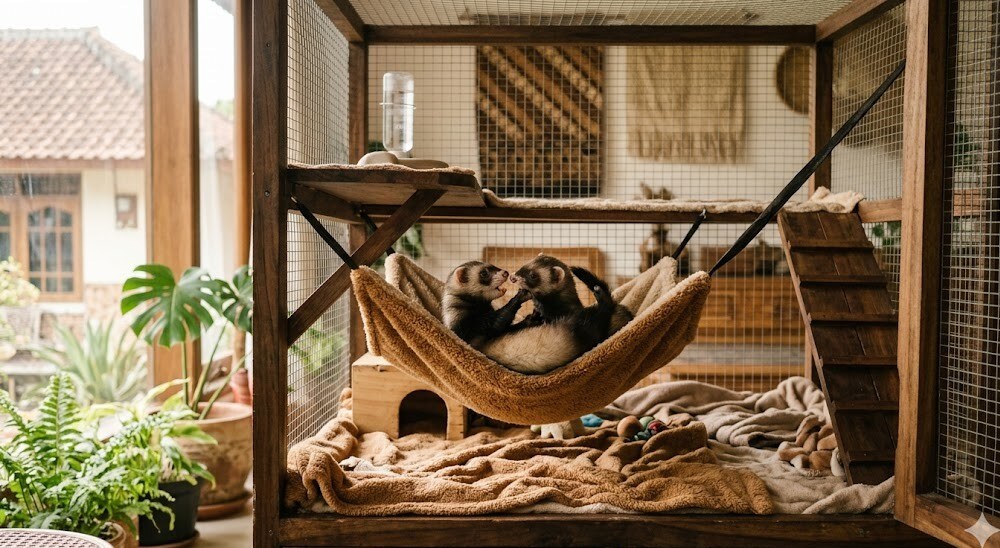
- VERTICAL multi-level, not horizontal and flat like a rabbit cage. A minimum of 3 floors with ramps or platforms
- Minimum height of 1 metre (taller is better)
- Minimum floor space: 60 × 60 cm for a solo, 80 × 60 cm for a pair, this is the minimum; many international references recommend a 1 m² floor base
- Wire mesh sides for ventilation (chinchillas need airflow), but the floor and platforms MUST BE SOLID (solid wood or flat plastic), a wire bottom across the whole cage risks bumblefoot (sore hocks/pododermatitis from the wire pressing on the small feet)
- The wire side spacing must not be too wide (max 1.5 cm), young chinchillas can squeeze through
Substrate
- Paper-based bedding (Carefresh, Kaytee, or generic paper pulp), the safest choice
- Aspen shavings, hardwood, non-toxic
- Fleece liner, washable, increasingly popular (requires the discipline of spot cleaning + a weekly wash)
- AVOID:
- Cedar shavings, toxic phenols (respiratory + liver issues)
- Non-kiln-dried pine shavings, moderate phenols
- Sand, rice husk, scented substrate, triggers allergic respiratory + skin problems
Cage furnishing
- A solid exercise wheel, a minimum diameter of 35-40 cm (chinchillas are bigger than hamsters and need a much larger wheel). A solid-floor wheel, NOT wire/grid (bumblefoot risk). An undersized wheel = a wrong spinal curvature, chronic orthopaedic problems
- A hideout / wood box at least 1 on the bottom floor (chinchillas need a place to retreat when they want to nap quietly)
- Wooden platforms/ledges at various heights for jumping (apple, pear, willow, kiln-dried pine wood are OK; AVOID cedar, citrus, walnut)
- A hay rack, so the hay does not scatter and get contaminated with faeces
- A heavy ceramic food bowl + a nipple water bottle (more sanitary than a water bowl for a chinchilla, bowls are prone to spilling and wetting the substrate)
- Chew toys are mandatory, chinchilla incisors grow continuously (open-rooted) and need constant gnawing to wear down. Provide safe wood blocks, pumice stone, dried apple branches
- A dust bath house, provide it outside or inside the cage (see the dust bath section below)
- Cage location: a stable air-conditioned room, away from sunlight, away from loud noise, away from the kitchen (cooking steam + spice smells = respiratory stress)
Diet, strict hay-based
The chinchilla is a hindgut fermenter with digestive physiology similar to a rabbit, the gut bacteria are sensitive to drastic dietary changes, highly dependent on high-fibre roughage, and prone to GI stasis if the diet is not right.
The ideal diet composition
- 80-90% timothy or orchard grass hay, the primary diet, free access 24/7
- Timothy hay is the most commonly recommended
- Orchard grass is a good alternative
- Meadow hay with a variety of grasses is good
- AVOID alfalfa hay as the primary for an adult chinchilla, it is too high in calcium and protein, triggering long-term kidney/bladder problems. Alfalfa is OK as an occasional treat (a small handful once a week) or for a pregnant/young growing chinchilla
- 5-10% quality chinchilla pellets (Oxbow, Mazuri, or a chinchilla-specific brand), a limited portion (1-2 tablespoons per day per chinchilla). Pellets for chinchillas, NOT rabbit or guinea pig pellets (the nutrient formulations differ)
- Very few fresh or dried treats:
- Dried rose hip (very small, occasional)
- Oat groats (a small handful, occasional)
- Dried raspberry leaves (occasional)
- Commercial hay-based treat tablets made for chinchillas
- Clean water always available via a water bottle (change daily)
NOT to be in a chinchilla's routine diet
- ANY FRESH FRUIT, chinchilla gut bacteria are intolerant of sugar. Fresh fruit (apple, banana, grape, mango) triggers severe diarrhoea, GI stasis, and diabetes long-term. Many international references explicitly state "NO fresh fruit". What is often considered a "healthy treat" is in fact the most dangerous
- Fresh vegetables (kale, carrot, lettuce, etc.), the high moisture content + sugars trigger GI upset. A strict hay-based diet is far safer
- Rabbit, guinea pig, or hamster pellets, the wrong formulation
- Bread, biscuits, human cereal, sugar and carbs trigger obesity + diabetes
- Chocolate, caffeine, alcohol, toxic
- Nuts, high fat triggers liver issues
- Onion, garlic, spring onion, toxic
- Avocado, toxic
- Alfalfa hay as the primary for an adult (see above)
Dust bath, an essential ritual
Chinchillas do NOT bathe in water. Their fur is very dense, if it gets wet, it takes a very long time to dry, and the moisture trapped against the skin triggers fungal infection + severe fur matting. Instead, they dust bathe, rolling in special volcanic dust to maintain their fur condition.
How to dust bathe correctly
- Use commercial chinchilla dust, pumice/volcanic dust made for chinchillas (Blue Cloud, Oxbow, Kaytee chinchilla dust). DO NOT use cat litter, ordinary sand, or house dust
- Dust bath container: a plastic or ceramic container large enough for the chinchilla to roll around without spilling (~20 × 30 cm)
- Frequency: 2-3x per week, sessions of 10-15 minutes. DO NOT leave the dust bath available 24/7 , it triggers eye irritation and over-drying
- Change the dust every 1-2 weeks (when there is faeces/urine in it or it looks dirty)
- Signs of too little dust bathing: sticky oily fur, matting, an unnatural smell
- Signs of over-bathing: dry flaky skin, patchy fur loss, eye irritation
Indonesia's climate (70-85% humidity) may mean the dust bath frequency needs adjusting, some owners need 3x/week to maintain fur quality. Monitor the fur condition and adjust accordingly.
Signs of a sick chinchilla you must recognise
Chinchillas hide signs of illness well (a prey species). Owners must routinely observe especially the following:
Emergency signs, go to an exotic vet immediately
- HEAT STRESS: panting, drooling, very red and hot ears, extreme lethargy, collapse. MAXIMUM-PRIORITY EMERGENCY, move to the coolest room immediately, apply a marble tile/ice pack to the armpits (avoid direct ice on the fur), contact an exotic vet immediately. The therapeutic window is very narrow
- GI STASIS / anorexia: not eating or drinking for >12 hours, no faeces or very small/infrequent faeces, a swollen/tense abdomen, lethargy. EMERGENCY, GI stasis can be fatal within 24-48 hours in a chinchilla (like a rabbit). A low-fibre diet, stress, or dental pain can trigger it
- Diarrhoea: soft or watery faeces (a normal chinchilla: round, dry, firm faeces). An indication of serious gut dysbiosis
- Dyspnoea / difficulty breathing: noisy breathing, flaring nostrils, a tense body posture straining to breathe
- Persistent drooling ("slobbers"), often an indication of advanced dental malocclusion, dental abscess. Wet fur on the chin and chest
- Seizures or muscle tremors
- Persistently watery eyes or purulent discharge, can indicate a corneal ulcer (from dust in the eye, or a dental root abscess pushing into the orbit)
- Progressive weight loss
- For males: a fur ring on the penis, a ring of fur strangulating the glans penis, which can cause a urinary blockage emergency. Check monthly for male chinchillas, especially those actively breeding or old
Signs that need an exotic vet evaluation
- Dental issues: drooling, reduced eating, weight loss, smaller faeces, preferring soft food. Chinchilla incisors + molars grow continuously, if they overgrow (malocclusion), they can ulcerate the cheek/tongue
- Fur quality decline: matting, oily fur, lost patches (not acute fur slip), can indicate an unbalanced diet, too little dust bathing, or internal disease
- Behavioural change: an active chinchilla suddenly hiding constantly, new aggression, or lethargy without acute signs
- Obesity: a body that looks round, fat folds at the neck
- Lumps on the body
Common diseases in chinchillas
1. Heat stroke / hyperthermia
Already discussed above, the most common cause of chinchilla death in Indonesia. Prevention via AC 24/7 + temperature monitoring. Emergency response: slow cooling (no direct ice), fluid therapy by an exotic vet. Mortality is high even when treated.
2. GI Stasis
Like a rabbit, a gut motility shutdown due to stress, a low-fibre diet, dental pain, or systemic disease. Signs: anorexia, reduced/absent faeces, a swollen abdomen, lethargy. Treatment by an exotic vet: IV/SC fluid therapy, motility drugs, pain management, syringe feeding a critical care formula. A 24-48 hour window, fatal if untreated. Prevention: an 80-90% hay diet, stable temperature, minimised stress.
3. Dental malocclusion
Chinchilla incisors + molars (cheek teeth) grow continuously throughout life. If wear is inadequate (a low-hay/roughage diet, or an alignment anomaly), tooth overgrowth causes cheek ulceration, difficulty eating, slobbers, weight loss, and secondary issues such as watery eyes (overgrown tooth roots pushing into the nasolacrimal duct). Diagnosis needs a dental exam with an otoscope/oroscope at an exotic clinic. Treatment: a dental trim/coronal reduction (anaesthesia required). Prevention: a hay-dominant diet (80-90%), adequate wood chew toys.
4. Fur ring (males)
Specific to male chinchillas, a ring of fur or shed hair that wraps around the glans penis. If undetected, it can cause strangulation, swelling, a urinary blockage. Manual emergency removal (a vet is needed to handle it safely). Owners of male chinchillas must check monthly, the prepuce is gently squeezed so the penis extrudes for inspection.
5. Fur slip and fur barbering
Fur slip = defensive patch shedding (already discussed). Fur barbering = a chinchilla chewing its own fur or a partner's, can be stress-related (a cramped cage, an unsuitable temperature, boredom), nutritional deficiency, or parasites. Investigate husbandry + consult a vet if persistent.
6. Respiratory infection
Chinchillas are prone to pneumonia from drafts, excess humidity, or the wrong dusty substrate. Signs: nasal discharge, sneezing, dyspnoea, lethargy. Treatment with antibiotics + supportive care from an exotic vet. Prevention: adequate ventilation, safe substrate (paper/aspen), a stable AC temperature, minimising dust bathing near the main cage.
Why a chinchilla needs an exotic vet (not a general-practice vet)
Chinchilla physiology and drug responses are very specific. Some risks of handling without expertise:
- A dental procedure needs an oroscope and an exotic-specific anaesthesia protocol (chinchillas are sensitive to anaesthesia and very prone to intraoperative hypothermia)
- GI stasis management requires familiarity with hindgut fermenter physiology (like a rabbit), a wrong approach can be fatal
- Certain antibiotics (penicillin, oral amoxicillin, clindamycin) are FATAL for chinchillas because they disrupt the gut flora. Only an exotic vet familiar with exotic small mammals knows the safe list
- A heat stroke emergency needs controlled cooling (not direct ice, which causes shock + paradoxical vasoconstriction)
- Fur ring removal needs gentle handling and a familiar position
For chinchilla owners in Jabodetabek, a house call exotic animal vet service can be very helpful, chinchillas are heavily stressed by a clinic trip (heat exposure in the car = a real risk), and most routine checks (body condition, dental visual, fur quality, diet review, cage assessment) can be done right at home in a temperature-controlled environment.
FAQ
Is a chinchilla suitable to keep in Indonesia?
It can be, BUT with a serious commitment: AC 24/7 in the cage room (set to 20-22°C), a backup plan for power outages, consistent temperature monitoring, and a budget for the AC electricity bill over the chinchilla's 15-20 year lifespan. If you live in a house without AC capable of this, have frequent power outages without a backup, or are not ready to commit to the electricity cost long-term, a chinchilla is not the right choice. Better to choose a more heat-tolerant exotic pet (a sugar glider with a moderate AC setup, or a warm-climate animal like a hedgehog/ferret).
Can a chinchilla be kept with a rabbit/guinea pig?
It is not recommended to keep them together in one cage. Even though they are all herbivores, they have different dietary needs (a rabbit can have timothy + leafy greens, a chinchilla needs strict hay + NO vegetables), a different activity pace, and different temperatures (rabbits are more heat-tolerant). There is a risk of fighting + cross-species disease transmission. Keep them separate in their own cages if you have both.
Can a chinchilla be bathed in water occasionally?
NO. Chinchilla fur is so dense that it takes a very long time to dry, and the moisture trapped against the skin triggers fungal infection + severe fur matting. A water bath = heavy stress + a hypothermia risk. How to clean them: a routine dust bath (2-3x/week). If there is a specific stain in the fur, spot clean with a damp cloth (not soaking wet) on a small area only, towel-dry immediately, then let it fully dry in the air-conditioned room before the next dust bath.
How much does it cost to keep a chinchilla per month?
As a general guide, the monthly cost of a chinchilla in Indonesia usually includes: quality timothy/orchard hay, chinchilla pellets, chinchilla dust for the dust bath, paper-based or aspen substrate, AC electricity 24/7 (the biggest component, variable depending on the PLN tariff + room size + AC efficiency), and the routine annual cost of an exotic screening + dental check. Emergency costs or treatment for chronic disease (GI stasis, dental, heat stroke) can be significant, set aside an emergency fund. For an estimate of the routine house call examination cost for a chinchilla in your area, please WhatsApp our team.
Can Prabasa Vet make a house call for a chinchilla?
Yes. Chinchillas are an exotic animal that benefits greatly from a house call, a clinic trip means heat exposure in the car (a real risk in Jakarta) + heavy stress. Most routine checks (body condition, dental visual, fur quality, cage and temperature assessment, diet review, fur ring check for males) can be done right at home in a temperature-controlled, air-conditioned room. When you WhatsApp, mention the chinchilla's age, husbandry history (substrate, diet, cage temperature), the condition you are worried about, and your area, our team will find a partner vet experienced in handling chinchillas.
Closing
A chinchilla can be a very rewarding exotic pet for an owner who appreciates observation, agility, and a long-term 15-20 year commitment. But they are far from "an easy little rodent", their physiology, adapted to the cold dry climate of the Andes, requires serious accommodation in Indonesia's tropical climate. AC 24/7 stable at 20-22°C, a strict hay-based diet of 80-90% (NO fresh fruit), a vertical multi-level cage with safe substrate (NO cedar/pine), a dust bath ritual 2-3x/week with chinchilla-specific dust, and access to an exotic vet to monitor dental + GI + fur ring are an investment that pays for itself. If you are just starting out or considering adoption, be honest with yourself about your capability to commit to AC 24/7 for 15-20 years, that is the most critical question before anything else.
Need a consultation or want to schedule a house call vet visit for your chinchilla? Contact us via WhatsApp, mention the chinchilla's age, husbandry history, the condition you are worried about, and your area, and our team will find a partner vet experienced in handling chinchillas.
Medical references used in this article
This article was prepared with reference to the following sources, verified per clinical statement:
- Quesenberry KE, Orcutt CJ, Mans C, Carpenter JW (eds). Ferrets, Rabbits, and Rodents: Clinical Medicine and Surgery 4th ed. Elsevier, Chinchilla husbandry, nutrition, and common diseases chapter (heat stress, GI stasis, dental malocclusion, fur ring)
- Hawkins MG. "Chinchillas as Exotic Pets" Veterinary Clinics of North America: Exotic Animal Practice, clinical overview of chinchilla medicine
- Keeble E, Meredith A (eds). BSAVA Manual of Exotic Pets. British Small Animal Veterinary Association, chinchilla medicine and preventive care chapter
- Mader DR, Divers SJ (eds). Mader's Reptile and Amphibian Medicine and Surgery / companion exotic small mammal sections, relevant references for exotic rodent care
- IECC (International Exotic Companion Animals Council), references for exotic small mammal preventive care guidelines applied to the chinchilla context
This article is a general guide based on exotic small mammal medicine guidelines. For your chinchilla's specific condition, especially signs of heat stress, anorexia, or drooling, consulting an exotic animal vet is the right step. Some antibiotics (penicillin, oral amoxicillin, clindamycin) are fatal for chinchillas, never self-medicate with dog/cat medicine.