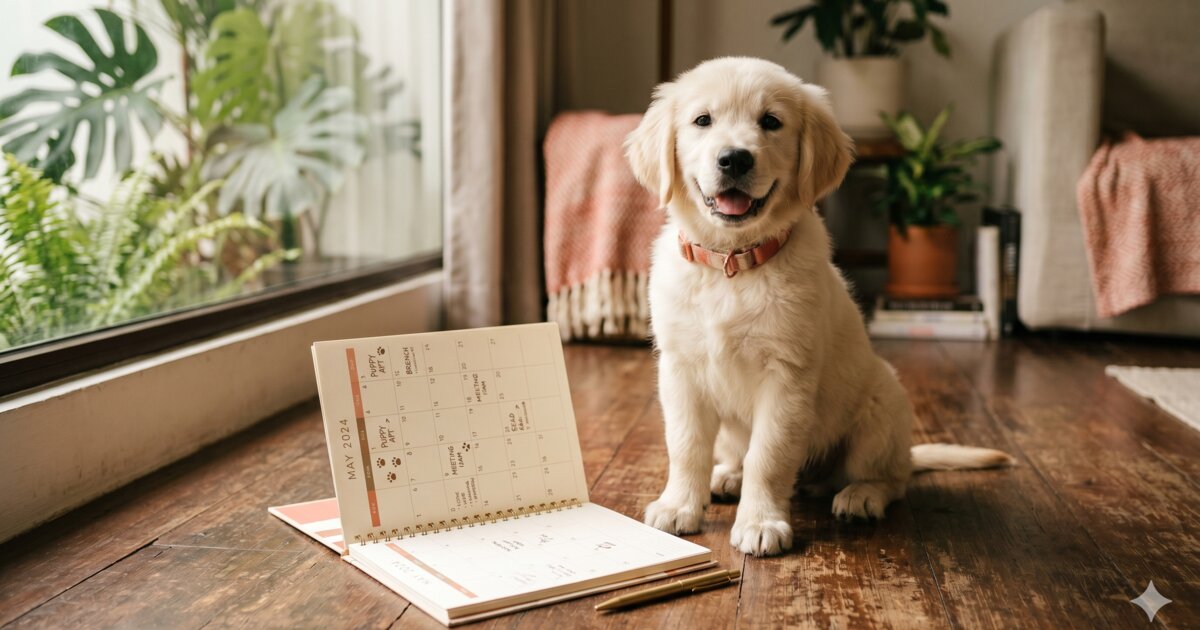

Adopting a puppy is exciting and demanding at the same time. A small dog newly home does not yet understand where to potty, is still afraid of new sounds, and the socialization window that determines whether it will become a confident or fearful adult dog is only open for a few weeks. If you are caring for a dog for the first time, the first week of preparation determines many long-term things.
This article is a complete guide for new puppy owners, pre-adoption considerations, 12 essential supplies, the vaccination + deworming + heartworm prevention schedule, the critical socialization window, and when to first take it to the vet. Disclaimer: general guidance, not a substitute for a direct vet consultation for your puppy's specific condition.
Pre-adoption: a long-term commitment often underestimated
Small-medium dogs (Pomeranian, Mini Poodle, Shih Tzu, Beagle) live on average 12-15 years. Large dogs (Golden, Labrador, Husky) 10-12 years. Giant dogs (Great Dane, Saint Bernard) about 7-10 years. The one you adopt today will accompany you for one large phase of life.
- Fixed daily time, not negotiable. A puppy needs active attention of at least 2-3 hours per day in the first 6 months, socialization, training, pottying outside (or pee pad), playing. An adult dog needs a consistent 1-2 hours of active time per day. If your schedule is 10-12 hours away from home without a support system (family, dog walker, day care), reconsider.
- A realistic budget. Owning a dog has recurring costs (puppy-grade food, grooming, pee pads, toys, light vet check) plus annual ones (booster vaccine, spay/neuter, heartworm prevention). How much depends heavily on the dog's size and breed, the type of food you choose, and how often you groom and care for it. Also set aside an emergency fund for sudden acute illness or injury. If you would like an idea of the cost range for your specific situation, feel free to reach out for a free consultation via WhatsApp.
- Space and neighbors. A small dog can live in an apartment, but it still needs access to potty outside or a routine pee pad. A medium-large dog needs a yard or park access. Check the apartment / complex rules about dogs, many have a weight limit or breed restrictions.
- Home-training conflict. A small dog that barks noisily will become a problem with the neighbors. Invest in training from puppyhood so you do not regret it at month 6.
12-point home preparation checklist
Ideally all of these items are ready before the puppy arrives. Shopping while carrying the puppy is usually stressful for everyone.
1. Crate / training kennel
A crate is not a "prison", if introduced correctly, the crate becomes a "safe den" for the puppy. Important for house training (a dog's instinct is not to potty in its bed) and for safety when you cannot supervise.
Choose a size large enough for the future adult dog (roughly the size of a standing turn), not just the puppy size. Many crates have a divider to adjust the size to the growth phase. Line it with a soft towel or crate pad, not bare wire.
2. Pee pad / training pad for house training
A puppy cannot hold its pee >1-2 hours at 8-12 weeks of age, and the full vaccination is still several weeks away before it is safe to go outside. The pee pad becomes a temporary solution in a designated area (away from the bed and food).
Choose a pee pad with an attractant scent (many brands in Greater Jakarta). Place it consistently in one spot, if moved around, the puppy gets confused. Transition tip: gradually move the pee pad closer to the door once the puppy is consistent, then after full vaccination transition to pottying outside.
3. Puppy-grade food
A puppy needs a different density of calories, protein, calcium, and DHA for brain and bone growth. Choose food with an explicit "for puppies" or "growth" label. For large breeds (Golden, Labrador, German Shepherd), choose "large breed puppy", a formula with controlled calcium-phosphorus so it does not trigger joint problems during fast growth.
Duration: small breed puppies until 9-12 months, medium breeds until 12-15 months, large breeds until 18-24 months before transitioning to adult food. Avoid giving human food early on, many of our foods (chocolate, onion, grapes, xylitol) are toxic to dogs.
4. Water + food bowls
Stainless steel or ceramic (not plastic), the same reason as with kittens, plastic scratches quickly and accumulates bacteria. For a large dog, choose a raised feeder if the dog has to lower its head so often that its neck hurts. For a small dog, a low bowl is more comfortable.
Make sure water is always fresh and plentiful. Puppies dehydrate faster than adult dogs, especially when actively playing or on a hot Jakarta day.
5. Bed
Besides the crate, provide a bed in the main room. Dogs are social animals, they need proximity to their owner. A puppy placed alone in a separate room often becomes overly attached and develops separation anxiety.
Washable material is important, puppies often pee in the bed early on, and pee residue, if not cleaned perfectly, makes them pee in the same spot again.
6. Leash + collar + ID tag
- Collar lightweight with an adjustable size (puppies grow fast, check every 2 weeks whether it still fits, not too tight)
- Leash standard 1.2-1.8 meters, avoid a retractable leash for a puppy (it creates a pull-habit and less control)
- ID tag with your WhatsApp number, mandatory from day one. Dogs get lost more often than you imagine, especially a puppy that runs to an accidentally opened door
- Microchip (optional but highly recommended), can be requested at the first vet visit
7. Chew-safe toys (teething)
Puppies start teething at 3-4 months of age. Without safe chew toys, they will chew the furniture, shoes, electrical cables, or anything within reach.
Choose:
- Kong rubber (can be filled with wet food and frozen, bonus mental stimulation)
- Nylabone puppy size (a puppy-specific chew toy softer than the adult version)
- Cotton chew rope without threads that can come loose and be swallowed
Avoid small toys that can be swallowed whole, toys with a squeaker that is easily torn (a plastic squeaker can block the intestine), and hard synthetic bones that can crack teeth.
8. Carrier for trips to the vet
For a small-medium puppy, a medium-sized carrier is enough. For a large breed puppy that grows fast, the carrier will be too small within 2-3 months, many owners end up using a car seatbelt harness to transport a puppy >10 kg.
Just like with a kitten, get the puppy used to the carrier as a "safe place" rather than a direct association with the clinic. Place it open at home with a towel + treats inside during the first 1-2 weeks.
9. Grooming tools
Depending on the coat type:
- Short coat (Beagle, Pug): bristle brush + hand glove brush
- Medium coat (Golden, Labrador): slicker brush + undercoat rake
- Long coat (Pomeranian, Shih Tzu, Maltese): slicker brush + pin brush + fine-toothed comb
- Poodle / cockapoo / mixed curly coat: slicker brush + grooming clipper (if you dare groom yourself) or schedule a regular groomer
Plus a dog-specific claw clipper and styptic powder (in case you accidentally cut a nail too deep and it bleeds).
10. Poop bags
Mandatory to bring every time you go for a walk, especially after the puppy is fully vaccinated and allowed outside. Neighbors in Greater Jakarta (especially in complexes and apartments) are very sensitive about uncleaned puppy poop. Basic etiquette that often makes dogs disliked in a complex.
11. Basic first aid kit
For the first 24-hour situation before a vet can visit:
- Sterile saline solution (to irrigate small wounds or a foreign body in the eye)
- Sterile gauze, elastic bandage (vet wrap)
- Digital rectal thermometer (normal dog temperature 38.3-39.2°C)
- 3% hydrogen peroxide (to induce vomiting ONLY if a vet instructs, do not do it on your own initiative, some toxins are actually more dangerous if vomited up)
- Oral syringe 3-5 ml without a needle
- The WhatsApp number of a trusted vet in your contacts
What SHOULD NOT be in a puppy first aid kit: paracetamol/acetaminophen (hepatotoxic to dogs in high doses), ibuprofen (nephrotoxic), human aspirin, and other human medications without a vet's instruction. If in doubt, do not give it.
12. Childproofing / puppy-proofing the home
Puppies explore with their mouths. Whatever is within reach will go in the mouth. Before adoption day:
- Cable covers for all electrical cables (cable bite = electrocution risk)
- Move poisonous plants (lily, certain orchids, philodendron, sago palm) out of reach
- Store human medications, vitamins, supplements in a closed cabinet (xylitol in chewing gum, ibuprofen, antidepressants, all fatally toxic to dogs in small doses)
- Cover the trash can (cooked chicken bones, chocolate, toxic fruit pits)
- Check windows and balconies, install netting if high, a small dog can fall or run out
- Cover lower electrical outlets with socket covers
Puppy vaccination schedule
Puppies get maternal antibodies from their mother until 6-8 weeks of age. After that, protection drops and vaccines need to be given in stages to build active immunity.
Standard schedule based on the WSAVA 2024 guidelines:
- 6-8 weeks: First DHPP / DHPPi (Distemper + Hepatitis + Parvovirus + Parainfluenza)
- 10-12 weeks: Second DHPP + Leptospira (if outdoor risk)
- 14-16 weeks: Third DHPP / final puppy booster + Rabies (mandatory in Indonesia)
- 12 months: First adult-year booster
For a puppy with a lot of interaction with other dogs (day care, dog park, a complex with many dogs), additional Bordetella (kennel cough) and Canine Influenza vaccines can be recommended. Discuss with your vet at the first visit.
Schedule details + cost per visit in the article Dog Vaccination Schedule (Puppy + Adult). For a general guide to vaccine categories, see Pet Vaccination Guide.
Deworming + heartworm prevention
Almost all puppies are born carrying worms from their mother. Deworming is mandatory from a young age, in stages:
- 2, 4, 6, 8 weeks, deworming once every 2 weeks
- 3-6 months, every month
- After 6 months, every 3 months routinely (or per your vet's recommendation)
Heartworm prevention is often forgotten by new owners, but it is important for Greater Jakarta. Heartworm (Dirofilaria immitis) is transmitted via mosquitoes, and Jakarta is full of mosquitoes year-round. Once the puppy reaches the appropriate minimum weight and age (usually starting around 8 weeks, follow the product label + vet advice), monthly heartworm preventive is given for life. It can be in the form of chewable tablets, topical, or an annual injection depending on the product.
Ask your vet at the first visit about the heartworm prevention product suitable for your puppy's size + lifestyle.
Puppy socialization: critical window of 8-16 weeks (do not skip)
This is the most important part and the one most often underestimated by new puppy owners. The AVSAB (American Veterinary Society of Animal Behavior) guidelines emphasize: the puppy socialization period of 8-16 weeks is the critical window that determines the adult dog's personality.
The challenge: in this window, the puppy has not yet completed full vaccination, so many owners assume it cannot go outside at all. This is the wrong tradeoff. The AVSAB position statement states clearly: "the risks of poor socialization far outweigh the risks of disease exposure for puppies in age-appropriate, controlled environments." The risk of an adult dog being fearful + aggressive + unhandleable is far greater than the risk of catching a disease, as long as exposure is controlled.
What needs to be exposed positively in this window:
- Different people, men, women, children, people with glasses, people with beards, people in uniform (delivery, security). Target 100+ different people in the first 16 weeks
- Other dogs that are definitely fully vaccinated and friendly, friends'/family's dogs at their homes. Avoid public dog parks before full vaccination
- Different sounds, vacuum, blender, motorbikes, horns, thunder (you can use a recording at low volume first)
- Different surfaces, tile, carpet, grass, stairs (slowly), grass, paving
- Routine handling, touch the paws, check the ears, open the mouth, brush the teeth gently. A big investment, an adult dog used to being handled since puppyhood greatly eases vet visits and grooming
- Carrier + car rides, 5-10 minutes back and forth with no clinic destination, so the car is not always = stress
Safe trick while vaccination is incomplete: carry the puppy when going out or use a dog stroller, visual + sound + environmental smell exposure without direct contact with high-risk surfaces (public parks, streets).
Crate training + house training (potty training)
Two fundamentals that determine the quality of life of both owner + puppy in the first 6 months.
Crate training principles
- The crate is not a punishment, do not put the puppy in the crate after it misbehaves
- Start with short sessions (5-10 minutes) + a treat inside the crate, door open first
- Gradually extend the time, start closing the door briefly then longer
- Rule of thumb: a puppy can hold it in the crate for a maximum of its age in months + 1 hour (a 3-month puppy = max 4 hours, no more)
- Never more than 8 hours, even an adult dog, that is not crate training, that is confinement abuse
House training basics
- Take the puppy to the pee pad (or outside after full vaccination) every: after waking, after eating, after active play, before sleeping, at least 8-12 times a day at first
- When the puppy poops/pees in the right place, immediately give a treat + praise right then, not 5 minutes later
- When caught pooping in the wrong place, do not scold (they do not connect it with a past event), gently take it to the right place and wait
- Clean the accident area with enzymatic cleaner (same as with kittens, urine smell persists on an ordinary floor and triggers repetition)
House training needs consistency of 2-4 weeks on average. Some puppies catch on fast (1 week), some need 2 months. It is not a reflection of intelligence, more about learning style and the owner's consistency.
Socialization with other dogs + new people
After full vaccination at 16 weeks, formal socialization can begin. But the crucial 8-16 weeks have already passed, so controlled socialization must start before that.
Practical ideas:
- Puppy playdate at the home of a friend whose dog is fully vaccinated, healthy, and known to be friendly. Short sessions of 30-45 minutes
- Puppy class, some vet clinics in Greater Jakarta are starting to offer them (check local dog training groups). An experienced trainer handles puppies not yet fully vaccinated in a clean setting
- Guests at home, ask friends/family to come by in turns during the puppy's 8-16 weeks. Many new people = an adult dog friendly to guests
- Children, if you or your environment have children, supervised interaction is important. A dog not used to children is often reactive to their high-pitched voices and sudden movements
Signs of a healthy vs sick puppy
A puppy can decline very quickly. One that was active the day before can become seriously dehydrated or lethargic within 6-12 hours.
Signs of a healthy puppy
- Active, curious, playing 60-70% of its waking time
- Eating with appetite, drinking water regularly
- Formed stool (not liquid), clear yellow urine
- Clear eyes, moist nose without thick mucus
- Pink gums, capillary refill time <2 seconds (press the gum gently, watch the color return)
- Body weight increasing consistently every week
Signs that need a vet consultation (do not delay)
- Not eating at all >12 hours (for a puppy 2-4 months, this is more critical than for an adult dog)
- Repeated vomiting, especially if there is blood or a yellow color
- Liquid diarrhea, especially with blood, this can be parvovirus, which is fatal in puppies. Incomplete DHPP vaccination = the puppy is VERY vulnerable. Bloody diarrhea + vomiting + lethargy in a puppy = emergency, do not wait until morning
- Lethargic, sleeping constantly, not responding when called
- Repeated dry cough ("honking cough"), this can be kennel cough or something more serious
- Not peeing >8 hours or not pooping >36 hours
- Temperature below 37.8°C or above 39.5°C
- Abdomen enlarged and hard when touched gently
- Constant sneezing with thick mucus
First vet visit: within 3-7 days of adoption
Standard recommendation: take the puppy to the vet within the first 3-7 days after adoption, even if it looks healthy. Earlier than a kitten because puppies more often come from a breeder/shelter with a partial vaccination history that needs verifying.
What is usually done at the first visit:
- A thorough physical exam (eyes, ears, mouth/teeth, heart, lungs, abdomen, skin, joints, reflexes)
- Check for external parasites (fleas, ear mites, ringworm)
- Check for internal parasites (a stool exam if needed)
- Verify the vaccination record from the breeder/shelter + plan ahead
- Discuss diet, environment, training, socialization, especially about safe socialization pre-full-vaccination
- Discuss heartworm prevention + when to start
- Discuss spay/neuter (timing depends on breed and size)
For a puppy still adapting at home, a house call is often more ideal than going to the clinic. It reduces the layered stress (car + carrier + smell of other dogs at the clinic) that actually worsens immunity. The puppy can also be observed in its own environment, info often emerges that would not be seen at the clinic (how it interacts with the family, where it sleeps, etc.).
FAQ for new puppy owners
At what age should a puppy be adopted?
Ideally at least 8 weeks from its mother + siblings. A puppy separated too early (4-6 weeks) often has bite inhibition problems (not knowing when a bite is too hard) and adult behavior problems. The window with the mother + siblings is important for the foundation of social interaction, humans cannot replace this.
Can a puppy go outside before full vaccination?
Yes, with an important caveat. The 8-16 week socialization is critical and cannot be delayed. But exposure must be controlled: carry the puppy or use a stroller (visual + smell exposure without direct contact with high-risk surfaces), visit the home of a friend whose dog is fully vaccinated + healthy, and avoid public parks + public streets until vaccination is complete. Discuss specifics with your vet at the first visit.
How long does a puppy need to adapt to a new home?
2-4 weeks to feel comfortable in the main area, 4-8 weeks to be truly settled. Signs of good adaptation: starting to play actively, eating regularly, consistent pottying in the right place, starting to respond to its name, sleeping relaxed (not constantly alert). If after 2 weeks it is still excessively fearful, not eating, or vomiting/diarrhea, do not wait, consult a vet.
When to start spaying / neutering a puppy?
Depends on breed + size. Small-medium breed dogs are generally 6-9 months. Large breed dogs are often delayed until 12-18 months so the bone growth plates have time to close (spaying/neutering too early in large breeds is associated with several adult orthopedic problems). Discuss with your vet at the first visit based on your puppy's specific breed.
Can Prabasa Vet do a house call for a new puppy?
Yes. A house call is very ideal for a puppy still adapting. It reduces the stress of going to the clinic and the vet can observe the environment + have a long discussion about socialization, training, and the home setup. Contact us via WhatsApp mentioning the breed + puppy's age + your area, and the team will schedule a partner vet for the first visit + vaccinations appropriate to the stage.
Closing
Adopting a puppy = a 12-15 year commitment, and the first weeks determine many things. The 8-16 week socialization window cannot be redone, an adult dog not well socialized in this period often has permanent behavior problems that are difficult (or expensive) to correct.
You do not need to be perfect. What matters: prepare the supplies before adoption day, prioritize controlled socialization from day one, recognize the emergency signs (especially parvovirus symptoms in a not-yet-fully-vaccinated puppy), and do not hesitate to consult a vet in the first week to establish a healthy baseline.
Need a consultation or to schedule a house call for your new puppy? Contact us via WhatsApp, mention the breed + puppy's age + your area, and our team will help schedule the first exam + a discussion of safe pre-full-vaccination socialization.
Read also: Dog Vaccination Schedule (Puppy + Adult), How to Manage a Dog Afraid of the Clinic, Pet Care Guide, House Call Vet.
Medical references used in this article
This article was prepared with reference to the following sources, verified clinical sentence by sentence:
- AAHA Routine Care + Puppy Care Guidelines, baseline visit, vaccination schedule, parasite prevention
- WSAVA Vaccination Guidelines 2024 , puppy core vaccines schedule (DHPP 6-8 / 10-12 / 14-16 weeks, rabies, booster 12 months)
- AVSAB Puppy Socialization Position Statement, critical period 8-16 weeks, risk-benefit of pre-full-vaccination socialization
- BSAVA Manual of Canine and Feline Behavioural Medicine, socialization critical period, crate training, common puppy behavior issues
This article is general guidance based on international canine medicine + behavioral medicine guidelines. For your puppy's specific condition, including breed, history from a breeder/shelter, health condition, and home environment, consulting a vet is the right step.