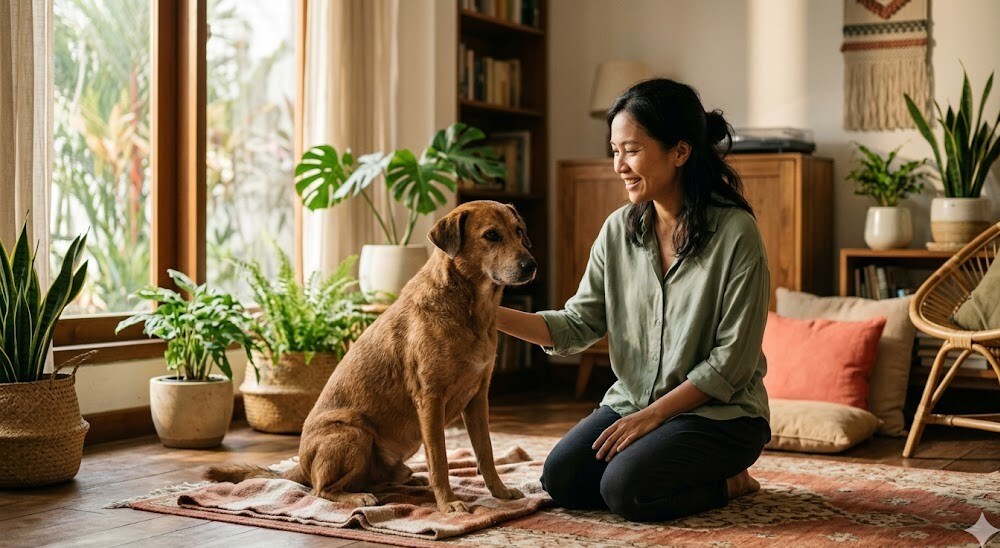

The doorbell rings, a guest enters, and your dog launches from the living room at full speed, then jumps toward the guest, front paws on their chest, scratching clothes, with a wet mouth trying to lick their face. The guest laughs politely while stepping back slightly, you hurriedly pull the dog away, and finally, the guest sits down with clothes already marked by scratches. This scenario repeats every time someone comes to the house, including delivery couriers, household assistants, or relatives who are afraid of dogs.
Many dog owners think this is simply "the dog being too friendly" or "just a happy dog." Partly true, jumping up is a natural and friendly form of greeting for dogs. But what is often not realized: this behavior is mostly a learned reward behavior, the dog learns that jumping = attention, and your job is to decouple that association through positive training.
This article is a guide on why dogs jump up, why it is problematic even if friendly, and step-by-step training solutions based on positive reinforcement, including common mistakes that actually strengthen the behavior. Disclaimer: this is a general guide based on international behavior guidelines, not a substitute for a veterinary behaviorist consultation for cases with aggression or severe anxiety components.
Why dogs jump up on guests
Jumping up is not "a bad dog", it is a behavior with evolutionary roots maintained by consistent reinforcement. Three main factors:
1. Natural greeting, wanting to lick faces
In the dog world, pack members lick each other's faces as a form of greeting and bonding (this behavior appears since puppies lick the corners of their mother's mouth for regurgitated food). Because humans are much taller, dogs must jump to reach the face. At an instinctive level, jumping on a guest and licking their face = "hello, you are part of my pack, I recognize you."
This is why jumping up is often most intense with guests the dog knows (partners, close friends, family members who rarely visit), the excitement level of the greeting is high.
2. Attention seeking, a learned reward
From the dog's perspective, jumping behavior produces a consistent response from humans: eye contact, touching hands, voices ("oh!", "sit!", "down!"), and physical contact (pushing down). All of this is attention. For a dog craving attention, negative attention is still better than no attention, so the behavior is maintained by inconsistent rewards.
Owners often don't realize that "pushing the dog down" is actually the contact + interaction the dog wants. From the dog's perspective: "I jump → human immediately touches me, inviting me to 'play' push-and-shove." The behavior is reinforced.
3. Territory and ritual
For some dogs, a guest's arrival is a territorial event, the signals: doorbell, footsteps, voices. A dog with a greeting ritual will escalate excitement when these signals appear. If that ritual always ends with the guest accepting the jump (or even reciprocating with a head pat), the ritual becomes cemented more strongly with each iteration.
Why jumping up is problematic, not just "cute"
Many owners of small-to-medium dogs still enjoy their dog's jumping because "the dog is adorable." But there are several scenarios where this behavior stops being cute:
- Guests who are afraid of dogs, for people with phobias or even those who just don't like dogs, jumping is intimidating. Guests become reluctant to visit your home, or at minimum, feel uncomfortable.
- Children and the elderly, medium-to-large dogs can knock over children or the elderly. Head injuries or hip fractures in seniors are real risks. Liability can be serious.
- Large dogs, risk of significant injury, Goldens, Labradors, Huskies, German Shepherds, or other large breeds can easily knock over an adult, let alone a child. Every jump outside is a potential case.
- Scratches that cause injury, untrimmed nails leave wounds on a guest's chest/arms, tear clothes, or hurt children's skin.
- Escalation of excitement, uncontrolled jumping often escalates to light biting ("mouthing"), grabbing items, or other attention-seeking behaviors.
- Household assistants / delivery couriers, people interacting with your home often have work contracts that prohibit injury risks from pets.
A dog that is polite when greeting guests is a dog that is pleasant for everyone, and an owner with such a dog is a responsible host.
Training solution, step-by-step positive reinforcement
The approach we will use follows the AVSAB Position Statement on Reward-Based Veterinary Behavior Modification and AAHA Behavior Management Guidelines: positive reinforcement (rewarding desired behavior) + extinction (removing rewards for undesired behavior). No physical punishment, no knee-in-chest, no stepping-on-paws, all these methods have a track record of worsening anxiety and sometimes triggering aggression.
Step 1–Stop rewarding jumping behavior
This is the foundation. Everyone in the house + every guest who visits must be consistent:
- Dog jumps → all attention is withdrawn. Stand tall, fold your arms across your chest, look up or to the side (not at the dog), do not speak, do not touch.
- Turn your body away if the dog tries to reach you from the side. The dog learns: jumping = no response at all.
- Wait until all 4 paws are on the floor. It may only be 1-2 seconds at first. When all paws are on the floor → reward heavy, treats, a cheerful voice, gentle petting (but don't get too hyped to avoid triggering another jump).
- If they jump again after the reward → return to "no attention." Repeat until the pattern of "4 paws on the floor = reward" is clear.
Most common failure: inconsistency among family members. The father grumbles "get down!", the mother turns away, the child laughs while pushing, and the assistant pats the head while saying "oh dear." The dog gets random reinforcement signals → the behavior actually strengthens (a random reward schedule is the strongest behavior reinforcer in operant conditioning). Everyone must be on the same page.
Step 2–Teach an alternative behavior: "sit"
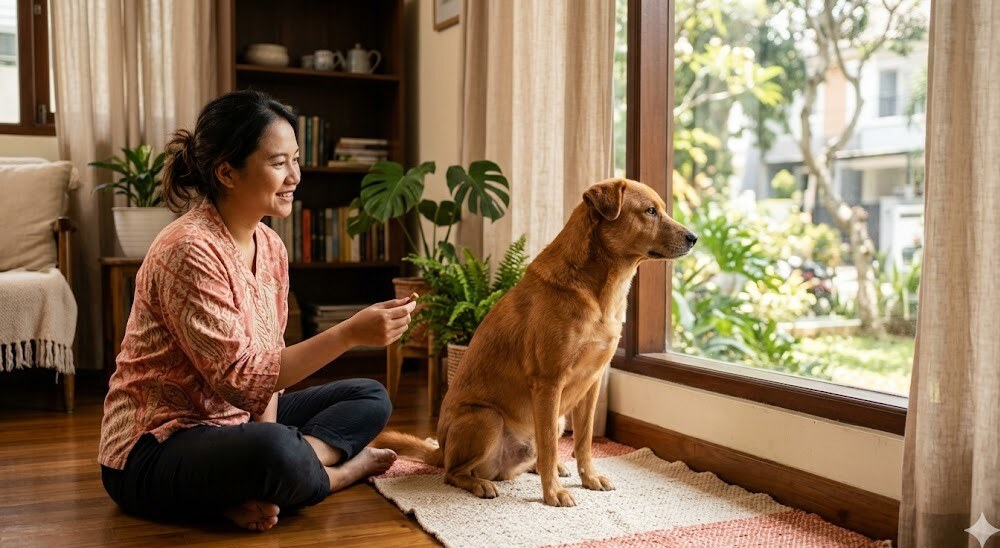
The behavior you want for a greeting: the dog sits when a guest approaches. A "sit" is incompatible with jumping, a dog cannot sit and jump at the same time. This strategy is called differential reinforcement of incompatible behavior (DRI) in behavior literature.
- Teach a solid "sit" cue in a quiet environment first (no distractions).
- Practice "sit" when family members come home, start small.
- Then when a guest arrives, give the "sit" cue before the dog has a chance to jump. Reward heavy when the dog sits.
- Goal: eventually, the "approaching guest" itself becomes the cue for the dog to sit automatically.
Step 3–Leash control when guests arrive
For dogs that are already strongly conditioned to jump, training without physical control is unrealistic in early sessions. Use a leash as a management tool, not a punishment:
- When a guest is scheduled to arrive, leash the dog with a 6-foot (about 1.8 m) leash before the guest enters.
- Tether the leash to a fixed point (stair railing, heavy table leg) 2-3 meters from the entrance, not right in front of the door.
- The guest enters calmly; do not greet the dog yet.
- The guest sits down first, let the dog settle. Once the dog is not excited (4 paws on the floor, maybe sitting), the guest may approach slowly while asking the dog to "sit."
- Reward a stable sit. If the dog escalates again → the guest retreats until the dog settles again.
The combination of leash control + DRI sit + extinction is the formula that AAHA and force-free trainers (Karen Pryor Academy, Fear Free Pet) consistently recommend for jumping up.
Step 4–Practice with willing helpers
What often stalls training: owners only practice when real guests arrive, which might only be 1-2 times per week. A dog cannot learn a skill from practicing once a week. Setup training sessions with helpers:
- Ask 1-2 friends or family members who are willing to be "practice guests", have them come to the house, ring the bell, and enter with a clear rule: follow the "no response to jumping, reward sit" protocol.
- Do this 3-5 times per session, 2-3 sessions per week.
- Variation: different helpers, coming from different doors, carrying different bags, visiting at day vs. night.
- Goal: the dog generalizes the skill, not just "don't jump on the owner" but "don't jump on anyone who visits."
Without deliberate practice like this, training stalls in the "only responds to specific context" phase, a dog that is polite to close friends but jumps on delivery couriers is a dog that hasn't generalized yet.
Step 5–Reward calmness before the door opens
Dogs that jump on guests often already escalate excitement before the guest enters, the doorbell, footsteps, greetings from outside. If the dog has already reached peak excitement when the door opens, all extinction training will be overwhelmed.
- Practice "sit" or "place" (see advanced) when the doorbell rings, ask someone to ring the bell, the dog must not go to the door before being told.
- Reward heavy when the dog settles in response to the bell without running to the door.
- Eventually, the bell itself becomes a cue to "settle," not a cue to "run hyperactively to the door."
Realistic timeline, how long until success
For most adult dogs that are already strongly conditioned to jump: 4-8 weeks of daily consistency until the behavior is reliable in the home environment. For puppies just starting to jump (not yet strongly conditioned): it can be 2-4 weeks.
Factors that extend the timeline:
- Inconsistency among family members (the biggest factor).
- Adult dogs (2-5 years old) that have been jumping for years (deeper conditioning).
- High-energy breeds (Labradors, Goldens, Border Collies, Huskies), they need enough exercise + enrichment to be calm for training.
- Comorbid anxiety or over-aroused temperament, sometimes they need basic calm training before greeting training.
To be realistic: even after the behavior is reliable at home with helpers, you still need ongoing maintenance with real guests for months to fully generalize. Don't be surprised if a dog that has "graduated" jumps on a relative who just returned from abroad, high arousal greetings with new stimuli can trigger regression. That is normal; return to the protocol.
Common mistakes that actually reinforce jumping
1. Guests petting the dog's head when they jump
This is the #1 reinforcer. Polite guests usually don't want to be "harsh" with the host's dog, so they laugh while petting the head of the jumping dog. From the dog's side: jump = petting = jackpot reward. The behavior is strongly reinforced.
Solution: brief guests before they enter. A quick WhatsApp message: "Please don't respond to the dog if they jump, ignore them until they are calm. We are in training." Guests who care about your dog will support you. Guests who don't care usually don't visit often.
2. Family members are inconsistent
Worth repeating: if 1 out of 4 family members allows jumping (or allows it sometimes), the training will fail. A dog cannot distinguish between "allowed to jump on Dad, not on Mom" with reliability, they will generalize that "sometimes jumping leads to a reward, so it's worth trying."
Have a family meeting before starting training. Establish the protocol. Post a small reminder on the door if necessary.
3. Forcible pushing down
"Pushing the dog down" is contact. For a dog craving contact, pushing down = "the human wants to wrestle with me." The behavior is actually fun and reinforced. Plus, pushing too hard can cause injury (to the human's shoulder or the dog's neck).
The correct way: no physical contact. Turn your body away, fold your arms, look up. The dog learns "jumping = the human becomes a statue, no response."
4. Knee in chest
An old method often taught: if the dog jumps, push your knee into their chest. Don't. Besides potentially injuring the dog's chest/ribs, this method has a low success rate and can actually trigger fear or defensive behavior. AVSAB explicitly encourages avoiding punishment-based methods for greeting training.
5. Yelling "no!" or "down!"
Loud voices = attention. An attention-seeking dog doesn't care if the attention is negative or positive, all attention is a reward. Yelling also escalates excitement, which actually reinforces the arousal cycle.
The correct way: silence + turning away. Silence is more powerful than yelling for extinction.
Advanced, "place" / "mat" cue for the doorbell
Once the basics (sit greeting + leash control + helper practice) are reliable, the next level is training a "place" / "mat" cue: the dog immediately goes to their mat when the doorbell rings and stays there until given a release cue.
- Choose a fixed mat location, not right at the entrance, but close enough so the dog is still "present" for the greeting but doesn't jump.
- Teach "place" as a separate cue (the mat as a target station).
- Pair the "doorbell" with the "place" cue, practice dozens of times.
- Eventual goal: the bell alone → the dog goes directly to the mat without a verbal cue.
This skill takes time (2-3 months after the basics are solid), but it is very valuable, the dog greets guests from their place mat calmly, the guest can enter and sit down first, then the greeting is done after the situation is calm. This is standard in many homes with multiple dogs or large dogs.
When a veterinary behaviorist is needed
For most jumping up cases, self-training with this guide + consistency is enough. However, a consultation with a behavior vet or certified trainer is required if:
- There is an aggression component, the dog jumps and then bites (not gentle mouthing but real biting), or growls when the guest approaches.
- Severe anxiety, the dog isn't just excited but panics when guests arrive (heavy drooling, panicked vocalization, running to hide then returning to jump).
- Fear-based behavior, a dog that was previously traumatized by guests (a rescue with a history of abuse) needs structured desensitization, not standard greeting training.
- 8+ weeks of consistent training without improvement, there is likely an underlying factor not yet identified (anxiety, lack of impulse control, breed-specific arousal pattern).
- Serious guest injury, someone has already fallen or been significantly injured from jumping. Liability and urgency are high; professional intervention is needed.
To evaluate a dog's behavior at home, a home visit is often more accurate, doctors or trainers can directly observe specific triggers, dynamics with family members, the entrance layout, and the setup relevant to the diagnosis. Many insights emerge from seeing the greeting ritual in situ that are not apparent from an owner's description in a clinic.
Jumping Up FAQ
My dog is just a small breed, the jumping isn't dangerous, is training still necessary?
It depends on the context. If only familiar adult family members live in the house and there are no children or seniors, the risk of injury is indeed minimal. But consider: guests who are afraid of dogs (still many people), household assistants, delivery couriers, or sick family members, all can be disturbed by jumping even from a small dog. Plus, a dog that greets politely is a dog that is easier to take to public places, stay at a pet hotel, or visit the vet. Jumping up training is not just about physical injury.
My dog is 4 years old and has been jumping on guests since they were a puppy, can they still be retrained?
Yes, but the timeline is longer than for a puppy (8-12 weeks of consistency vs. 2-4 weeks for a puppy). Adult dogs are fully retrainable, the myth "old dog new tricks" is not accurate in modern behavior literature. The key: consistency from all family members + setting up helpers for deliberate practice + environment management (leash, mat, separate room when emergency guests arrive) during the training phase.
Is crating the dog when guests are over an OK solution?
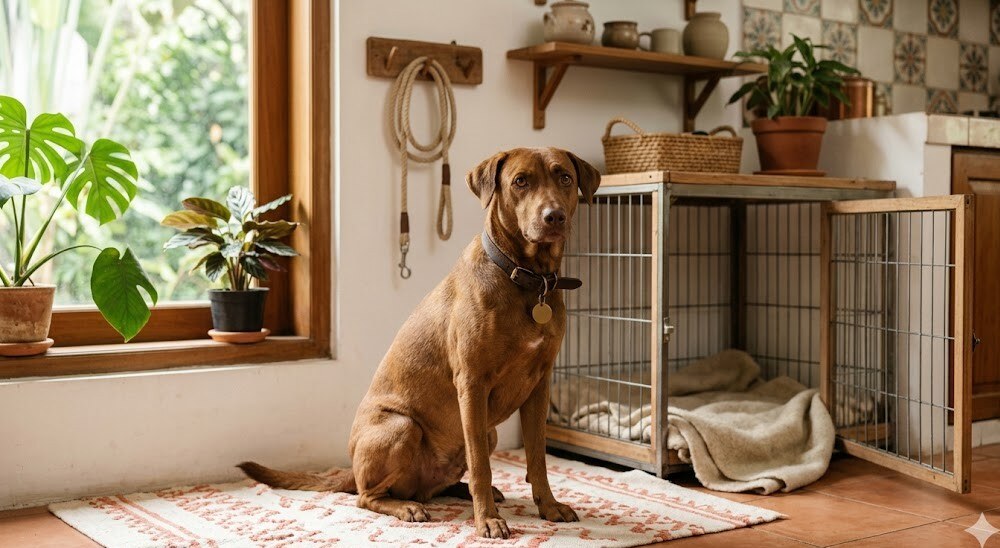
As temporary management (while training is underway, or for specific guests who fear dogs), it's OK as long as the crate already has a positive association (see the puppy crate training guide if not). As a permanent solution, it's not ideal, because the dog will never learn the actual skill. Combination: crate management while training is on, then transition to "dog sit greeting" once the skill is reliable.
My dog jumps only on me (the owner), not on guests, is it OK to leave this as is?
It depends on the owner's preference. Many owners are OK with greeting jumps for themselves and don't mind. But consider: a dog allowed to jump on 1 person often has difficulty distinguishing "this person is allowed, this one isn't", guests they know well (partners, close friends) often get jumped on too. Plus, when you come home in work clothes, pregnant, or injured, jumping can become uncomfortable. A middle ground: teach an "up" cue as permission, the dog may jump only when given the cue, otherwise they sit. But this is advanced and requires a lot of consistency.
Can Prabasa Vet visit my home for a dog behavior evaluation, including jumping up?
Yes. Especially for behavior cases with complex components (aggression, anxiety, multi-dog dynamics), a home visit is much more accurate because the doctor or behaviorist can directly observe specific triggers, door layouts, family dynamics, and environmental setups. For jumping up training without aggression/anxiety components, this written guide is often enough, try it for 4-6 weeks consistently. If you get stuck or have other concerns, contact us via WhatsApp, mention the breed + age of the dog + jumping pattern + other signs experienced + your area, the team will schedule an evaluation with a partner doctor or a referral to a certified trainer.
Closing
A dog that jumps on guests is not a "bad dog", they are a friendly dog with inconsistent rewards that reinforce the behavior. The training solution is also not punishment, but reconditioning: stop rewarding the jump, give heavy rewards for a sit greeting, and practice with helpers so the skill generalizes.
The three keys to success: consistency from all family members, deliberate practice with helpers, and 4-8 weeks of patience. A dog that is polite when greeting guests is a dog that is pleasant for everyone, and this training investment pays back for decades in the form of a dog that is comfortable to take anywhere.
Want to consult about your dog's behavior or evaluate heavy jumping up at your home? Contact us via WhatsApp, mention the breed, age, observed jumping pattern, and your area. The team will help schedule an evaluation with a partner doctor.
Read also: Leash Training Puppy: Step-by-Step Positive Reinforcement, Recall Training Dogs: How to Get Your Dog to Come When Called, Crate Training Puppy: Step-by-Step and Benefits, Separation Anxiety in Dogs: Signs, Causes, and Solutions, Adopt Puppy: New Owner Checklist, Pet Care Guide.
References used in this article
This article was prepared with reference to the following sources, verified for clinical/training accuracy:
- AVSAB (American Veterinary Society of Animal Behavior) Position Statement on Reward-Based Veterinary Behavior Modification, foundations of positive reinforcement, avoidance of punishment-based methods, differential reinforcement of incompatible behavior (DRI)
- AAHA (American Animal Hospital Association) Behavior Management Guidelines, greeting training protocols, environment management, consistency among family members, referral criteria to a behaviorist
- Karen Pryor Academy training resources, operant conditioning principles, capturing and shaping behavior, extinction protocol, generalization in multiple contexts
- Fear Free Pet program resources, low-stress handling, leash management during guest arrival, place/mat cue training
- BSAVA Manual of Canine and Feline Behavioural Medicine 2nd Edition, greeting disorders, attention-seeking behavior, criteria for differential diagnosis from anxiety or aggression components
- Overall KL. Manual of Clinical Behavioral Medicine for Dogs and Cats, standard textbook for veterinary behavior medicine, greeting behavior chapter
This article is a general guide based on international veterinary behavior medicine and positive reinforcement training guidelines. For cases with aggression components, severe anxiety, or a history of trauma, consulting a behavior vet or certified trainer is the right step, self-training is not ideal for complex cases.