
"My dog is biting my hand, why are they being aggressive?" is one of the most common behavior consultations. The answer, which is often uncomfortable: most dog bites to owners are not aggression in a predatory or dominant sense, but a form of communication that the owner failed to decode. Before a bite, a dog almost always gives more subtle warning signs, if these warnings are consistently ignored or punished, the dog learns that the only way their communication is heard is to escalate to a bite.
This article discusses the spectrum of reasons why dogs bite hands (from normal puppy mouthing to serious fear aggression), how to read body language warning signs before a bite, safe management protocols, why punishment worsens the problem, and when to seek professional evaluation. Disclaimer: this is a general guide based on international behavior guidelines, not a substitute for a direct consultation for bites causing serious injury or dogs with a history of multiple bites.
The spectrum of causes: not all "biting" is the same
Before management, identify the category first. The handling is very different.
1. Puppy mouthing / play biting (normal developmental)
Puppies 6-16 weeks old explore the world through their mouths, including human hands, feet, toys, everything. This is not aggression, but normal puppy behavior that should be redirected, not punished. Characteristics: bite inhibition has not yet developed (hard biting because they haven't learned limits), not accompanied by serious growling, usually in a play context.
2. Adult play biting
Excited adult dogs may nibble hands during play (especially herding breeds or breeds with a high prey drive). It’s not aggressive, but can unintentionally hurt due to low bite inhibition. It often occurs when an owner rewards play that is too rough.
3. Fear aggression (most common cause of "sudden biting")
A dog that is afraid, cornered, or trapped will bite as self-defense, especially if the option to flee is not available. Example triggers: a hand suddenly moving toward the head from above, restraint for nail trims or examinations, physical contact in sensitive areas (ears, tail, postoperative wounds), or confrontation with a stranger.
4. Resource guarding
A dog bites when a hand approaches an object they consider "theirs", food, a bone, a favorite toy, the sofa, sometimes even a person. This is not dominance, but anxiety that a resource will be taken. It often arises from a background of scarcity (shelter, multi-pet competition) or over-rewarded behavior.
5. Pain-induced aggression
A dog that is usually calm suddenly bites when touched in a certain area, dental pain, otitis, arthritis, abdominal pain, or an injury that is not yet visible. Pain aggression is often unexpected because the owner is unaware of an underlying medical condition.
6. Redirected aggression
A dog that is highly aroused due to another trigger (a neighbor's dog, a passing motorcycle, a cat) and then bites the hand of an owner who tries to intervene or happens to be nearby. It's not personal, it's an overflow of high arousal that cannot be channeled toward the original target.
7. Predatory behavior
Fast hand movements (especially fingers) in the peripheral vision of a dog with a high prey drive can trigger a chase-and-grab response. It's not emotional aggression, but predatory reflex. Generally rare as a cause of hand biting in pet dogs, but it exists in certain breeds.
Body language: warning signs before a bite
The most important thing in this article: dogs almost always give a warning before biting. An owner who can read these warnings can intervene and prevent escalation.
The hierarchy of warnings from the most subtle to the most overt:
- Lip licking (when no food is around), a subtle sign of stress/discomfort.
- Yawning (when not sleepy), a displacement behavior; the dog is not comfortable.
- Look away / turn head, the dog is asking for space, "I'm not comfortable."
- Whale eye, the white of the eye is visible as the dog turns their head but remains focused on the trigger. A sign of high stress.
- Body stiffening / freezing, a dog that is usually relaxed suddenly becomes still and stiff, tail rigid, body tense. A pre-bite escalation point.
- Lip lift / tooth display, gums/teeth become visible. A final warning.
- Growl, a very clear vocal warning. DO NOT PUNISH a growl, if a growl is punished, the dog learns not to growl and may bite directly, removing the warning system.
- Snap (air bite without contact), a final warning; the dog is capable of biting but chooses not to. Bite inhibition is still intact.
- Bite with contact, the last escalation, and usually the result of the above warnings being repeatedly ignored or punished.
Critical insight: if an owner consistently respects the warnings in tiers 1-3 (lip licking, head turn, whale eye), by giving the dog space, ending the interaction, or redirecting, the dog won't need to escalate to tiers 7-9. Dogs that "suddenly bite without warning" actually always give warnings; the owner just didn't recognize them.
Management protocols by category
Puppy mouthing
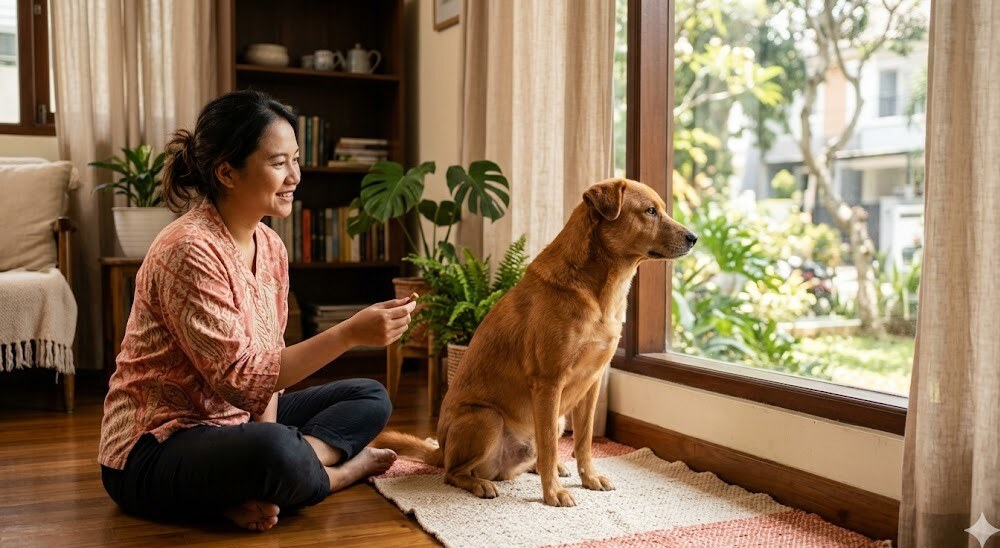
- Redirect to toys, every time the puppy mouths your hand, redirect them to an appropriate chew toy (rope, kong, soft rubber).
- Yelp + withdraw, when the puppy mouths too hard, say "ouch!" and stop the interaction for 30-60 seconds. This teaches bite inhibition.
- Adequate exercise + mental stimulation, bored puppies mouth more often. Walks, short training sessions, food puzzles.
- Do not physically punish, slapping, alpha rolling, or holding the snout causes trust damage and can lead to adult fear aggression.
Fear aggression
- Identify triggers, note specific situations when the dog bites (hands from above, restraint, brushing). The pattern is usually clear.
- Avoid triggers while counter-conditioning, don't force interactions that trigger fear. Build positive associations via treats + low-intensity exposure.
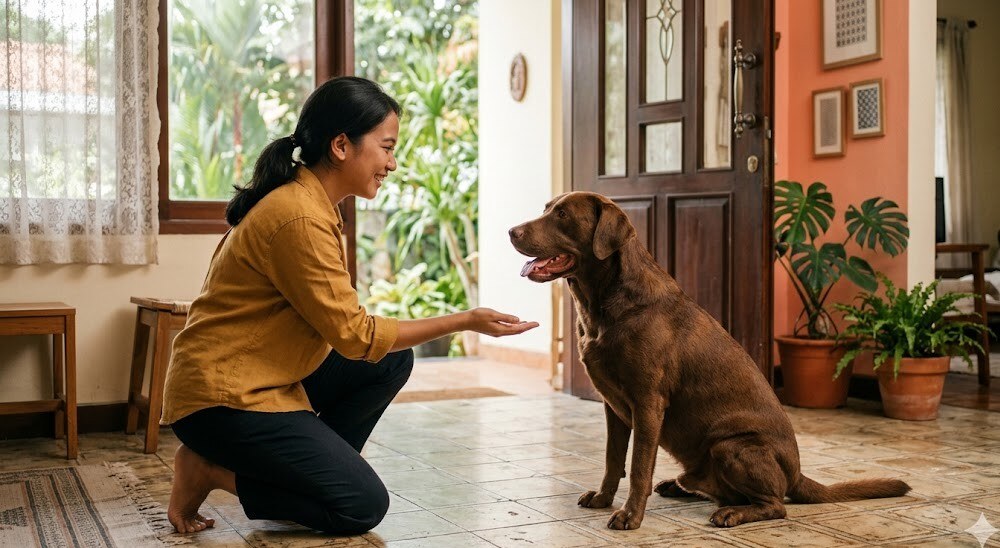
- Make your body posture non-threatening, squat (don't stand over them), approach from the side (not head-on), reach from below (not from above).
- Consult a behaviorist for severe cases, a combination of behavior modification and sometimes anxiolytic medication (fluoxetine, trazodone) according to ACVB guidelines.
Resource guarding
- DO NOT reach for the resource while the dog is actively guarding, escalation is guaranteed.
- Trade-up protocol, when the dog has a bone, approach with a high-value treat (like cheese) and trade. The dog learns that a hand approaching a resource means something better is coming, not that the resource is being taken.
- Manage the environment, if guarding food, feed in a separate room; if guarding the sofa, deny access to the sofa; if guarding the owner from a partner, work on the body language of all family members.
- Severe cases: professional behavior consultation is mandatory.
Pain-induced
- Medical workup is mandatory, before behavioral management, rule out pain with a veterinary examination.
- Common sources: dental disease, otitis, arthritis (especially in senior dogs), abdominal issues, or postoperative wounds.
- Appropriate pain management + behavior recheck post-treatment. Many cases of "sudden biting" resolve once the pain is addressed.
Redirected aggression
- DO NOT reach in when the dog is highly aroused by another trigger, owners often become the target of a redirected bite.
- Manage the trigger, block the visual (curtains, opaque fence) or remove the dog from the trigger area.
- Cool-down period of 15-30 minutes before approaching.
Why physical punishment worsens the problem
According to the AVSAB Position Statement on Humane Dog Training and consistent ACVB recommendations:
- Punishing a growl/snap = removing the warning system, the dog learns not to growl and instead bites directly. The owner loses the early warning.
- Punishing fear aggression = intensifying fear, a dog that is afraid and is then hit becomes even more afraid and defensive. It escalates.
- Damage to the relationship, the dog begins to avoid the owner, showing fearful body language around them, and training opportunities decrease.
- Risk to children, a dog that associates human approach with punishment is more likely to bite a child.
- Research evidence, multiple studies (Hiby, Casey, Herron) consistently show that training based on aversives is more likely to develop aggression than positive reinforcement.
Anti-patterns to avoid: alpha rolls, scruff shakes, pinning, slapping, e-collar shocks, prong collars. All worsen the problem long-term even if they seem to "work" temporarily because the dog freezes in fear.
When a professional evaluation is needed
Consultation with a behavior vet or a certified force-free trainer (Karen Pryor Academy, IAABC, CCPDT) is mandatory if:
- The bite causes a skin wound or requires medical treatment.
- The biting pattern is recurrent (more than 2-3 incidents) toward family members or guests.
- The dog bites children, the medical and legal risks are high.
- You cannot identify the trigger or warning pattern.
- There is resource guarding toward people (not just toward other dogs).
- A rescue dog with an unknown history shows aggression in multiple contexts.
- Aggression is combined with severe anxiety/fear in other contexts.
- A senior dog shows a new onset of aggression, rule out medical issues (pain, neurologic, cognitive dysfunction).
For serious cases, a combination of a medical workup (ruling out pain, neurologic, or endocrine issues) + behavior modification + sometimes anxiolytic medication according to ACVB guidelines is used. A multi-modal approach is more effective than training alone.
Dog Biting Hands FAQ
My dog bit for the first time, should I be worried?
Yes, but don't panic. A single bite incident in a dog that is usually calm often has a specific underlying cause, pain (check if a sensitive area was touched), fear (is there a new trigger in the environment?), or a specific context (the dog was scolded while eating). Identify the trigger, avoid it while working on management, and if it becomes recurrent or there is a wound, consult a behaviorist. For senior dogs biting for the first time, a medical workup is mandatory.
Can a dog that has bitten once "heal" or will they always be dangerous?
Most can significantly improve with proper management and behavior modification. However, a total "cure", where a dog will never bite in any context, is an unrealistic expectation. Realistic goal: identify and avoid triggers, build coping skills via counter-conditioning, and accept that management will be lifelong. Dogs with a history of serious bites (wounds requiring stitches) need a professional evaluation and a lifelong management protocol.
My dog growls at children, what should I do?
This is a critical situation that requires an immediate professional evaluation. Do not punish the growl (the dog will lose its warning system). Do not leave children unattended with the dog. Seek a consultation with a force-free behaviorist immediately and implement strict safety management (gates, crate separation, supervised interaction only). The medical and legal risks are serious, do not delay.
My puppy nibbles my hand hard, is that normal?
It's normal for puppies 6-16 weeks old to explore via their mouths. However, bite inhibition must be taught: yelp "ouch!" and withdraw for 30-60 seconds every time they bite hard, redirect them to an appropriate chew toy, and ensure they have adequate exercise and mental stimulation. The bite inhibition learning window is primarily 8-16 weeks, an important critical period. Consult a behaviorist or force-free trainer if the intensity doesn't decrease after 4-6 weeks of a consistent protocol.
Can Prabasa Vet visit for a dog aggression behavior consultation?
Yes. For cases of persistent aggression or dogs with a history of biting, a home visit offers a significant advantage, partner doctors can observe the actual setup (home layout, family dynamics, specific triggers in the environment) and provide realistic recommendations. At the same time, a medical screening can rule out pain or neurologic components. For bites causing serious injury, a board-certified behavior vet evaluation is needed, we can recommend a referral. Contact us via WhatsApp; mention the breed + age + incident pattern + your area.
Closing
Dogs biting hands is not about "a bad dog" or "a dominant dog." It's failed communication, a dog that is afraid, in pain, or overwhelmed cannot hear respect for more subtle warning signs and eventually escalates to a bite as a last resort.
The solution is not physical punishment (which actually worsens it), but: identifying the category (puppy mouthing vs. fear vs. resource guarding vs. pain vs. redirected), reading body language warning signs, respecting warnings (don't punish growls), medical workup to rule out pain, managing triggers while working on counter-conditioning, and professional help for serious cases.
Most cases of dogs biting hands can significantly improve with a force-free approach, positive reinforcement, and patience. But safety management must always be the priority, especially with children. For dogs with a serious bite history, a professional evaluation is not optional.
Want to consult about your dog's aggression or schedule a home visit for a medical + behavior evaluation? Contact us via WhatsApp, mention the breed, age, incident pattern, and specific situation.
Read also: Recall Training Dogs, Separation Anxiety in Dogs, How to Manage a Dog Who Is Afraid of the Clinic, Pet Care Guide.
Medical references used in this article
This article was prepared with reference to the following sources, verified for clinical accuracy:
- AVSAB Position Statement on Humane Dog Training, recommendations for force-free, anti-aversive philosophy, evidence that punishment worsens aggression.
- AVSAB Position Statement on Punishment in Dog Training, risk of fear + aggression from aversive methods.
- AVSAB Position Statement on Reward-Based Veterinary Behavior Modification, positive reinforcement as the foundation.
- ACVB (American College of Veterinary Behaviorists), clinical guidance for aggression assessment, pharmacological adjuncts.
- BSAVA Manual of Canine and Feline Behavioural Medicine 2nd Edition, chapter on aggression assessment, classification, treatment protocols.
- Overall KL. Manual of Clinical Behavioral Medicine for Dogs and Cats, clinical protocols for fear aggression, resource guarding, predatory aggression.
- Hiby EF, Rooney NJ, Bradshaw JWS. Dog training methods: their use, effectiveness and interaction with behaviour and welfare, research evidence on punishment vs. reward.
- Casey RA, et al. Inter-dog aggression in a UK owner survey, risk factors for aggression development.
- Herron ME, Shofer FS, Reisner IR. Survey of the use and outcome of confrontational and non-confrontational training methods, confrontational methods increase aggression risk.
- Shepherd K. Ladder of aggression (BSAVA), body language warning hierarchy.
This article is a general guide based on international behavior guidelines. For dogs with a history of serious bites or aggression toward children, evaluation by a board-certified behavior vet or a certified force-free trainer is not optional, direct consultation is the correct step. Safety management for family members must be the top priority.