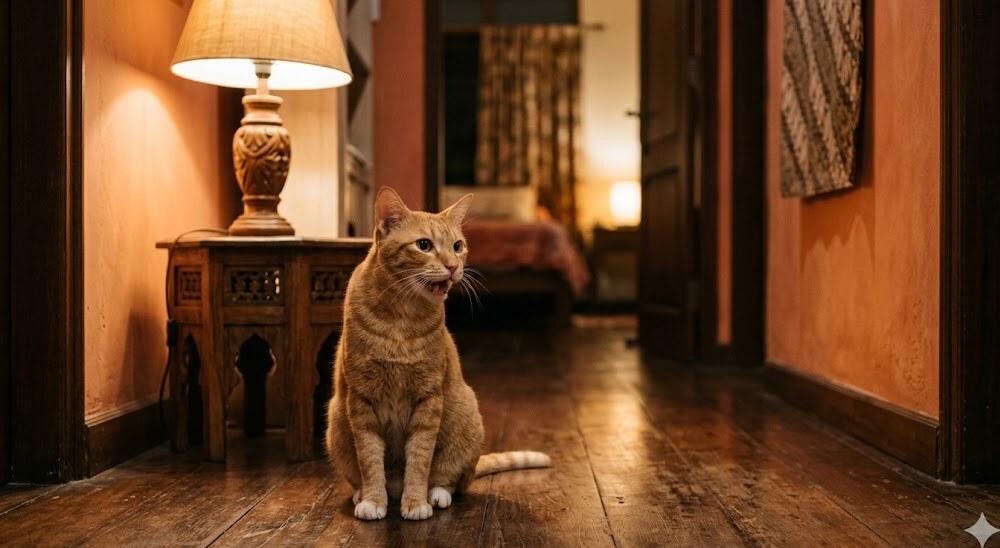

A brand-new sofa, three months old, already frayed at the corner. The teak dining chair has scratch marks on its legs. The lower part of the curtains is ruined. Many first-time cat owners assume this is a "naughty" or "spoiled" cat, until they read that the solution could be amputating the cat's toes (declawing) and start asking: is there really no other way?
The good news: there are many other ways. Destructive scratching is a very solvable problem with a proper understanding of why cats scratch, plus an environment setup that suits their instincts. This article is a complete guide: why cats must scratch (not a choice, but a biological need), why declawing is not recommended by AAFP and AVMA, and proven positive strategies, from choosing a scratching post to a training protocol. Disclaimer: this is a general guide based on international feline behavior guidelines, not a substitute for a veterinary examination of your cat's specific condition.
Why cats must scratch, this is not a choice
Many owners mistakenly believe scratching is a "bad habit" that can be eliminated. In reality, scratching is a natural instinct serving three biological functions at once, and a healthy cat will always scratch, the question is not "will it scratch", but "where".
1. Claw maintenance
A cat's claws grow in layers (sheaths). The old outer layer must shed so the new, sharp layer beneath is exposed. Scratching on a fibrous surface helps lift off this outer sheath, you may have found a "claw husk" left around the scratching post or carpet; that is the result of this normal process.
2. Territorial marking (visual + olfactory combined)
Cats have scent glands between their paw pads (interdigital glands). When scratching, a combination of a visual mark (lines on the surface) and a chemical mark (pheromones from the glands) marks the territory. This is why cats often scratch in locations that are strategic from their point of view, room entrances, near the bed, along the family's main walkways.
3. Stretching and muscle tone
When scratching vertically (on a tree, an upright scratching post, a tall sofa leg), a cat stretches its whole body, shoulders, back, hind legs. This is its routine "morning stretch", just like yoga for humans. Senior cats often scratch more frequently precisely because they need to stretch joints that are starting to stiffen.
These three functions explain why solutions like spraying water at a cat every time it scratches never work in the long run, you are trying to suppress a biological need. The strategy that works is redirection: provide a more appealing target than your sofa, and the cat will choose it on its own.
How common is the destructive scratching problem?
The ISFM/AAFP Feline Environmental Needs Guidelines (Ellis et al, Journal of Feline Medicine and Surgery 2013) note that "scratching furniture" is one of the five most frequently reported behavior problems by cat owners, and one of the main causes of relinquishment (cats being surrendered to a shelter or released). What is sad: the majority of cases can actually be resolved if the owner knows how to set up the environment + redirect properly, before the problem develops to the point of frustration.
Why declawing is NOT recommended
Before discussing positive solutions, we need to clarify declawing, because some clinics in Indonesia still offer this procedure as a quick "solution". The international veterinary profession's position is very clear and consistent:
The AAFP (American Association of Feline Practitioners) position statement on Declawing and the AVMA (American Veterinary Medical Association) Position on Onychectomy both do not recommend declawing as a routine procedure, for the following reasons:
1. Declawing is not "nail trimming", it is bone amputation
Anatomically, declawing (the medical term: onychectomy) is amputation of the third phalanx (P3), the very last bone segment of the toe. It is equivalent to amputating a human fingertip at the distal joint. It is not simply pulling out the nail, the nail grows from the P3 bone, so to permanently remove the nail, the bone must be removed.
2. Long-term physical consequences
- Chronic post-operative pain. Studies show many cats post-declaw experience persistent pain that often goes undetected because cats instinctively hide signs of pain.
- Altered walking biomechanics. Without P3, the cat loses normal toe-pad alignment. Posture and weight distribution change, often triggering secondary joint problems in the hind legs and back later on.
- Risk of surgical complications. Misdirected nail fragment regrowth (claw regrowth), infection, neuroma (abnormal nerve growth after amputation).
3. Behavioral consequences
- Increased biting. A cat that loses its claws as a first line of defense often shifts to biting as defense, adding a new problem, especially for households with small children.
- Litter box aversion. The litter hurts the freshly amputated paws → the cat avoids the box → inappropriate elimination problems appear. See also Cat Litter Box Training: A Complete Guide for context.
- General defensiveness. Without their natural defense, many cats become more anxious and reactive to interaction.
The AVSAB (American Veterinary Society of Animal Behavior) Position Statement on Punishment also underlines that negative approaches (declawing, physical punishment, water spraying) are not only ineffective for scratching, but often make the problem worse by creating new anxiety. The effective solution is positive redirection, not suppression.
Positive strategy #1: Choose a scratching post that suits your cat's preferences
Many owners buy a cheap scratching post from a pet shop, the cat uses it for 2 days then goes back to the sofa, and they conclude "my cat doesn't like scratching posts". But the problem is not scratching posts in general, it is the wrong type of post. Cats have specific preferences about orientation, height, and material.
Orientation: vertical vs horizontal
Most adult cats prefer vertical scratching (an upright post) because it allows full body stretching while scratching. But around 15-25% of cats prefer horizontal scratching (a flat mat on the floor), usually cats more often found scratching the carpet than the sofa. The practical solution: provide both, observe your cat's preference, keep the one it chooses more.
Height: at least 90 cm for vertical
A vertical scratching post must be tall enough for the cat to stretch its body fully, at least 90 cm for a medium-sized adult cat, 100-120 cm is more ideal. The short 40-50 cm posts sold at many pet shops are often rejected by adult cats because they do not provide stretching satisfaction. For a kitten, a 60 cm post is enough, but prepare to upgrade as it matures.
Stability: it must not wobble
This is very often overlooked. A cat will not use a post that wobbles when it scratches at full force, instinctively it will back off because an unstable post = perceived as a tree about to topple. Test before buying: push it with your hand; if it wobbles more than 1-2 cm, it is too unstable. Choose a post with a wide, heavy base (minimum 4-5 kg base).
Material: sisal > carpet > cardboard
- Sisal rope. The favorite material of most cats, a rough texture similar to tree bark, durable, the claw sheath sheds well. Worn sisal can be replaced without buying a new post.
- Sisal fabric. Smoother than rope, some cats prefer it. Try it if rope is rejected.
- Corrugated cardboard. Cheap, biodegradable, many cats love it (especially horizontal mats). Wears out quickly, needs replacing every 1-2 months.
- Carpet. Avoid if possible, cats struggle to distinguish between the carpet on the post and the carpet on the floor/sofa, which actually worsens the confusion.
- Natural wood log. Actually the best option (most similar to what cats scratch in the wild), but hard to source and needs upkeep. If you have access, provide it.
Positive strategy #2: Strategic placement, not just stuck in a corner
The most common mistake: buying a great scratching post then putting it in a storage corner or a never-used nook. Then wondering why the cat still scratches the sofa in the living room.
Cats scratch to mark, the function is to mark territory in locations it considers important. The locations it considers important usually overlap with your and your family's favorite spots. So:
- Place the post NEAR the location it currently scratches often. If it scratches the living room sofa, put the post 30-50 cm from that sofa. Not in your separate bedroom, the marking function will not be channeled.
- Family gathering spots. The TV room, dining room, near the main door, areas where the family gathers and the cat wants to mark its presence.
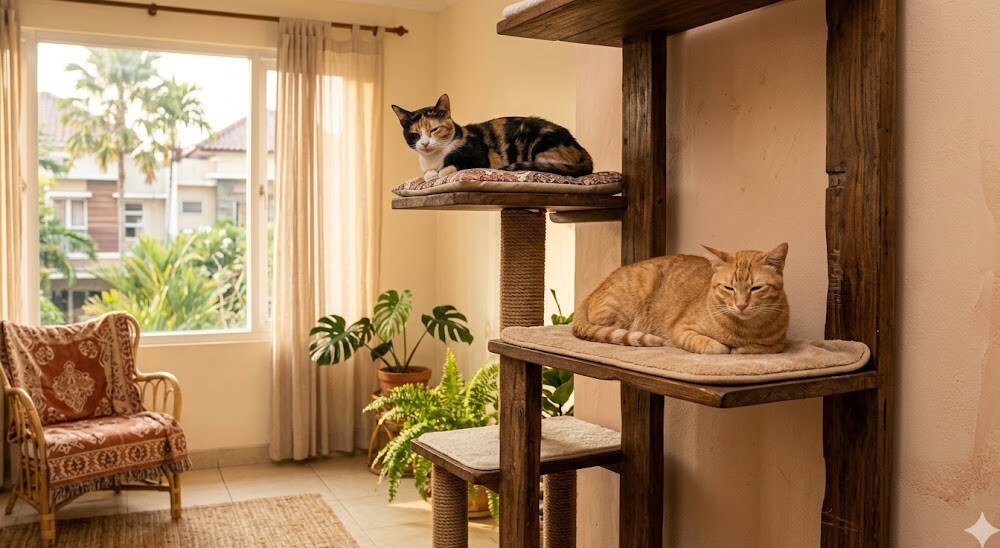
- Near where it wakes up. Cats often scratch + stretch right after waking. A post beside a cat tree or favorite sleeping spot = high usage.
- Multiple posts in multiple locations. For a 2-story house or more than one main room, provide at least 1 post per activity area. Do not expect the cat to go down the stairs to another room just to scratch.
Once the cat is used to the new post in a strategic location, you can move it gradually (5-10 cm per week) to a spot more aesthetically comfortable for you. But at first, accept that a large post in the living room is a trade-off for an intact sofa.
Positive strategy #3: Reward the scratching post + protect the furniture
Simply providing a post is not enough. You need to actively make the post more appealing than the sofa.
Reward + positive association
- Catnip spray or dried catnip on the post, many cats are immediately drawn to it. Refresh every 2-3 days as the aroma fades. For cats that do not respond to catnip (around 30% of cats are genetic non-responders), try silver vine (Matatabi) or valerian root as alternatives.
- Treat dropping. Every time the cat uses the post on its own (without you forcing it), toss a small treat its way or place one at the base of the post. The association: "scratching here = something good happens".
- A hanging toy above the post. A feather wand or dangling toy at the top of the post invites the cat to approach → naturally ends in scratching as it stretches toward the toy.
- DO NOT force it. Holding the cat's paws and forcing it to scratch the post is a strategy that always fails, the cat associates the post with uncomfortable force/handling. Let it approach on its own.
Protect the furniture temporarily (not permanently)
- Double-sided sticky tape (a specific product like Sticky Paws, or ordinary double-sided masking tape) on the sofa areas that are often scratched. Cats dislike a sticky texture on their paws → they avoid the area.
- Plastic furniture guard / corner protector. A clear plastic that adheres to the corner of the sofa/chair, claws cannot "catch" the slippery surface.
- Temporary aluminum foil. For the first 1-2 weeks, cover the target sofa area with foil. The crinkle sound and unfamiliar texture make the cat avoid it. Remove it once it is reliably using the post.
- Furniture cover. For damage prevention while training is ongoing, cover the sofa with a thick, easily washable cloth.
The combination of a more appealing post + temporarily unappealing furniture usually redirects the habit within 2-4 weeks. Once the cat is established on the post, the protective items can be removed gradually.
Positive strategy #4: Pheromone diffuser for stress reduction
Some cases of excessive scratching (especially those that appear suddenly or increase in intensity abruptly) have a stress / anxiety component. Common triggers: a new cat in the home, a move, renovations, a new baby, changes in the family routine.
For cases like this, a synthetic pheromone diffuser (an analog of the feline facial pheromone, for example the Feliway Classic product) can help lower baseline anxiety. How it works: it mimics the "calming" pheromone a cat releases when rubbing its cheek on a familiar object, the signal "this place is safe".
- Install the diffuser in the main room where the cat is active, leave it plugged in 24/7.
- The effect starts to be felt within 1-2 weeks, plateauing at 4 weeks.
- Refill the cartridge every 4 weeks (check the product instructions).
- Not a standalone solution, combine it with the correct environmental setup (post + location).
The scientific evidence for pheromone diffusers varies (some studies positive, some neutral), but because the risk profile is very low, many behavior practitioners include it as an adjunct for stress-driven cases.
Positive strategy #5: Routine claw trimming
Trimming the nail tips routinely does not eliminate scratching (because scratching is not about nail length, but about instinct), but it reduces the damage that occurs when the cat does scratch. Nails with blunt tips will not shred the sofa fibers as much as sharp ones.
Frequency: every 2-4 weeks for adult cats, more often for senior cats that do less natural scratching. See the full technical guide at Claw Trimming for Cats and Dogs: How to Do It Safely + the Right Tools for handling technique, the location of the quick, and tips for cats that dislike having their paws held.
Positive strategy #6: Soft Paws nail caps (optional)
Soft Paws (the original brand) or generic nail caps are silicone nail covers attached with a special glue to the tips of a cat's nails. The cat can still scratch, the motion and satisfaction stay intact, but the nail tip, covered with a soft tip, does not damage surfaces.
- Plus: A quick solution for owners whose furniture is very expensive/sensitive (leather sofa, antiques). Reversible (they fall off naturally as the nail grows, around 4-6 weeks).
- Minus: Application takes patience (you need to hold a stressed cat's paw to apply per nail), and not all cats tolerate it. It does not replace a scratching post, the cat still needs a natural scratching outlet.
- For whom: As a temporary bridge while redirect training is still ongoing, or for cats with a medical issue where declawing is being considered (Soft Paws is a humane alternative).
For the first application, many owners ask for help from a vet professional, it can be done during a visit for routine vaccination or a health check.
Reframing training: positive reinforcement, not punishment
Many owners still believe a water spray, a loud noise, or a firm "no!" will stop scratching. The AVSAB Position Statement on the Use of Punishment for Behavior Modification in Animals is very clear: punishment-based training is not effective for long-term behavior modification and often makes the problem worse.
What happens when you spray water every time the cat scratches the sofa:
- The cat learns "scratching while a human is watching = getting sprayed", not "scratching is wrong". The result: it scratches when you are not around.
- A negative association with you, the cat starts avoiding you or becoming anxious.
- Stress increases → scratching increases (because scratching is also stress relief).
What works is redirection: when you see the cat approach the sofa to scratch, gently bring it (or lure it with a toy) to the scratching post, and reward it when it uses the post. After a few repetitions, the cat learns that the post = reward, the sofa = nothing happens (not punishment, but neutral). Combining this with temporary furniture protection speeds up the shift.
When to see a vet (or call a vet to your home)
Consult a vet or a behavior vet if:
- Scratching appears suddenly with high intensity in a cat that previously had no problem, this could indicate sudden stress or something medical (sore nails, dermatitis on the paws, pain causing over-grooming + over-scratching)
- Scratching is accompanied by self-injury (the cat scratches until it bleeds, or fur is lost in certain areas), this needs a dermatological and behavioral examination
- You have tried all the positive strategies consistently for 6-8 weeks without improvement
- A multi-cat household with dynamic stress that could be the underlying trigger
- Before considering any medical option (declawing, gabapentin for anxiety, etc.), a second opinion from a vet with behavior training is important
For behavior cases, a house call is very valuable because the vet can directly observe the environment setup, the location of the sofa vs the post, the dynamics with family members, and specific triggers that are often missed if only described at the clinic. Plus, cats with a scratching issue are generally more anxious at the clinic, a visit at home provides a more accurate baseline observation.
Destructive cat scratching FAQ
Is there a quick way to stop a cat from scratching the sofa?
There is no instant solution, every approach takes 2-6 weeks to redirect the habit. The fastest: a combination of a tall+stable+sisal scratching post placed NEAR the target sofa (not in a separate corner) + double-sided tape or foil on the sofa for 2-3 weeks + catnip + treat rewards when it uses the post. Most owners see a significant shift within 3-4 consistent weeks.
Is an expensive scratching post better than a cheap one?
Not always, what matters is the specifications, not the price. A simple, affordable post with sisal rope, 90 cm tall, with a stable base is often used by a cat more than a fancy, expensive cat tree with a short 50 cm post. Check: minimum 90 cm vertical height, sisal/cardboard material, a wide and heavy base (no wobble). That is more predictive than price.
My cat scratches the wallpaper, not the sofa, same solution?
The principle is the same, provide a vertical scratching post in a location near the target wall. If it scratches the wall at a certain height (for example half a meter from the floor), choose a post that at least covers that height. Additionally: for wallpaper, cover the target area with a clear acrylic panel while training is ongoing, it does not damage the wallpaper, and the cat cannot catch the slippery surface.
Is it true that declawing is still practiced in Indonesia?
Some clinics in Indonesia still offer it, often under the anatomically inaccurate term "permanent nail removal". The international AAFP + AVMA + ISFM position is consistent: declawing is not recommended for the sake of owner convenience. Before considering it, ask for a second opinion from a vet familiar with feline behavior, cases that genuinely do not respond to all positive strategies are very rare, usually with an underlying factor that has not yet been addressed.
Is Soft Paws safe for cats in the long term?
For most cats it is safe, medical-grade silicone, pet-specific glue, it does not block natural claw retraction. Long-term use (over years) is generally fine if the cat tolerates it. Issues to watch for: glue irritation in some sensitive cats (check for signs of redness, swelling), or a cat that tries to remove the caps until the nail lifts. For outdoor cats it is better not to, cats need functional claws for defense and climbing. As a temporary bridge during training, ideally phase it out once the behavior is stable.
Can Prabasa Vet make a house call to consult on a cat scratching problem?
Yes. Behavior cases, especially scratching, actually benefit greatly from a house call because the vet can directly observe the environment setup, the position of the existing sofa vs post, the specific locations that are often scratched, and the cat's dynamics with the room. Contact us via WhatsApp, mention the number of cats + the scratching problem you are experiencing + your area, the team will schedule a partner vet for a medical evaluation (ruling out sore nails, dermatitis) + an environmental setup audit + concrete recommendations for your home situation.
Closing
Destructive scratching is not a sign of a naughty or spoiled cat, it is a natural instinct serving important biological functions. The solution is not to suppress (let alone declaw), but to redirect: provide a target that suits the cat's preferences (tall vertical, sisal, stable), place it in a strategic location near the currently scratched area, combined with positive rewards and temporary furniture protection.
The majority of cases are solved within 4-6 weeks if the setup and training are consistent. What often causes failure: a scratching post with the wrong specifications (too short, wobbly, wrong material), an unstrategic location (placed in a separate corner), or still combining punishment that undoes the redirection effort. Re-audit from the cat's perspective, what it needs from scratching, and whether your environment provides it.
Need a consultation or to schedule a house-call vet for your cat's scratching / behavior problem? Contact us via WhatsApp, mention the number of cats, the problem you are experiencing, and your area, and our team will help schedule an evaluation with the nearest partner vet.
Read also: Claw Trimming for Cats and Dogs: How to Do It Safely + the Right Tools, Cat Litter Box Training: A Complete Guide, Adopt a Kitten: 10 Complete Checklists for New Pet Owners, Pet Care Guide.
Medical references used in this article
This article was prepared with reference to the following sources, verified sentence by sentence for clinical claims:
- AAFP (American Association of Feline Practitioners) Position Statement on Declawing, recommendation against elective onychectomy, humane alternatives (environmental enrichment, nail caps, routine claw trimming)
- AVMA (American Veterinary Medical Association) Position on Onychectomy of Domestic Cats, definition of the procedure as P3 amputation, long-term medical and behavioral consequences
- Ellis SLH, Rodan I, Carney HC, et al. AAFP and ISFM Feline Environmental Needs Guidelines. Journal of Feline Medicine and Surgery, 2013;15(3):219-230 , prevalence of scratching complaints, principles of environmental enrichment, the 5 pillars of a domestic cat's needs
- AVSAB (American Veterinary Society of Animal Behavior) Position Statement on the Use of Punishment for Behavior Modification in Animals, the basis for positive reinforcement, the anti-punishment evidence base
- Fear Free Pet Professional Education, minimal-stress handling protocols for training, positive association with the environment
- BSAVA Manual of Canine and Feline Behavioural Medicine 2nd Edition, chapter on feline scratching behavior, diagnostic flow for excessive scratching, indications for a behaviorist consult
- Overall KL. Manual of Clinical Behavioral Medicine for Dogs and Cats, chapter on scratching marking behavior, integration of the medical + behavioral approach
This article is a general guide based on international feline behavior guidelines. For your cat's specific condition, including medical history, home environment setup, and multi-cat dynamics, consulting a vet is the right step. Invasive procedures such as declawing are not recommended by AAFP/AVMA for the sake of owner convenience; ask for a second opinion before considering it.