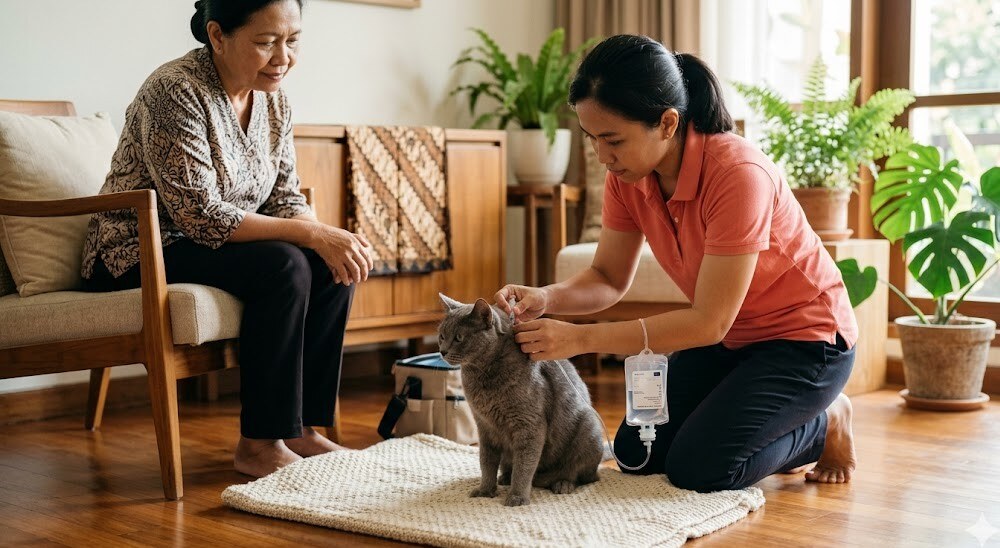

"Doctor, over the past week my dog has been drinking a huge amount of water, and urinating very often, to the point the bed gets wet. We have done blood tests, the sugar is normal. We have checked the kidneys, normal too. The previous vet was puzzled. I was browsing and it said it could be a kind of diabetes but a different one, diabetes insipidus, what is that, Doctor?" A pattern like this, extreme PU/PD (polyuria + polydipsia) + diabetes mellitus ruled out + normal kidneys, is one of the presentations of diabetes insipidus that is often missed or misreferred.
Diabetes insipidus (DI) is rare compared to diabetes mellitus (DM), but the presentation overlaps (severe PU/PD). Many owners and vets are confused because the name "diabetes" is the same even though the mechanism and treatment are completely different. This article is a guide for owners, what DI is, why it differs from DM, how to diagnose it systematically, and treatment with desmopressin.
What is diabetes insipidus?
Diabetes insipidus is a disorder of the body's ability to retain water due to a deficiency of, or resistance to, the antidiuretic hormone (ADH, also known as vasopressin). The result: very dilute urine in a very large volume (polyuria), the body loses a lot of water → constant thirst → polydipsia.
"Diabetes" here comes from the Greek diabainein = "to pass through" (referring to water passing through the body). "Insipidus" = "tasteless/not sweet", different from diabetes mellitus (mellitus = "sweet"), whose urine is sweet because of glucose.
The normal mechanism:
- The body becomes dehydrated or plasma osmolality rises → the hypothalamus releases ADH from the posterior pituitary gland
- ADH acts on the kidney's collecting tubules → binds to the V2 receptor → inserts aquaporin-2 → reabsorbs water from the urine back into the blood
- The urine becomes concentrated, the volume small, the body hydrated
In diabetes insipidus, this mechanism fails at one of these points.
Classification of DI
1. Central diabetes insipidus (CDI)
ADH deficiency, the pituitary does not produce enough ADH because of:
- Idiopathic (the most common in dogs and cats)
- Pituitary tumor (especially craniopharyngioma, pituitary macroadenoma)
- Head trauma with pituitary damage
- Post-pituitary surgery
- CNS infection or inflammation
- Congenital (rare)
2. Nephrogenic diabetes insipidus (NDI)
ADH resistance at the kidney, the pituitary produces enough ADH, but the collecting tubules do not respond. Classification:
- Primary NDI (congenital): very rare, a genetic defect in the V2 receptor or aquaporin-2
- Secondary NDI: far more common, caused by other conditions that interfere with ADH action at the kidney. These include:
- Severe hypokalemia
- Hypercalcemia
- Hyperadrenocorticism (Cushing's)
- Hyperthyroidism (cats)
- Pyometra
- Chronic kidney disease
- Diabetes mellitus with glucosuria
- Hepatic encephalopathy
- Medications: corticosteroids, loop diuretics, lithium
- Hyperaldosteronism
The key point: "primary" NDI is very rare, most clinical cases that initially look like NDI turn out to be secondary to another condition that must be ruled out first.
Clinical signs of DI
Main signs
- Polydipsia (PD), excessive drinking, can be more than 100 ml/kg/day (normal: dogs less than 90 ml/kg/day, cats less than 45 ml/kg/day). A 10 kg dog with DI can drink 2-4 liters/day, some cases more
- Polyuria (PU), excessive urination, frequency and volume increase dramatically. Some cases reach incontinence because the bladder is always full
- Apparent nocturia, waking at night to drink and urinate
- Very low urine specific gravity, below 1.008 (hyposthenuric) even when dehydrated
Other signs
- Normal or slightly decreased body weight (different from DM, which often drops significantly because glucose cannot be used)
- Normal or slightly increased appetite
- Normal activity in primary DI (different from secondary DI, which has signs of the primary disease)
- Dehydration can appear if access to water is restricted (dangerous!)
In CDI from a pituitary tumor: CNS signs can appear (seizures, behavior changes, visual disturbances) as the tumor grows.
Telling it apart from other causes of PU/PD
The PU/PD differential is very broad, DI is a diagnosis of exclusion after the more common causes are ruled out:
- Diabetes mellitus (DM), high blood sugar + glucosuria. Check blood glucose + urine
- Chronic kidney disease (CKD), elevated BUN/creatinine, elevated SDMA, isosthenuria, possibly proteinuria
- Hyperadrenocorticism (Cushing's), generally in dogs: pot belly + thin skin + alopecia. Check with an ACTH stim or LDDST
- Hyperthyroidism (senior cats), an old cat with PU/PD + weight loss + increased appetite + a heart murmur. Check T4
- Hypercalcemia, from various causes (cancer, parathyroid, vitamin D toxicity). Check blood calcium + ionized calcium
- Pyometra, an intact female dog/cat with vaginal discharge or even without discharge. Check with abdominal ultrasound
- Hepatic insufficiency, including porto-systemic shunt. Check a liver function panel + bile acids
- Psychogenic polydipsia, compulsive drinking behavior without an underlying medical cause (rare, a diagnosis of exclusion)
- Iatrogenic (medication), corticosteroids, diuretics, phenobarbital
Because of the many differentials, a systematic work-up is important. Owners should not jump to DI before the common causes are ruled out.
Diagnosis of DI
Step 1: Confirm PU/PD
- The owner records the actual water intake over 3-5 days (weigh water in minus what is left)
- Confirm the volume is above 100 ml/kg/day for dogs or 45 ml/kg/day for cats
Step 2: Baseline work-up
- CBC, full biochemistry, T4, urinalysis with culture, abdominal ultrasound
- Specific tests per the suspected differential (LDDST for Cushing's, etc.)
- Rule out all common differentials first before proceeding to DI testing
Step 3: Water deprivation test (WDT)
The classic test for DI but DANGEROUS if done incorrectly, it can cause severe dehydration leading to shock. Per the ACVIM Small Animal Internal Medicine guidelines, the WDT must be done in a clinical setting with close monitoring:
- Modified protocol: gradual water restriction over several days (not an abrupt stop) to recover the medullary concentrating gradient
- During the test: hospitalize the pet, record the starting weight, restrict water, monitor body weight every 1-2 hours (stop if it drops 5%)
- Monitor urine specific gravity (USG) every 1-2 hours
- Stop the test if there is clinical dehydration or USG > 1.030 (normal concentrating restored)
- If the pet cannot concentrate urine despite dehydration → suspect DI or a concentrating disorder
Step 4: Desmopressin trial
After the WDT, or directly as clinical practice in certain cases:
- Give desmopressin (DDAVP), a synthetic analog of ADH
- Per Plumb's Veterinary Drug Handbook 7e, an ophthalmic preparation (eye drops) 1-4 drops into the conjunctival sac, or an intranasal/oral preparation
- Monitor water intake and urine output for 5-7 days
- A positive response (intake drops significantly + urine USG increases) → CDI
- No response → NDI or another cause
Step 5: CNS imaging (if CDI confirmed)
- Head MRI to rule out a pituitary tumor (especially a pituitary macroadenoma)
- Important because treatment and prognosis depend on the underlying cause
- Advanced MRI imaging is expensive and rare in Indonesia, refer to a facility with this capability
Treatment of DI
Central DI (CDI)
Desmopressin acetate (DDAVP) is the treatment of choice. Per Plumb's 7e:
- Ophthalmic preparation (most often used in veterinary practice), 1-4 drops into the conjunctival sac 1-3x/day. Absorbed via the conjunctival mucosa
- Intranasal, not common for pets (low compliance)
- Oral tablet, can be used, dosing per veterinary evaluation
- SC injection, for hospitalized or short-term cases
Monitoring the response via water intake (dropping to the normal range), urine USG (increasing), and body weight. The dose is titrated individually.
Side effects are rare but possible: water intoxication (if dosing is too aggressive + free water access), manifesting as hyponatremia (lethargy, seizures). Monitoring is important.
Nephrogenic DI
- The main goal: treat the underlying cause (Cushing's, hypercalcemia, hypokalemia, etc.)
- For primary NDI (genetic, very rare), difficult to treat. Adjuncts: thiazide diuretics (paradoxical reduction in urine output) + a low-sodium diet
- Secondary NDI with correction of the underlying cause generally improves
General supportive care
- Free access to water at all times, DO NOT restrict water in a pet with DI (except during a controlled WDT in a clinical setting)
- Routine body weight monitoring
- Periodic electrolyte checks
Prognosis
- Idiopathic CDI with DDAVP treatment: very good prognosis, the pet can live normally with lifelong medication
- CDI from a pituitary tumor: prognosis depends on the tumor, small and slow-growing can be managed; an aggressive macroadenoma has a guarded prognosis
- Secondary NDI with a treatable underlying disease: prognosis follows the underlying disease
- Primary genetic NDI: challenging, life-long management with diet + diuretics
Diabetes insipidus FAQ
What is the difference between diabetes insipidus and diabetes mellitus?
Diabetes mellitus (DM) = "sweet diabetes", a disorder of glucose metabolism (insulin deficiency/resistance) → high blood sugar + glucosuria + weight loss + increased appetite. Diabetes insipidus (DI) = "tasteless diabetes", a disorder of water retention (ADH deficiency/resistance) → very dilute urine + massive PU/PD, normal blood sugar, no glucosuria, weight usually normal. The treatment is completely different: DM with insulin, DI with desmopressin (for CDI).
My dog's diabetes test is negative but the PU/PD is severe, is it automatically DI?
Not necessarily. The PU/PD differential is wide, Cushing's, CKD, hypercalcemia, pyometra (intact females), hyperthyroidism (cats), psychogenic polydipsia, medications. DI is a diagnosis of exclusion after the common causes are ruled out via a systematic work-up. Consult a vet for an efficient step-by-step diagnostic strategy before jumping to DI.
Is DI dangerous if untreated?
Yes, especially if water access is restricted. A pet with DI that cannot concentrate its urine + does not have enough water intake can quickly become dehydrated → hypovolemia → shock. As long as water access is free, most pets with DI can compensate and survive. But the quality of life is poor (extreme PU/PD, nocturia, incontinence) and there is an emergency risk if water access is disrupted (travel, hospitalization, etc.). Treatment with desmopressin greatly improves quality of life.
DDAVP eye drops, how do they work for DI?
Desmopressin is a synthetic analog of ADH/vasopressin. When dropped onto the eye conjunctiva, it is absorbed via the mucosa into the system with a relatively fast onset. At the kidney, DDAVP binds the V2 receptor in the collecting tubules → inserts aquaporin-2 → reabsorbs water from the urine → concentrated urine + reduced volume. Eye drops are a practical choice because absorption is reliable, they are easy to administer, and the duration of action is typically 8-12 hours. Dosing frequency is per veterinary evaluation.
My senior cat has PU/PD + weight loss + increased appetite, is this DI or something else?
This profile more strongly suggests hyperthyroidism (the most common in senior cats) or diabetes mellitus, NOT primary DI. Hyperthyroid: weight loss + increased appetite + PU/PD + often a heart murmur + irritability. DM: glucosuria + ketonuria in DKA cases. Check T4 + blood sugar + urinalysis first. Pure DI in a senior cat is very rare (mostly secondary to CKD/hyperthyroid/Cushing's).
Can the water deprivation test be done at home?
NO. It is dangerous. The WDT can cause severe dehydration leading to shock if done incorrectly. It must be done in a clinical setting with staff monitoring body weight and urine USG periodically, plus the capability to resuscitate if dehydration becomes excessive. Modern practice more often goes straight to a desmopressin trial (DDAVP trial) without the WDT for efficiency and safety.
How much does diagnosing and treating DI cost in Jakarta?
The cost depends on several factors: how broad the PU/PD differential work-up needs to be (CBC, biochemistry, T4, urinalysis, ultrasound, specific tests per differential), whether advanced imaging such as MRI is needed to rule out a pituitary tumor (rarely available in Indonesia), and the desmopressin (DDAVP) treatment, which is usually lifelong plus periodic monitoring. So the range can be meaningful and depends very much on the individual case. Contact Prabasa Vet on WhatsApp for a free consultation and an initial estimate tailored to your pet's condition.
Summary
Diabetes insipidus (DI) is a disorder of water retention due to ADH deficiency (CDI) or ADH resistance at the kidney (NDI). It differs from diabetes mellitus, there is no high blood sugar, and the urine is very dilute with a massive volume. Clinical signs: extreme PU/PD (more than 100 ml/kg/day in dogs, 45 ml/kg/day in cats), very low urine USG (below 1.008), with weight and appetite usually normal.
Diagnosis: rule out the common differentials first (DM, CKD, Cushing's, hyperthyroid, hypercalcemia, pyometra, etc.), the water deprivation test (in a clinical setting, mind the safety), the desmopressin trial (a positive response → CDI), and a head MRI if CDI is confirmed to rule out a pituitary tumor. Treatment: CDI with desmopressin (DDAVP) ophthalmic as the primary choice, secondary NDI by treating the underlying cause. The prognosis for idiopathic CDI with treatment is very good.
Is your dog or cat showing extreme PU/PD but the diabetes test is negative? See the Prabasa Vet pet care guide or contact us on WhatsApp for an initial triage consultation. Do not restrict water at home without medical supervision, it can be dangerous.
Read also: Cushing's in Dogs: Signs and Treatment, Addison's in Dogs: Signs and Treatment, Diabetes Mellitus in Dogs and Cats: Signs and Treatment.
Medical references used in this article
This article was prepared with reference to the following sources, verified sentence by sentence for clinical claims:
- Ettinger SJ, Feldman EC, Cote E. Textbook of Veterinary Internal Medicine, 8th edition, pathophysiology of the ADH/vasopressin axis, classification of CDI vs NDI, comprehensive PU/PD differential, modified water deprivation test protocol, desmopressin response interpretation
- BSAVA Manual of Canine and Feline Endocrinology, 4th edition, chapter on diabetes insipidus, pituitary MRI imaging for CDI work-up, NDI secondary to Cushing's/hyperthyroid/hypercalcemia, treatment protocols
- ACVIM Small Animal Internal Medicine, 6th edition, step-wise PU/PD work-up, contraindications to the water deprivation test in certain cases, the desmopressin trial as a safe diagnostic shortcut
- Plumb's Veterinary Drug Handbook, 7th edition, desmopressin acetate (DDAVP) dosing for dogs and cats (ophthalmic 1-4 drops, intranasal, oral, injection), monitoring, water intoxication side effect, drug interactions
- Nelson RW, Couto CG. Small Animal Internal Medicine, 6th edition, chapter on the polyuria/polydipsia diagnostic algorithm, distinguishing DI from psychogenic polydipsia, MRI findings of pituitary tumors
- WSAVA 2024 endocrinology working group materials, the modern approach to DI diagnosis (favoring the desmopressin trial over the risky WDT), monitoring the quality of life of chronic CDI patients
This article is a general guide based on the ACVIM, BSAVA, and veterinary internal medicine textbook guidelines. Diabetes insipidus is a diagnosis of exclusion that requires a systematic work-up in a clinical setting, do not self-diagnose or treat at home. The Prabasa Vet house-call service can provide an initial consultation and coordinate the work-up with a referral clinic that has advanced diagnostic capability.