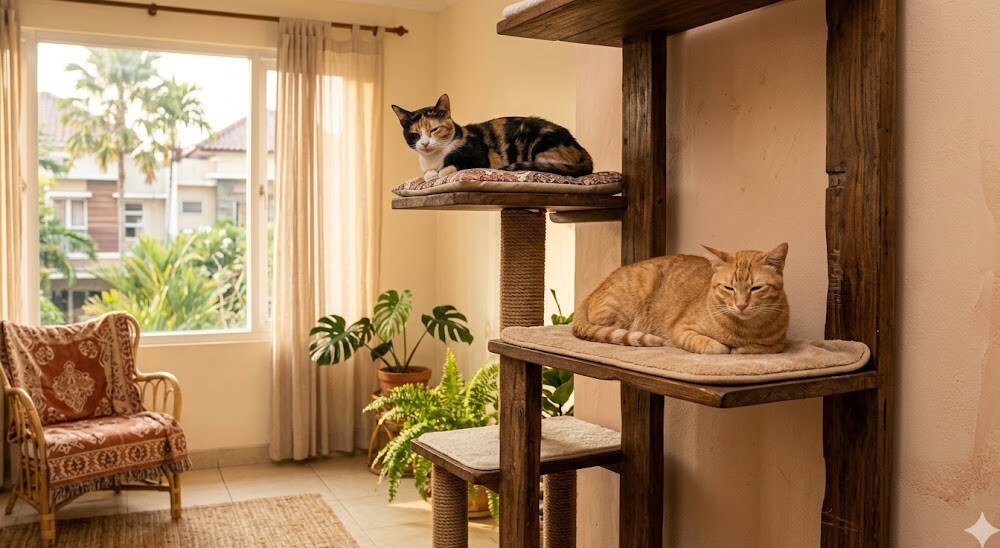

It's 2 a.m., the lights have been off for a while, and your cat is standing in the middle of the living room letting out a long, drawn-out meow, not a hungry sound, not a let-me-out-the-door sound, but a yowling that sounds like a call into an empty space. You turn on the light, he stares back for a few seconds, then carries on. This pattern has repeated every night for the past 2-3 weeks. He's a 12-year-old cat, previously a calm one.
If a pattern like this is happening with your senior cat, the first step is not "just leave it, maybe he's senile" and also not rushing to buy a pheromone diffuser. The first step is a medical work-up. Geriatric veterinary research consistently shows that new-onset night vocalization in cats 7+ years old is more often caused by treatable medical conditions than by a purely behavioral change, and many of those medical conditions are progressive if not detected.
This article is a guide to the differential diagnosis for owners of senior cats whose night vocalization has changed, the work-up sequence vets usually follow, when behavioral intervention is appropriate, and how to distinguish it from a vocalization pattern that is still within normal limits. Disclaimer: this is a general guide based on ISFM/AAFP guidelines, not a substitute for a direct consultation with a veterinarian for your cat's specific condition.
Why senior cats can vocalize at night, an overview
Vocalization is a cat's communication signal, asking for something, expressing discomfort, responding to a stimulus, or expressing disorientation. In young adult cats, sporadic episodes of night vocalization (3 a.m. zoomies, running through the hallway, a meow or two) are often normal, part of a cat's crepuscular activity rhythm (active at dawn and dusk).
What is pathological and needs evaluation is the following pattern in cats 7+ years old:
- New onset, a cat that was previously quiet at night suddenly becomes continuously vocal
- Persistent, not one night, but a pattern repeating week after week
- Long yowling, not a short greeting meow, but a long, drawn-out sound with a different quality
- Accompanied by other behaviors, pacing, disorientation, appearing to stare at blank walls, urinating outside the litter box, changes in appetite, or weight loss
The ISFM 2022 Senior Cat Healthcare Guidelines and the AAFP Cat Friendly Practice framework place new nocturnal vocalization in senior cats as a red flag that needs a medical work-up, not a purely behavioral problem until proven otherwise.
Medical differential diagnosis, the vet's priority before behavior
Here are the differentials a vet usually considers for a senior cat with new-onset night vocalization, roughly ordered from most common to most specific. Many of these conditions can occur simultaneously, a senior cat with hyperthyroidism can also have CKD plus hypertension plus osteoarthritis all at once.
1. Hyperthyroidism
One of the most common causes of night vocalization in senior cats. Hyperthyroidism causes hyperactivity, restlessness, a paradoxical increase in appetite with weight loss, and frequently excessive vocalization. Screening: a blood T4 test, which ISFM recommends as part of a routine geriatric panel for all cats 7+ years old.
Other signs that often accompany it: eating a lot but losing weight, a dull coat, hyperactivity, tachycardia (a fast heartbeat), and sometimes recurrent vomiting. There are several treatment options (oral methimazole, Hill's y/d diet, radioiodine therapy, thyroidectomy), the decision depends on the stage, comorbid kidney condition, and access to therapy. Full details in the guide to hyperthyroidism in senior cats, signs, T4 diagnosis, and treatment.
2. Systemic hypertension (high blood pressure)
Often comorbid with hyperthyroidism and CKD. Uncontrolled hypertension can cause disorientation, agitation, and in severe cases, sudden blindness from retinal detachment. A cat that has just lost its vision often vocalizes in panic because of disorientation in an environment that was previously familiar.
Blood pressure measurement (Doppler or oscillometric) is a standard part of the ISFM geriatric panel. Unfortunately, feline blood pressure measurement is not often routine in practice in Indonesia, so it's frequently missed. If your cat is a senior and has symptoms of night vocalization plus signs of disorientation or changes in vision, explicitly request a BP measurement.
3. Chronic Kidney Disease (CKD)
CKD is one of the most common diseases in senior cats. One manifestation that is often overlooked: nocturia, frequent urination at night. Discomfort from polyuria (large urine volume) plus constant thirst keeps the cat from settling at night, pacing between the litter box and the water bowl, and vocalizing out of frustration or uremic discomfort.
Early signs of CKD are often non-specific: drinking and urinating more, a gradual decrease in appetite, weight loss, a dull coat. Diagnosis requires a combination of creatinine + BUN + SDMA + urinalysis (USG, protein/creatinine ratio). Details on staging and management in the guide to CKD in senior cats, signs, IRIS staging, and renal diet.
4. Chronic pain, senior osteoarthritis
BSAVA notes that osteoarthritis is detected in more than 60% of cats 12+ years old, but it is very often missed because cats don't limp the way dogs with OA do. OA signs in cats are subtler: stopping jumping to high places that used to be easy, changes in grooming (difficulty grooming the lower back, matting at the hips), behavior becoming more withdrawn, and, relevant to this topic, vocalization due to discomfort, especially when standing for a long time or changing position.
Chronic pain often worsens at night because the body's natural anti-inflammatory (endogenous cortisol) decreases. A cat that seems fine during the day can yowl at night due to joint discomfort. Assessing pain in a senior cat requires structured observation (gait assessment, joint palpation, sometimes radiography), not just "well, he's old, he's bound to ache."
5. Sensory decline, vision and hearing loss
Decline in vision and hearing is common in senior cats. Gunn-Moore and the feline geriatric literature note that cats beginning to lose these two senses often become vocal at night, in the dark, visual cues are lost, and if hearing has also declined they don't get echolocation feedback from the room, so they become disoriented. Vocalizing becomes a way to "call for reassurance", "is anyone else here?"
Owners often don't realize their cat is losing its vision because cats cleverly map the home from memory (whiskers + olfactory landmarks). Subtle signs: cautiously navigating unfamiliar surroundings, bumping into new furniture, or pupils that dilate in a brightly lit room.
6. Feline Cognitive Dysfunction Syndrome (FCD / CDS)
Similar to Alzheimer's in humans, FCD is a neurodegeneration that causes disorientation, changes in the sleep-wake cycle, nocturnal vocalization, changes in social interaction, and confusion about familiar environments. A commonly used acronym: DISHA, Disorientation, Interaction changes, Sleep-wake cycle changes, House-soiling, Activity changes.
FCD is more common in cats 11+ years old. Diagnosis is a diagnosis of exclusion, meaning the vet must rule out other medical conditions (hyperthyroidism, hypertension, CKD, pain, sensory decline) before attributing it to cognition. FCD management: daytime cognitive enrichment, consistent routine, a predictable environment, and sometimes a nutraceutical (SAMe, omega-3) or pharmacological intervention.
7. UTI / FLUTD / cystitis
Infection or inflammation of the urinary tract causes urgency, frequency, and discomfort. A cat with FLUTD often vocalizes when approaching the litter box, while inside it, or afterward. In male cats, urinary blockage is a fatal emergency within 24-48 hours, yowling accompanied by straining without producing urine is a red flag.
Screening: urinalysis, ideally accompanied by imaging (bladder ultrasound). For a full picture of urinary emergency signs in male cats, see the guide to urinary blockage in male cats and FLUTD.
8. Hunger, an empty food bowl in the middle of the night
The most banal cause but a frequent one. Senior cats with hyperthyroidism in particular eat far more, and if the bowl is empty at 2 a.m. they will vocalize to demand food. Also check if there are many cats in the house, a dominant cat may finish the night's ration, leaving the senior cat without access.
A simple solution for this possibility: an automatic feeder scheduled for 2-4 small portions per 24 hours, including one midnight portion. If the night vocalization stops after the feeder is installed, it's most likely not purely medical, but the geriatric panel still proceeds for screening.
9. Outdoor cat, heat cycle in an unspayed female
For senior female cats that are not spayed and still have outdoor access, estrus (heat) can still occur into old age. The characteristic yowling of estrus has a different quality, longer, more "calling," often accompanied by rolling and a lordosis posture. The solution: spaying, which also reduces the risk of pyometra (a uterine infection that is fatal in seniors).
The vet's work-up, what actually happens
For a senior cat with new-onset night vocalization, the investigation sequence a vet usually arranges (per the ISFM/AAFP geriatric panel guidelines):
Step 1 , Structured history-taking
- When did the vocalization start? Sudden or gradual onset?
- Frequency: every night or intermittent? At what time usually?
- Quality of the sound: long yowling, short meows, a strained sound?
- Does it respond when answered or held? (FCD cats often don't respond, or respond strangely)
- Other changes: appetite, body weight, drinking-urination, litter box habits, mobility, grooming, interaction
- History of disease and current medications
Step 2 , Thorough physical examination
- Body condition score, muscle condition score
- Palpation of the thyroid in the neck (hyperthyroid cats often have a palpable goiter)
- Palpation of the joints (osteoarthritis), abdomen (masses, small/enlarged kidneys)
- Eye examination: pupils, retina (if ophthalmoscopy is available)
- Cardiac auscultation: tachycardia, murmur, gallop rhythm
- Dental-oral examination (chronic pain is often undetected)
Step 3 , Geriatric laboratory panel
- CBC + complete biochemistry including creatinine, BUN, SDMA, ALT, glucose, total protein
- T4 (thyroxine), mandatory for all cats 7+ years old with new symptoms
- Urinalysis including USG and, if possible, UPC (urine protein:creatinine ratio)
- Blood pressure (BP), Doppler or oscillometric, multiple readings
Step 4 , Selective imaging based on findings
- Abdominal ultrasound if there is suspicion of a mass, CKD, or liver disease
- Radiography of the joints/spine if there is suspicion of severe osteoarthritis
- Thoracic radiography if there is a heart murmur or dyspnea
Step 5 , Behavioral diagnosis (FCD) only if the above is clean
FCD is the last diagnosis, not the first. Many cats said to be "senile" actually have hyperthyroidism that hasn't been screened, or hypertension that hasn't been measured, or osteoarthritis that hasn't been palpated. Giving a pheromone diffuser and melatonin to a cat with untreated hyperthyroidism won't help and hides a progressive problem.
After medical causes are clear, behavioral intervention
If the geriatric panel has been done and there is no medical finding that explains it, or a medical finding has been treated but the night vocalization persists (FCD or compensation for sensory decline), here are evidence-based behavioral interventions:
Daytime enrichment
- Food puzzles 2-3 times a day so the cat gets mental stimulation + activity. A cat that is active during the day sleeps more easily at night
- Play sessions of 10-15 minutes 2-3 times a day, including one 30-60 minute session before bed (wand toy, laser, hunt simulation). End with a "catch" so the hunt cycle is complete and the cat isn't frustrated
- Window perch + vertical space, senior cats still need visual enrichment
Consistent routine
- A predictable schedule for feeding, play, and sleep
- A play session + last meal 30-60 minutes before you go to bed so the cat is full and tired
- Avoid inconsistent responses to night vocalization (sometimes turning on the light, sometimes ignoring), this reinforces the behavior through random reinforcement
Environment for cats with FCD or sensory loss
- A small night light along the route to the litter box for cats with vision decline
- A litter box in a predictable place not too far from the sleeping area
- A familiar bed with a consistent scent
- Avoid rearranging the furniture, cats with FCD rely heavily on spatial memory
Adjunct, Feliway diffuser and nutraceuticals
- Feliway Classic (synthetic facial pheromone), modest evidence but favorable cost-benefit. Place it in the cat's main areas
- A diet for senior cats with cognitive support (Hill's b/d, Purina NeuroCare, Royal Canin Mature, etc.), containing omega-3, antioxidants, and medium-chain triglycerides
- Supplements: SAMe, fish oil omega-3 EPA/DHA, modest evidence for FCD
Pharmacology (prescribed by a vet)
For severe FCD cases or nocturnal anxiety that seriously disrupts quality of life:
- Melatonin, sometimes used to regulate the sleep-wake cycle. Dosing and safety must come from a vet
- Selegiline, an MAO-B inhibitor, sometimes used for canine FCD, off-label in cats
- SSRI / TCA (fluoxetine, clomipramine, amitriptyline), for a significant anxiety component, requires kidney-heart screening first
DO NOT give human behavioral medications to a cat without a vet's prescription. Many human anti-anxiety drugs (alprazolam, diazepam) are toxic to cats or require very specific dosing. Plumb's 7e is the vet's standard reference for dosing feline behavioral medications.
Distinguishing it from normal cat behavior, zoomies vs persistent yowling
Not all nighttime cat activity is pathological. What's different:
| Normal crepuscular activity | Senior persistent yowling | |
|---|---|---|
| Cat profile | Young adult cat, healthy | Cat 7+ years old, new onset |
| Duration | A 5-15 minute burst, then settles | Hours, or recurring every 30-60 minutes |
| Character | Running, jumping, playing, an occasional short meow | Standing still or pacing, long drawn-out yowling |
| Response when soothed | Settles when tired or given brief attention | Often doesn't respond, or returns to yowling a few minutes later |
| Accompanying signs | None, a fully healthy cat | Weight loss, appetite changes, polydipsia, urinating outside the litter box, grooming changes |
| Frequency | A few times per week, intermittent | Every night, persistent week after week |
Practical rule of thumb: a cat 7+ years old with new-onset night vocalization lasting more than 1-2 weeks = schedule a geriatric panel. Don't wait until it's obviously ill, many conditions (early hyperthyroidism, CKD stage 2, hypertension) can still be managed well if caught early.
When to see a vet (or call a vet to your home)
Consult a vet if:
- A senior cat (7+ years old) has new-onset night vocalization lasting more than 1-2 weeks
- It's accompanied by weight loss, appetite changes, changes in drinking-urination, or urinating outside the litter box
- It's accompanied by disorientation, appearing to stare at blank walls, confusion in a familiar home
- A male cat is yowling accompanied by straining in the litter box without producing urine, a 24-48 hour emergency
- A chronic condition has already been diagnosed (hyperthyroidism, CKD, OA) and there is a change in the vocalization pattern, it could indicate progression
For a senior cat's geriatric panel evaluation, a home visit is often more accurate than bringing the cat to a clinic. Many senior cats are anxious when brought to a clinic, blood pressure becomes falsely high (white coat effect), tachycardia becomes falsely high, and the examination is limited because the cat is tense. At home, the BP reading is more representative, thyroid palpation is more accurate, and the vet can observe the sleeping environment, litter box access, and feeding setup relevant to distinguishing FCD vs medical.
Senior cat night vocalization FAQ
Is a 10-year-old cat that has just started meowing in the middle of the night definitely senile?
No. FCD is a diagnosis of exclusion, meaning the vet must rule out other medical conditions first. The most common causes of night vocalization in cats 10+ years old are actually hyperthyroidism, hypertension, and CKD, all of which can be screened with a blood panel + T4 + BP + urinalysis. Attributing it to "he's just senile" without a work-up is one source of progressive disease being missed.
I've tried a Feliway diffuser and melatonin without consulting a vet, why hasn't it changed?
If the cause is medical (hyperthyroidism, hypertension, pain), behavioral intervention won't help until the medical cause is treated. Feliway helps with the anxiety component but not with tachycardia from hyperthyroidism or discomfort from osteoarthritis. The correct sequence: geriatric panel first → treat the medical findings → then see whether the behavior still persists → only then behavioral intervention. Also, melatonin without a vet's prescription is risky because feline dosing differs from human dosing.
Does setting up a CCTV camera to watch the cat's vocalization pattern help the vet?
Very much so. Footage from 1-2 nights shows the starting time, duration, behavior during the vocalization (pacing, staring at walls, approaching the litter box, etc.), and the response to intervention. It's more objective than the description of a tired owner. Show the video to the vet during the consultation, this often directs straight to a specific differential.
How much does a geriatric panel for a senior cat cost?
It depends on the scope and the lab used. A comprehensive geriatric panel (CBC + complete biochemistry + T4 + urinalysis + BP) in Jakarta usually requires 1-2 visits. For a specific price estimate, please ask via WhatsApp, mentioning the cat's age and the condition it's experiencing, the team will help recommend an appropriate scope and a cost estimate.
Is it safe to separate a senior cat with night vocalization into another room at night so the owner can sleep?
It depends on the cause. If it's FCD or sensory decline, nighttime isolation can worsen the disorientation and anxiety, the cat becomes more vocal because it's more isolated. A better solution: address the main cause (medical first), arrange daytime enrichment so it's tired at night, and if needed consult a vet about a safe pharmacological intervention for a senior cat. The owner's well-being also matters, if you've been burned out for days without sleep, tell the vet; there is usually a short-term plan while the work-up proceeds.
Can Prabasa Vet make a home visit for a senior cat's geriatric panel?
Yes. For a senior cat with night vocalization, a home visit is actually more accurate than bringing it to a clinic, blood pressure is more representative (no white coat effect), the cat is more cooperative for the examination, and the vet can directly observe the sleeping setup, litter box, feeding access, and the dynamic with other cats/pets in the home that are relevant to the diagnosis. Contact us via WhatsApp, mention the cat's age + the vocalization pattern + other changes you've noticed + your area, the team will schedule a partner vet for a geriatric panel + a discussion of an appropriate investigation plan.
Closing
Night vocalization in senior cats is not "it's just old age" and not "spoiled, wanting attention." It's a signal that deserves serious investigation. The majority of cases in cats 7+ years old have a treatable medical root, hyperthyroidism, hypertension, CKD, chronic pain, sensory decline, and many are progressive if not caught early.
The correct sequence: medical work-up first, behavior later. Give your senior cat the chance to be evaluated properly before attributing it to "senility" or "behavior." Many conditions, if caught at an early stage, can still be managed for a long time with a good quality of life.
Want to schedule a geriatric panel or a consultation about your senior cat's night vocalization at home? Contact us via WhatsApp, mention the cat's age, the vocalization pattern observed, other changes you've noticed (weight, appetite, drinking-urination), and your area. Our team will help schedule an evaluation with a partner vet.
Read also: Senior Cats 10+ Years: Changes and Geriatric Care, Hyperthyroidism in Senior Cats: Signs, T4 Diagnosis, and Treatment, CKD in Senior Cats: Signs, Staging, and Renal Diet, Senior Osteoarthritis: Signs and Multimodal Management, Pet Care Guide.
Medical references used in this article
This article was prepared with reference to the following sources, verified clinical sentence by sentence:
- ISFM (International Society of Feline Medicine) 2022 Senior Cat Healthcare Guidelines, age categorization (mature/senior/geriatric), recommended examination frequency, geriatric panel components (CBC, biochemistry, T4, urinalysis, BP)
- AAFP (American Association of Feline Practitioners) Senior Care Guidelines + Cat Friendly Practice resources, structured diagnosis for new symptoms in senior cats, the importance of BP measurement, the low-stress at-home approach
- Gunn-Moore DA et al. Feline geriatric medicine literature, Feline Cognitive Dysfunction (FCD), the DISHA criteria (Disorientation, Interaction, Sleep-wake, House-soiling, Activity), differential from medical mimickers
- Harvey A, Tasker S (eds). BSAVA Manual of Feline Practice: A Foundation Manual, osteoarthritis in senior cats (prevalence >60% in cats 12+ years), chronic pain assessment, vocalization as a sign of discomfort
- Plumb's Veterinary Drug Handbook 7th Edition, methimazole, melatonin, fluoxetine, amitriptyline, and other behavioral medications for senior cat indications (dosing and contraindications)
- IRIS (International Renal Interest Society) staging guidelines, feline CKD staging, treatment indications per stage, monitoring
This article is a general guide based on international feline medicine guidelines. For your cat's specific condition, including age, medical history, comorbidities, and response to previous interventions, consulting a veterinarian is the right step. Behavioral medications, hyperthyroidism therapy, and CKD management should only be prescribed by a vet after a thorough examination.