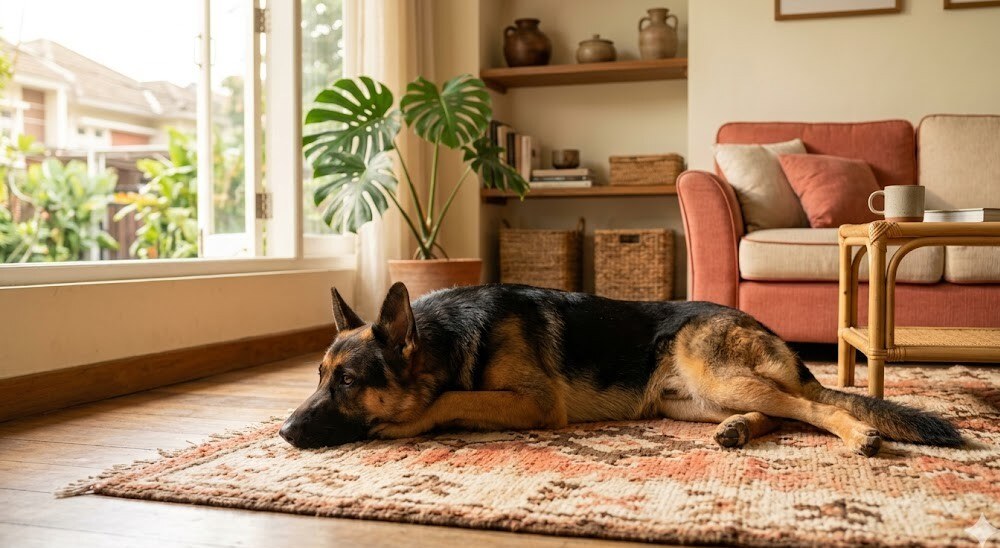

"My dog is a 9-year-old Labrador. Lately when he gets up in the morning he walks stiffly, he won't jump onto the sofa anymore even though he used to love it, and on a walk he limps a bit on the hind leg. But after about 10 minutes of walking his movement improves. Why is that?" This question comes in to the Prabasa Vet team often. Most of the time the answer is: osteoarthritis (OA), a degenerative joint disease that is very common in senior dogs, especially large breeds.
OA is often underestimated because the signs are gradual and dogs, as a species, are masters of hiding pain. Many owners only notice once their dog is clearly limping or has stopped a favorite activity. Yet effective management has the greatest benefit when it starts at the subtle-sign stage, not once the dog is in severe pain.
This article helps you recognize the early signs of OA, understand how a vet makes the diagnosis, and learn why "multimodal management", combining several interventions at once, is the gold-standard approach according to the WSAVA and AAHA guidelines.
What is osteoarthritis (OA) in dogs?
Osteoarthritis, also called degenerative joint disease (DJD), is a progressive disease involving cartilage damage in the joint, sub-chondral bone changes, inflammation of the synovial membrane, and the formation of osteophytes (bone spurs). The end result: painful, stiff joints with reduced range of motion.
OA can occur via two main pathways:
- Secondary OA (most common), as a consequence of another joint abnormality: hip dysplasia, elbow dysplasia, cranial cruciate ligament (CCL) rupture, luxating patella, OCD (osteochondrosis dissecans), or previous joint trauma. Dogs often have these abnormalities from a young age, and OA develops gradually over time.
- Primary OA (idiopathic), joint degeneration without a clear predisposing cause, more related to age and genetics.
The WSAVA Global Pain Council recognizes OA pain as one of the most under-treated chronic pain conditions in dogs, especially in developing countries where access to modern pain management is still limited.
Why are senior dogs, especially large breeds, most at risk?
Several main risk factors for OA in dogs:
- Age, OA prevalence rises significantly after 7-8 years of age. Population studies show most senior dogs 8+ years have some degree of radiographic OA in one or more joints, though not all are symptomatic.
- Breed and body size, large + giant breeds (Labrador, Golden Retriever, German Shepherd, Rottweiler, Great Dane, Bernese Mountain Dog) are very prone because of the high mechanical load on their joints + a genetic predisposition to hip/elbow dysplasia. But small breeds can get OA too, especially from luxating patella or trauma.
- Body condition / overweight, a very large factor and the one the owner can most modify. An overweight dog not only puts more mechanical load on joints, but the fat tissue also releases pro-inflammatory cytokines that worsen systemic joint inflammation.
- History of joint injury, a CCL rupture in one leg is very often followed by a rupture in the other leg within 1-2 years, plus progressive OA in the affected joint.
- Genetic / hereditary, hip dysplasia and elbow dysplasia have a strong genetic component, especially in predisposed breeds.
- Lifelong activity type, dogs that are very active in intense exercise (frisbee, agility, long jogs) with high impact can accelerate joint wear-and-tear.
Clinical signs of OA, recognize the subtle ones first
OA rarely appears suddenly. It is usually gradual over months, and the early signs often don't look like "limping." Categories of signs to watch for:
Subtle early signs, often missed
- Stiffness in the morning or after a long rest, the dog walks stiffly for the first 5-10 minutes after waking, then "warms up" and moves more smoothly. This is very characteristic of OA and is often the first sign owners notice.
- Reluctance to jump, a dog that used to jump onto the sofa, the bed, or into the car suddenly hesitates, uses only the front legs, or needs help
- Slower going up/down stairs, sometimes stopping, hesitating, or refusing to go down the stairs at all
- A different way of getting up, the dog rises from lying down by using the front legs first then "dragging" the rear body up, or appears to struggle
- Excessive licking over a particular joint area, dogs often lick the knee, elbow, or hip, which is one of the signals of chronic local pain
- Less enthusiasm for walks, a dog that used to dash to the door at "let's go for a walk" is now slow, or only comes along briefly then wants to go home
- Change in sleeping position, the dog chooses a certain position, avoids hard surfaces, or wakes up frequently
Advanced signs, usually already diagnosable
- Limping that is obvious (sometimes intermittent, sometimes constant)
- Muscle atrophy (the muscle of the affected leg shrinks due to underuse)
- Crepitus (a "crackling" sound when the joint is moved), often felt by the vet during the exam
- A palpably swollen joint or one with effusion
- Reduced range of motion when the vet manipulates the joint
- Behavioral changes: more irritable, withdrawn, sometimes even growling when a certain area is touched (defensive because of pain)
- Decline in overall body condition, loss of overall muscle mass, reduced fitness
If you notice a cluster of the signs above in a senior dog, don't wait until it's severe. An orthopedic examination + radiograph can confirm the diagnosis and the degree of OA. For owners in Jakarta and Greater Jakarta who find it hard to bring a large dog that is already in pain to a clinic, WhatsApp Prabasa Vet for an initial discussion.
How a vet diagnoses OA
History and orthopedic examination
The vet starts with a detailed history: when it began, which joints are affected, the symptom pattern (worse in the morning? worse after exercise?), daily activities, breed, injury history. Then a full physical exam with an orthopedic focus:
- Gait observation on a flat floor and while going up/down stairs or a kerb
- Palpation of the major joints (hip, knee/stifle, elbow, shoulder, hock, carpus), checking for swelling, heat, pain on manipulation, range of motion
- Checking muscle symmetry and atrophy
- Specific orthopedic tests (drawer test for CCL, Ortolani for the hip)
Radiograph (x-ray)
The standard imaging for OA. What's looked for: joint space narrowing, osteophytes (bone spurs), sclerosis of sub-chondral bone, soft-tissue calcification, sometimes joint effusion. Radiographs are important not only to confirm OA but also to rule out differential diagnoses (fracture, neoplasia, joint infection, dysplasia).
Important note: the radiographic degree of OA does not always correlate with the degree of clinical pain. Some dogs with severe radiographic OA remain active; some with mild OA are in severe pain. Diagnosis and treatment decisions must integrate the clinical picture + radiograph, not the radiograph alone.
Advanced imaging (rarely used routinely)
CT scan and MRI can provide more detailed joint information (especially for surgical planning), but they are expensive and require anesthesia. They are usually only for special cases or pre-surgical planning.
Canine Brief Pain Inventory (CBPI) and other tools
The WSAVA Pain Council recommends using validated pain scoring tools to objectify the degree of OA pain. The CBPI is a questionnaire completed by the owner, measuring pain severity and its interference with activity. It's useful for a baseline and for tracking treatment response. Other tools: Helsinki Chronic Pain Index (HCPI), Liverpool Osteoarthritis in Dogs (LOAD).
Multimodal management, the gold-standard approach
Per the AAHA Canine Pain Management Guidelines and the WSAVA Global Pain Council, OA should not be treated with a single modality. The most effective approach is multimodal, combining several interventions that work on different mechanisms synergistically. Here are the main components:
1. Weight management, most important, most under-utilized
If I had to choose one intervention for an overweight OA dog, this is it. Weight loss alone can significantly reduce clinical OA pain even without medication. Mechanism: reduce mechanical load + reduce inflammatory cytokines from fat tissue.
The target body condition score (BCS) for an OA dog is 4-5/9 (lean), the waist and ribs easily palpable. Many owners underestimate their dog's weight, often thinking "a bit chubby" when it's actually obese.
Strategy:
- Calculate the ideal target weight with your vet
- Choose a therapeutic weight-management diet or reduce portions of the regular diet in a controlled way
- Track weight weekly, targeting a 1-2% loss per week
- Eliminate or replace treats with low-calorie veggies (carrot, cucumber)
- Be patient, canine weight loss often takes several months
2. Exercise modification, gentle, low-impact, consistent
Not absolute rest (which actually worsens atrophy and stiffness), but modified exercise:
- Gentle walks, multiple times of short duration (2-3x a day, 15-20 minutes) are better than one long session
- Swimming is very good (high resistance, zero impact), if there's access to a pet pool or a safe beach
- Avoid high-impact: jumping, extreme fetch, sudden sprints
- Avoid slippery surfaces (tiled floors without rugs) that can cause slipping
- Daily consistency is more important than intensity, OA dogs do worst with a stop-go lifestyle (rest on weekdays, heavy exercise on weekends)
3. NSAID, VET ONLY, do not self-prescribe
NSAIDs (non-steroidal anti-inflammatory drugs) are the pharmacological pillar for OA pain. Plumb's Veterinary Drug Handbook 7e lists several NSAIDs approved for canine OA:
- Meloxicam, a commonly used NSAID, available as an oral suspension for accurate dosing
- Carprofen, well-studied for canine OA, available as tablet and chewable
- Firocoxib, COX-2 selective, a better gastric safety profile
- Robenacoxib (in some countries), grapiprant (a newer EP4-antagonist approach)
STRONG WARNING:
- Canine NSAIDs REQUIRE a vet's prescription, dose, duration, and monitoring differ depending on the dog's condition
- NEVER give human NSAIDs (ibuprofen, naproxen, aspirin) to a dog, severely toxic to a dog's kidneys and gastrointestinal tract, can be fatal
- NEVER give an NSAID to a cat without consulting a vet, feline tolerance is very different from canine, and some canine NSAIDs are fatal to cats
- NSAIDs need routine monitoring (kidney + liver blood panel every 3-6 months for chronic use) because of the risk of nephrotoxicity and hepatotoxicity
- Stop and contact your vet if the following appear: vomiting, bloody diarrhea, anorexia, lethargy, changes in urination, yellow eyes/gums
- Do not combine 2 different NSAIDs or an NSAID with a corticosteroid, risk of severe ulcers
4. Adequan (polysulfated glycosaminoglycan / PSGAG)
An intramuscular injection containing PSGAG, a disease-modifying agent reported to have a protective effect on joint cartilage (per the profile in Plumb's 7e). Common protocol: a course of injections 2x a week for 4 weeks, then monthly maintenance or based on response. It pairs well with an NSAID for a synergistic effect.
5. Glucosamine + chondroitin + omega-3 (EPA + DHA)
Nutritional support in the "joint supplement" category:
- Glucosamine + chondroitin sulfate, cartilage building blocks. Evidence quality is mixed in the literature, but the safety profile is very good and many clinicians report a clinical benefit, especially for mild-moderate OA. A quality brand and the correct dose matter.
- Omega-3 (EPA + DHA from fish oil), a proven anti-inflammatory effect in canine OA. Plumb's lists EPA+DHA doses for an anti-inflammatory effect in canine joint conditions. Choose a marine source (fish) rather than flax oil (dogs are less efficient at converting ALA to EPA/DHA).
- Combination products that bring all three together are widely available (Cosequin, Dasuquin, Nutramax), choose a reputable brand.
6. Physical therapy and rehabilitation
Modalities performed by a trained animal therapist (Certified Canine Rehabilitation Practitioner / CCRP or equivalent):
- Passive range of motion (PROM) exercises
- Therapeutic exercise (targeted muscle strengthening)
- Underwater treadmill / hydrotherapy
- Massage therapy
- Therapeutic ultrasound
- Cold laser therapy / photobiomodulation
- Transcutaneous electrical nerve stimulation (TENS)
Access to animal physical therapy in Greater Jakarta is still limited compared with countries like the US/EU, but facilities are starting to appear. Ask your vet for a referral.
7. Acupuncture
The WSAVA Pain Council recognizes acupuncture as an adjunct modality for chronic pain management including OA. The mechanism involves neurogenic modulation and endorphin release. It must be performed by a certified veterinary acupuncturist. Some dogs respond very well, others mildly, hard to predict before trying.
8. Environmental modification, often the most impactful, the cheapest
Home modifications to reduce mechanical stress and support mobility:
- Orthopedic / memory foam bed, a thick, soft bed that supports the joints (vs tiled floor or a thin mattress)
- No-slip flooring, carpet, a rug, or a yoga mat in high-traffic areas (in front of the bedroom, the kitchen). Slippery tiled floors can make the dog slip and cause additional injury
- Ramp for getting into the car or onto the sofa, eliminates jumping that accelerates OA + risk of injury
- Elevated food/water bowl, reduces pressure on the neck and back while eating, especially for cervical or shoulder OA
- Short pet stairs to the sofa/bed if the dog wants to keep accessing a high resting place
- Warm temperature, OA dogs are often more comfortable in a warm environment, avoid direct AC airflow
9. Gabapentin as an adjunct
Plumb's 7e lists gabapentin as an adjunct analgesic for chronic pain in dogs and cats. It is often combined with an NSAID for severe OA that responds poorly to NSAID monotherapy. Mild sedation is a common side effect early in use.
10. Other drug approaches, case-specific
For very severe and refractory OA, the vet can consider: intra-articular corticosteroids (rarely, only for an acute flare), tramadol (limited efficacy in dogs but sometimes used), amantadine (NMDA antagonist), or anti-NGF monoclonal antibody (bedinvetmab/Librela, relatively new, available in some countries). All of these require case-by-case evaluation by the vet.
When is surgery needed?
Most OA in senior dogs can be managed conservatively with the multimodal approach above. Surgery becomes a consideration if:
- Severe pain that does not respond to aggressive multimodal management over several months
- Quality of life is severely reduced (the dog cannot stand, cannot walk a few meters)
- A surgically correctable underlying cause (e.g. acute CCL rupture, severe hip dysplasia in a young dog)
Surgical options depend on the joint and the condition:
- TPLO (Tibial Plateau Leveling Osteotomy) or TTA, for CCL rupture, one of the most common veterinary orthopedic surgeries
- Total Hip Replacement (THR), for severe hip OA / dysplasia, very good results but expensive and requires a specialist surgeon
- Femoral Head Ostectomy (FHO), an alternative to THR for small/medium dogs, cheaper, with acceptable results
- Arthrodesis, joint fusion (for a joint that cannot be repaired), more often the carpus/tarsus
Consult an orthopedic vet or specialist surgeon for a candidacy evaluation.
Senior dog osteoarthritis FAQ
Are glucosamine + chondroitin truly effective for canine OA?
Evidence quality is mixed, some studies show benefit, others are equivocal. But the safety profile is very good and many clinicians report a clinical benefit, especially when combined with other modalities (NSAID, weight management). Worth a trial for mild-moderate OA, but don't make it the sole therapy if the dog is clearly in pain, combine it with other pain management modalities.
My dog has OA pain, can I give paracetamol?
Paracetamol for dogs must be a vet's decision, it can be used in dogs at the correct dose in certain conditions, but NEVER give it to a cat (fatal). Even for dogs, veterinary-specific NSAIDs (meloxicam, carprofen, firocoxib) are usually the first choice with a better efficacy and safety profile. Don't self-medicate.
Is swimming safe for an OA dog?
Yes, very good. Swimming is the best exercise for an OA dog because of its high resistance and low impact. Things to be careful about: make sure the dog is cardiovascularly safe (for a senior dog, the vet may assess the heart first), use a PFD life jacket for a large dog, and don't go on too long to the point of exhaustion.
How much does managing senior dog OA cost per month in Jakarta?
It varies a lot and is hard to pin down because it depends on several factors: the severity of the OA and the mix of modalities used (a generic NSAID such as meloxicam is usually the most economical component; the glucosamine + chondroitin + omega-3 joint supplement and a weight-management diet add to the monthly cost; an Adequan course is a multi-week package followed by maintenance; physical therapy / hydrotherapy is charged per session), the dog's body weight which determines the drug dose, and the frequency of NSAID monitoring blood panels (more often at first, then less frequent). For an estimate tailored to your dog's condition, reach out for a free WhatsApp consultation with Prabasa Vet. For an overview of routine home visits, the South Jakarta house call breakdown for 2026 is here.
My dog has severe OA and is already struggling to get up. When should we discuss quality of life?
A heavy but important question. Indicators of significantly declining quality of life: repeatedly unable to stand without help, incontinence because of being unable to assume the toileting position, obvious pain that doesn't respond to aggressive multimodal management, loss of interest in food and interaction, inability to maintain self-cleanliness. These are signals for a serious discussion with your vet, pain management can be intensified, the prognosis can be reassessed, and if it is the time, a humane endpoint can be discussed. There is no universal "right time", it's a case-by-case discussion with a vet who knows your dog.
Can an OA dog still be taken for walks?
Yes, and it's actually a must (with modifications). Absolute rest actually worsens muscle atrophy and stiffness. The key: gentle, multiple times a day of short duration, on a non-slip surface, avoiding high-impact. If the dog shows obvious pain during or after a walk, reduce the duration and consult your vet, the medication may need adjusting.
Closing
Osteoarthritis in senior dogs is a progressive chronic disease, but with multimodal management started early, many OA dogs can maintain a good quality of life and stay active for years. The main key: don't wait until the dog is clearly limping. Subtle early signs (morning stiffness, reluctance to jump, less enthusiasm for walks) are the best window to begin intervention, especially weight management and exercise modification, whose effects compound over time.
A single-modality approach (just a supplement, just an NSAID, just weight control) is rarely optimal. Combining several interventions that work on different mechanisms synergistically, per the WSAVA and AAHA guidelines, is the gold-standard approach.
For owners of senior dogs in Jakarta and Greater Jakarta who find it hard to bring a large dog that is already in pain to a clinic (a dog with severe OA often becomes more stressed and in more pain getting into the car), WhatsApp Prabasa Vet for an initial discussion, we help assess the situation, schedule a visit for an orthopedic examination at home, and discuss a realistic multimodal management plan for your lifestyle and your dog.
Read also: Senior dogs at 7 years: changes and senior care, Dog afraid of the clinic: strategies for owners, Pet care guide (pillar).
Medical references used in this article
This article was prepared with reference to the following sources, verified per clinical statement:
- Mathews K, Kronen PW, Lascelles D, et al. WSAVA Guidelines for Recognition, Assessment and Treatment of Pain. Journal of Small Animal Practice, multimodal pain management framework, validated pain scoring tools, drug class evidence summary
- Epstein M, Rodan I, Griffenhagen G, et al. 2015 AAHA/AAFP Pain Management Guidelines for Dogs and Cats (updated AAHA Canine Pain Management Guidelines), multimodal approach principles, NSAID safety monitoring, environmental modification
- Companion Animal Pain Management Council (Companion Animal Health), physical rehabilitation modalities and recommended frequency for chronic OA management
- Plumb's Veterinary Drug Handbook 7e, dosing and safety profile for meloxicam, carprofen, firocoxib, gabapentin, Adequan (PSGAG), fish oil EPA+DHA in dogs
This article is a general guide based on the international WSAVA + AAHA guidelines + veterinary pain management textbooks. For diagnosis and a management plan specific to your dog's OA, including the choice of NSAID and dose, integration with other comorbidities (CKD, heart), and surgical decisions, consulting a veterinarian is the right step.