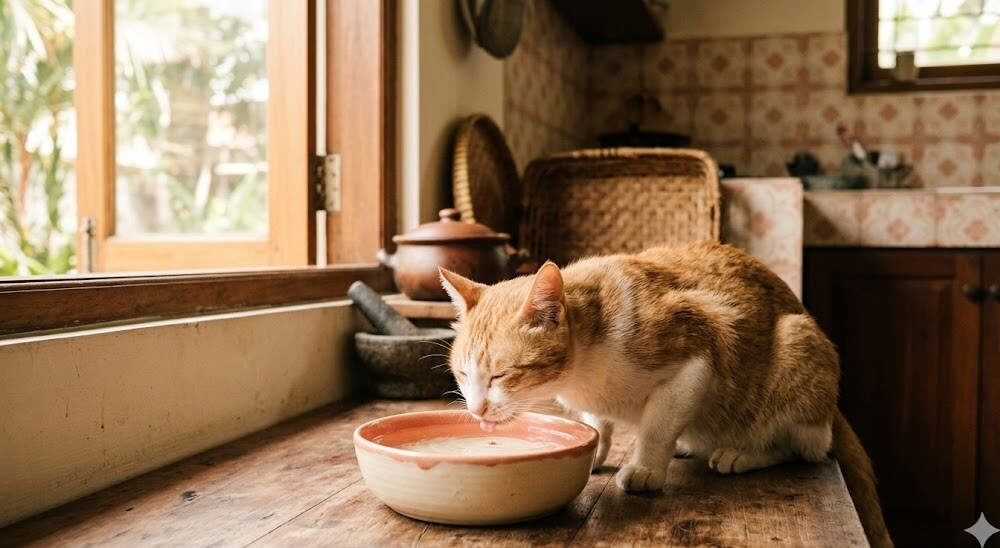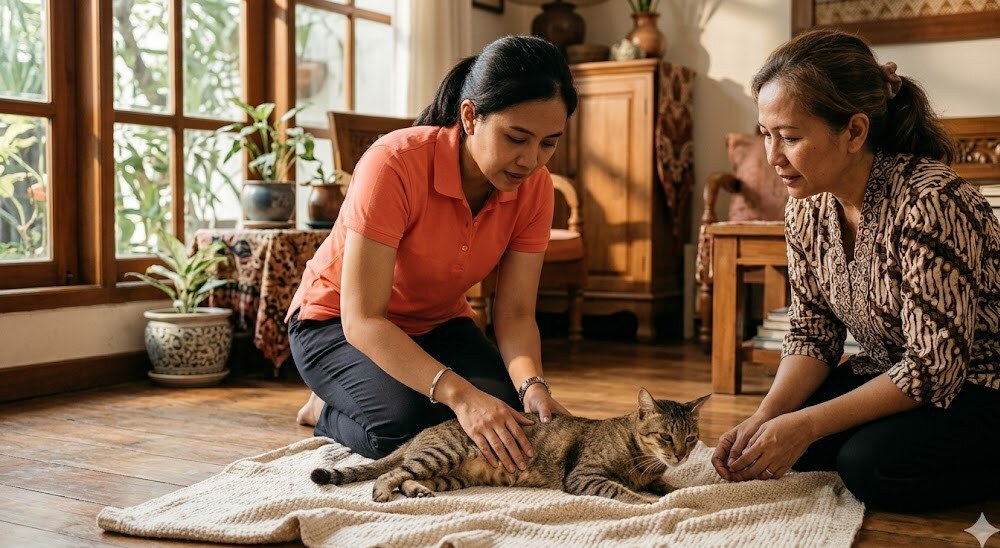

"My cat is 13 years old, and lately he eats voraciously, double the usual portion, but his body keeps getting thinner. He is also more hyper, often meowing at night, and sometimes vomits. Why is that?" This question comes up often to the Prabasa Vet team. The answer is often: hyperthyroidism, the most common endocrine disease in senior cats.
Hyperthyroidism is often called "the great masquerader" because its symptoms overlap with many other diseases (CKD, diabetes, cancer), and ironically the most characteristic sign, eating a lot but getting thinner, is often mistaken for "a healthy cat with a good appetite". In reality, this is an alarm signal.
This article helps you recognize the clinical signs of hyperthyroidism, understand how a vet diagnoses it with the Total T4 test, learn why hyperthyroidism often overlaps with CKD in senior cats, and the 4 treatment options available.
What is hyperthyroidism in cats?
Hyperthyroidism is a condition in which the thyroid gland produces excessive thyroid hormone (T4 and T3). In cats, the most common cause (about 98% of cases based on the ISFM Consensus 2016) is a functional adenoma, a benign enlargement of one or both lobes of the thyroid gland. The malignant form (carcinoma) is rare, about 1-2% of cases.
Thyroid hormone regulates the body's metabolism globally, if there is too much, all systems "run fast". The heart beats faster, the kidneys work harder, the nervous system becomes over-active, and the body burns calories faster than it can be replaced through food.
Hyperthyroidism is one of the most frequently diagnosed endocrine diseases in cats aged 10+ years. Various population studies show its prevalence rises significantly after age 10 , meaning that for senior cat owners, this is not a disease that can be considered "rare".
Why are senior cats prone to hyperthyroidism?
The exact cause of why senior cats tend to develop thyroid adenoma is still an area of active research. Several factors are often cited in the literature:
- Aging of thyroid tissue, natural degeneration that can trigger nodular hyperplasia
- Chronic exposure to certain substances, several observational studies highlight the potential role of fluctuating iodine content in commercial diets and exposure to certain chemicals (e.g. flame retardants in the home), although the causal link is not yet conclusive
- Genetic predisposition, some breeds (Siamese, Himalayan) are reported to have a lower prevalence, suggesting a genetic component
What is clear from population data: hyperthyroidism is almost never found in young cats. If your cat is 10+ years old, this is one of the main differential diagnoses when "thin but eating a lot" symptoms appear.
Clinical signs of hyperthyroidism, recognize the "eating a lot but thin" paradox
Hyperthyroid signs often appear gradually, over weeks to months, so owners are often only aware after a clear change is visible. The characteristic cluster of symptoms:
Polyphagia + weight loss (the classic paradox)
The cat eats more than usual, sometimes constantly asking for food, seeking food, aggressive when given food, but its body weight drops progressively. The cause: a "racing" metabolism burns calories faster than they can be replaced through food, so the body enters a catabolic state (breaking down muscle and fat reserves).
This is the sign most often detected late because owners often think "the cat is healthy, good appetite." Check at home: weigh the cat regularly (monthly for seniors). A 5-10% loss over a few months, accompanied by an increased appetite, is highly suggestive of hyperthyroidism.
Hyperactivity and restlessness
A cat that was once calm and slept a lot suddenly becomes more active, often pacing, unable to sit still. There is often a change in sleep patterns, awake at night, sleeping in short bursts during the day.
Excessive vocalization
Many hyperthyroid cats start meowing frequently for no clear reason, especially at night. The sound is sometimes louder or "panicked". This is often the main complaint of owners whose sleep is disturbed.
Vomiting and diarrhea
About 30-50% of hyperthyroid cats experience occasional vomiting (often after eating) and/or diarrhea. The cause is a combination: accelerated GI tract motility from thyroid hormone, and sometimes eating too fast because of the high appetite.
Unkempt fur, dry skin
A cat that usually grooms diligently suddenly has a dull, matted coat, or small clumps. Partly because the cat is too hyper for focused grooming, partly because the catabolic state also affects coat quality.
Tachycardia and secondary hypertension
Excess thyroid hormone makes the heart beat faster (tachycardia, often >200 bpm in moderate-to-severe hyperthyroid cats) and raises blood pressure. On physical examination, the vet can often feel the rapid heart rate and sometimes a murmur. If hypertension is uncontrolled long-term, serious complications can appear: retinopathy (retinal damage up to sudden blindness), secondary hypertrophic cardiomyopathy, accelerated kidney damage.
Other signs that may appear
- An enlarged thyroid gland that the vet can palpate in the neck (a small nodule)
- Rapid breathing (tachypnea) at rest
- Polydipsia (drinking a lot), often overlaps with CKD
- Muscle weakness, especially the neck that looks "bent" (ventroflexion)
If you notice the cluster of symptoms above in a senior cat, especially the eating-a-lot-but-thin paradox, do not wait. A simple Total T4 blood test can confirm or eliminate hyperthyroidism within 1 working day. For owners in Jakarta and Greater Jakarta who find it difficult to bring a senior cat to a clinic (hyperthyroid cats often experience severe stress in the car), WhatsApp Prabasa Vet for an initial discussion.
How a vet diagnoses hyperthyroidism: Total T4, free T4, T3 suppression test
Diagnosing hyperthyroidism is not based on symptoms alone, lab confirmation is mandatory. The common layered approach:
Total T4 (TT4), first-line test
The first blood test the vet requests if hyperthyroidism is suspected. Simple, cheap, available in many labs in Indonesia. Interpretation:
- TT4 clearly high (above the lab's normal range), combined with clinical symptoms, this is enough to diagnose hyperthyroidism in the majority of cases
- TT4 normal but symptoms suggestive, about 10-15% of cats with early/mild hyperthyroidism have a TT4 in the upper-normal range (false negative). This is often called "occult hyperthyroidism." It needs further testing
- TT4 high-normal/borderline, especially if there is another concurrent disease (CKD, infection), TT4 can be "pulled down" by non-thyroidal illness, further confirmation is needed
Free T4 (fT4), follow-up test
Measures the "active" fraction of T4 (not bound to protein). More specific for hyperthyroidism. Used when TT4 is borderline or there is non-thyroidal illness. Usually uses the equilibrium dialysis method (gold standard), not all labs in Indonesia run it, so ask your vet.
T3 suppression test (rarely used now)
A more complex test involving oral T3 administration for 2-3 days followed by T4 measurement. In a normal cat, T4 will be suppressed; in hyperthyroidism, it is not. Most modern protocols rarely use this test now because the combination of TT4 + fT4 + clinical symptoms is sufficient in many cases.
Thyroid scintigraphy (Tc-99m)
Imaging of the thyroid gland with a radioisotope, the gold standard for localizing abnormal thyroid tissue (important if planning I-131 or surgery). Not yet widely available in Indonesia, usually only at large university clinics or in Singapore.
Mandatory complementary examinations
Because hyperthyroidism is often comorbid with other diseases in senior cats, the vet usually requests a full panel at the initial visit:
- Complete blood panel, including creatinine, BUN, SDMA (check kidney function, often overlaps with CKD)
- Urinalysis, urine specific gravity, UPC ratio
- Blood pressure, secondary hypertension is common, needs separate management
- Cardiac examination, auscultation, sometimes echocardiogram if there is a murmur (check for hypertrophic cardiomyopathy)
- Eye (fundus) examination, check for hypertensive retinopathy
Hyperthyroidism vs CKD: why you must distinguish them and why they often overlap
One of the biggest challenges in managing senior cats: hyperthyroidism and CKD often appear together, and both can "mask" each other in lab results.
The mechanism that makes it tricky:
- Hyperthyroidism increases the glomerular filtration rate (GFR) → creatinine often "looks normal" or low-normal even when the cat actually also has CKD
- When hyperthyroidism is treated and metabolism returns to normal, GFR drops, and the "true" CKD is newly revealed, creatinine can suddenly rise after methimazole takes effect
- The reverse: advanced CKD that causes non-thyroidal illness syndrome can "pull down" T4 → masking hyperthyroidism
Practical implication: after starting hyperthyroid treatment (especially methimazole), the vet must monitor creatinine + SDMA within 2-4 weeks, then routinely. If previously hidden CKD appears, management becomes dual-disease, diet and medication are balanced carefully. Details on CKD management are in the article CKD in senior cats: signs, IRIS stages, and renal diet.
4 treatment options for feline hyperthyroidism
Per the ISFM Consensus 2016, there are 4 main treatment options for hyperthyroidism in cats, each with pros and cons. The choice depends on the cat's age, comorbid conditions, facility access, and the owner's budget.
1. Oral methimazole (lifelong)
An anti-thyroid drug that inhibits T4 production. Plumb's Veterinary Drug Handbook 7e lists methimazole as the primary medical treatment for feline hyperthyroidism. Given orally, usually 2x a day (or 1x a day for certain slow-release products).
Pro: Cheap, available, no special facility needed, reversible if there are side effects
Con: A lifelong commitment (does not cure, only controls), requires routine T4 + kidney monitoring every 1-3 months at first then 3-6 months, some cats are allergic or have side effects (anorexia, vomiting, facial pruritus, hepatotoxicity, rarely neutropenia)
Note: Methimazole is a prescription drug, do not give it without a vet. The dose and frequency are the vet's decision based on the baseline TT4 and response.
2. Transdermal methimazole gel
Methimazole made in a special gel base that is absorbed through the skin (usually the inner ear pinna). Useful for cats that completely refuse oral medication.
Pro: No fight during administration, owner-friendly, still reversible
Con: Compounding pharmacy (not available in every city in Indonesia), absorption can be less consistent, the price is higher than oral, still lifelong, the owner must wear gloves during application (transdermal absorption into human skin too)
3. Radioactive iodine (I-131) therapy, curative
The definitive treatment: the cat is given an I-131 injection that selectively destroys hyperactive thyroid tissue. Considered the gold standard in many countries because it is curative with a single treatment in the majority of cases.
Pro: Curative (no lifelong medication needed), very high success rate (90%+ of cats become euthyroid within 3 months)
Con: Requires a special facility with nuclear medicine licensing, in Indonesia access is very limited (the majority of owners must fly to Singapore or another country), relatively costly (plus travel costs), the cat must be isolated in the facility for 1-2 weeks post-treatment per radiation regulations, not suitable for cats with severe comorbidities (advanced CKD, unstable heart)
For owners in Indonesia, this is usually an option limited to cats that are relatively healthy aside from hyperthyroidism and owners with sufficient budget and a willingness to travel.
4. Surgical thyroidectomy
Surgical removal of one or both thyroid lobes. Rarely done now because there are simpler medical and I-131 options.
Pro: Curative if the adenoma is unilateral and the resection is complete
Con: General anesthesia in a senior cat that often has comorbidities = high anesthesia risk, risk of parathyroid gland injury (post-op hypocalcemia), if bilateral there is a risk of permanent hypothyroidism, many cats have ectopic thyroid tissue (in the mediastinum) that is not removed by surgery → recurrence
Bonus: Iodine-restricted diet (Hill's y/d)
An alternative approach: give a special commercial diet with very low iodine content (Hill's Prescription Diet y/d). Without enough iodine, the thyroid gland cannot produce excess T4.
Pro: No drug, no surgery, no radiation, appealing for cats that do not tolerate medication
Con: MUST eat y/d 100% exclusively (no other food at all, including treats; other cats in the home must eat separately on their own, no scavenging), this is often not realistic in a multi-cat household, the effect takes 2-3 months, not suitable if the cat has concurrent CKD (a renal diet has a different profile), some cats refuse the taste
Monitoring after starting treatment
Whatever the treatment choice, routine monitoring must not be skipped. For methimazole (the most common in Indonesia), the general monitoring pattern:
- 2-4 weeks post-start: recheck TT4, creatinine, BUN, SDMA, CBC (check for neutropenia), liver enzymes, adjust the dose based on TT4
- 3 months post-start, then every 3-6 months: recheck TT4 + kidney + blood pressure
- Every routine visit: body weight, body condition score, blood pressure
- Any time new symptoms appear: vomiting, anorexia, lethargy, facial scratching/itch, bleeding, report to the vet (could be drug side effects)
FAQ on feline hyperthyroidism
My cat is 12 years old, chubby and does not look hyper, should I still worry about hyperthyroidism?
Possibly. Not all hyperthyroid cats show the classic thin paradox, some early/mild cases still have a normal or even obese weight. For cats 10+ years old, annual senior screening (which includes TT4) can catch hyperthyroidism before severe symptoms appear.
Can feline hyperthyroidism be cured completely?
Only with successful I-131 or thyroidectomy. Methimazole and an iodine-restricted diet = symptom control, not a cure, if stopped, T4 will rise again.
Can I use a human drug (methimazole for human hyperthyroidism) on a cat?
Methimazole is the same molecule, but the dose for a cat is very different from a human's, and the formulation and dosing schedule must be calculated by a vet. DO NOT self-medicate with a human drug, the overdose risk is high and without proper lab monitoring it can be fatal.
How much does managing a hyperthyroid cat cost per month in Jakarta?
It varies greatly and is hard to pin to a fixed number because it depends on several factors: the treatment choice (generic oral methimazole is usually the most economical, transdermal gel and the special diet are more expensive, while I-131 or surgery is a much larger one-time option), the drug dose and brand, the frequency of TT4 + kidney blood monitoring (more often early on, then less frequent), and whether there is a comorbidity such as CKD that adds to the test panel. For an estimate tailored to your cat's condition, reach out for a free WhatsApp consultation with Prabasa Vet. For an overview of routine home visits, a breakdown of South Jakarta home visit services for 2026 is here.
How long can a hyperthyroid cat live?
With good control, many hyperthyroid cats can live several more years with a good quality of life. The prognosis depends on the presence of comorbidities (especially CKD, which often coexists), the age at diagnosis, and monitoring compliance. Cats with well-controlled hyperthyroidism and no severe comorbidities can often live 3-5 years or more from diagnosis.
Can hyperthyroidism be prevented?
There is no well-established prevention strategy yet. What can be done: routine senior screening (TT4 + kidney panel + blood pressure annually for cats 10+ years old) so that if it appears, it is detected early when treatment is most effective.
Conclusion
Hyperthyroidism in senior cats is a serious but very manageable disease when diagnosed and treated correctly. Many hyperthyroid cats that are managed well can return to a normal body weight, stable energy, and a good quality of life, even several additional years with the condition controlled.
The key point: do not ignore the "eating a lot but thin" paradox in a senior cat. This sign is often dismissed ("my cat's appetite is good"), when in fact it is one of the most characteristic alarm signals of hyperthyroidism. A simple TT4 blood test can confirm it within 1 working day.
For senior cat owners in Jakarta and Greater Jakarta who find it difficult to bring an old cat to a clinic (a hyperthyroid cat that is already hyper often experiences severe added stress in the car), WhatsApp Prabasa Vet for an initial discussion, we help assess the situation and schedule a visit for blood sampling at home.
Read also: CKD in senior cats: signs, IRIS stages, and renal diet, Senior cat at 10 years: changes and geriatric care, Signs of a sick cat that needs to see a vet promptly, Pet care guide (pillar).
Medical references used in this article
This article was prepared with reference to the following sources, verified per clinical sentence:
- Carney HC, Ward CR, Bailey SJ, et al. 2016 AAFP Guidelines for the Management of Feline Hyperthyroidism. Journal of Feline Medicine and Surgery (JFMS) 2016 , clinical staging, diagnostic algorithm, and treatment framework (ISFM/AAFP consensus)
- AAFP Senior Care Guidelines for Veterinarians, screening protocol for cats 10+ years old, monitoring comorbid hyperthyroidism + CKD
- Mooney CT, Peterson ME. Canine and Feline Endocrinology 4th ed (Feldman, Nelson, Reusch, Scott-Moncrieff), pathophysiology of thyroid adenoma, differential T4 interpretation, treatment modality comparison
- Plumb's Veterinary Drug Handbook 7e, methimazole dosing for cats, contraindications, monitoring requirements, ibandronate for hypercalcemia complications
This article is general guidance based on international AAFP/ISFM guidelines + veterinary endocrinology textbooks. For diagnosis and a treatment plan for your cat's specific hyperthyroidism, including interpretation of lab results, choice of drug and dose, and integration with other comorbidities, consulting a veterinarian is the right step.