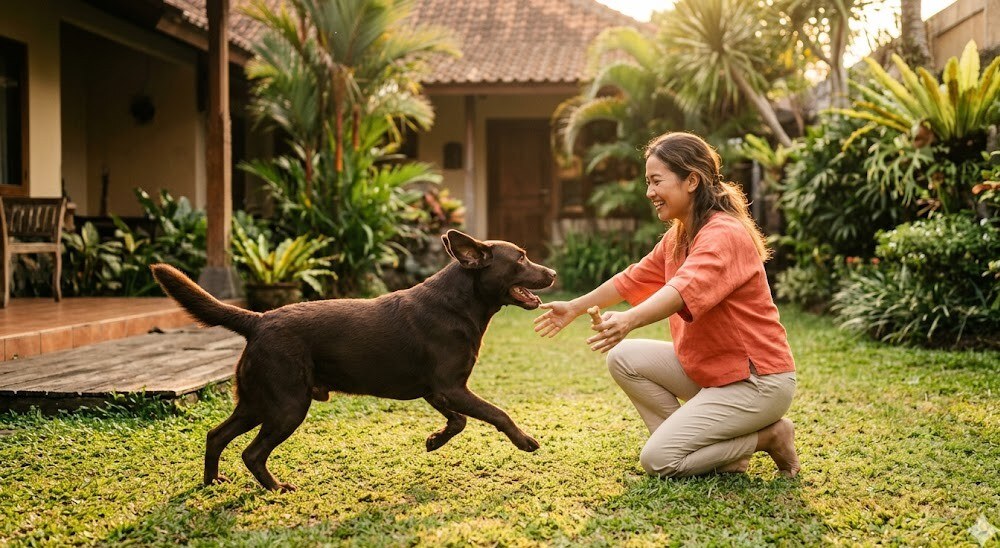

Almost every new puppy owner has experienced this moment: just bought a cute pink leash, an adorable new harness, with the romantic plan of an evening stroll with the little dog, then reality slaps you: the puppy stands frozen and won't walk, or the opposite, pulls and tugs like a mini sled dog that wants to go everywhere except toward you. Frustration comes quickly: "Why is this so hard, it looked easy on YouTube."
The good news is that leash training is one of the skills that most consistently succeeds if done with the right approach, gradual, positive reinforcement, with equipment suited to the puppy's age and physique. The less good news: most owners jump straight to the "walk outside the house" step without an indoor foundation, and it almost always ends with a dog that pulls for years, or worse, becomes completely afraid of the leash.
This article is a complete step-by-step guide from the early phase (puppy not yet fully vaccinated, still inside the house) to a puppy that is outdoor-ready and can walk on a loose leash. It includes how to choose safe equipment, reward-based protocols, common mistakes that ruin training, and when you need help from a vet or a certified trainer. Disclaimer: this is a general guide based on international behavior guidelines, not a substitute for a direct consultation for specific cases with high reactivity, severe fear, or a history of trauma.
When to start leash training a puppy
Short answer: as soon as the puppy comes home, usually 8-10 weeks of age. But what needs to be clearly separated are two phases:
Phase 1: Indoor familiarization (8-10 weeks until full vaccination)
Before a puppy may set foot on public ground (parks, sidewalks, alleys), which usually waits until 1-2 weeks after the full puppy vaccination series at around 16 weeks of age, all early leash training is done indoors. The goal of this phase: the puppy becoming familiar with the sensation of the collar and leash on its body, not immediately learning to walk formally.
This also aligns with the primary socialization window (3-12 weeks) emphasized by the AVSAB Position Statement on Puppy Socialization, a critical period when the puppy is most receptive to new experiences. Introducing the equipment in this phase, with positive associations (treats + a calm voice), builds a foundation that is hard to reverse if started too late.
Phase 2: Outdoor socialization (16+ weeks, post-full-vaccination)
After the core puppy vaccines are complete and the vet confirms the puppy is ready for outdoors (usually 7-10 days after the last vaccine for full immunity to develop), leash training then moves to public environments gradually: the home yard → quiet alley → sidewalk → busier areas. While simultaneously closing the primary socialization window with controlled exposure to sounds, people, and other dogs, per the AAHA Canine Behavior Management Guidelines.
A note for owners in dense housing complexes: if the home yard is enclosed and safe, the yard can be used as a bridge between indoors and the public sidewalk even before full vaccination. What's avoided is public ground where other dogs can pass and leave contaminants (especially parvo, which is persistent in soil).
Choosing safe leash training equipment
The wrong equipment is the #1 cause of leash training failure, not only ineffective, but it can physically injure the puppy. Here's an honest breakdown, referencing the AVSAB Position Statement on Humane Dog Training and Fear Free Pet Professional protocols:
Flat buckle collar: MANDATORY for an ID tag
Every dog, puppy or adult, should always wear a flat buckle collar (a fabric/nylon collar with a flat buckle) to hold an ID tag + the owner's phone number. This isn't for training, it's for safety: if the puppy gets loose/lost, this tag is the main lifesaver.
- Size: it must fit, 2 fingers fit between the collar and the puppy's neck. Not looser (slip-off risk), not tighter (chafing + tracheal restriction).
- Material: lightweight nylon or soft leather. Avoid metal chains for a puppy.
- Adjust frequently: puppies grow fast, check every 1-2 weeks, adjust or change the size.
DO NOT pull on a leash attached to the flat collar when the puppy pulls. A puppy's trachea is still delicate, and a hard pull on the neck can cause laryngeal injury or tracheal collapse. The flat collar is for ID + a home grab point (around the door, in the yard), not for training force.
Y-front no-pull harness: the default choice for training
For training sessions and daily walks, a no-pull harness with a Y-front design is the choice most consistently recommended by modern behavior references. Characteristics:
- Ergonomic Y-front design: the front strap forms a Y that stops at the sternum (breastbone), not pressing on the trachea or restricting shoulder (scapula) movement. The dog can walk naturally without a changed gait.
- 2 leash attachment points: one on the back (back-clip, for dogs already loose-leash trained), one on the chest (front-clip, while the puppy still pulls, the front-clip redirects direction when pulling, effective without physical punishment).
- Soft padding: at the sternum and armpit areas, reducing chafing on long sessions.
- 4-5 point adjustment: for a precise fit (important because a puppy's body proportions change quickly).
Avoid cheap "step-in" harnesses where the front strap runs horizontally across the chest, this design restricts the shoulder's range of motion and can contribute to orthopedic problems in a still-growing dog. Choose a Y-front even if it's slightly more expensive.
Leash: standard 1.2-1.8 meters, fixed-length
- Material: lightweight nylon/canvas for small puppies; biothane or leather for large dogs.
- Length: 1.2-1.8 meters standard. Gives the puppy room to sniff (important for mental decompression) but stays manageable.
- Handle: a padded loop for your grip comfort.
Equipment to AVOID for early training
1. Retractable lead (flexi-lead)
It seems practical, but it's not suitable for early training at all. Reasons: the thin, long cord teaches the puppy that "pulling = getting more space" (the mechanism opposite of loose-leash), the plastic handle doesn't give sudden control when there's danger (another dog, a passing motorbike), and there have been many injuries (cuts to the owner's fingers/hands when the cord goes taut, neck injuries to the dog on a sudden stop). Some cases have also reported a retractable lead snapping and causing the dog to run loose into traffic.
It may be used for an adult dog already loose-leash trained, in a safe open area (a field, an open park), not for a puppy still learning.
2. Choke chain
The AVSAB Position Statement on Punishment explicitly recommends avoiding aversive collars including choke chains. The mechanism relies on pain/pressure to suppress behavior, which is not only ineffective long-term, but is proven to associate the pain with the stimulus being faced (often another dog, a person, the environment), creating new reactivity or fear. For a puppy whose nervous system is still developing, this impact can be more persistent.
3. Prong collar
The same as a choke chain, aversive-based, not recommended. Promoters often argue "used correctly it doesn't hurt," but research consistently shows a correlation with increased stress signals (whale-eye, lip-licking, redirected aggression). A modern no-pull harness can achieve the same goal (reducing pulling) without an aversive mechanism.
4. Head halter (Gentle Leader, Halti, etc.)
Not forbidden, but it needs a very gradual introduction (1-2 weeks with a treat trail), if put on by force, most dogs hate the sensation of a strap on the muzzle and develop an aversion. For a new owner without trainer supervision, a Y-front no-pull harness is a safer and easier choice.
Step-by-step leash training intro
Total process duration: 2-4 weeks for a typical puppy, longer for a fearful puppy or one that already has a previous negative experience. Consistency matters more than speed.
Step 1: Collar acclimatize indoors (Days 1-3)
- Put on the flat buckle collar at a proper size. When the puppy seems bothered (clawing at the collar, stopping and sitting passively), distract with a treat, a toy, or a meal. Don't take it off right away, that teaches "if I claw, the collar comes off."
- Wear the collar for 30 minutes in the first session, increasing gradually to all day (remove it during sleep for safety).
- Reward calmly with a "good" voice + the occasional treat, not over-celebrating (which actually makes the puppy too focused on the new collar).
Step 2: Leash drag freely indoors (Days 4-6)
- Attach the leash to the harness/collar, let the puppy drag the leash freely on the indoor floor for 5-10 minutes per session, 2-3× a day. Don't hold the end of the leash yet.
- Goal: the puppy becoming familiar with the sensation of the leash's weight on its body, without immediately associating "leash = something pulling from behind."
- Keep watching so the leash doesn't get caught on a table leg or an object that could panic the puppy.
Step 3: You follow the puppy (Days 5-8)
- Hold the end of the leash, but you follow the puppy, not the other way around. No destination, no pulling. The puppy leads, you just "exist" at the end of the leash with a loose slack.
- Reward when it happens to turn toward you, "good" + a small treat.
- Goal: building the association "leash on = good things keep happening, no scary control."
Step 4: Puppy follows you with a lure (Days 7-10)
- Hold a treat at the puppy's nose height (roughly at your knee), get it to follow you 3-5 steps, then reward "good" + give the treat.
- Repeat with gradually greater distance. This is the early phase of "puppy follows you", the foundation of loose-leash walking.
- Don't pull the leash when it stops. If it stops, wait, call in a cheerful tone, treat at the target position, not a pull.
Step 5: Teach the heel position with luring (Days 10-14)
- "Heel position" = the puppy walks on the left side (or your consistent choice) with its head level with your knee.
- Lure with a treat in the heel position, walk 3 steps, reward. Gradually extend to 5, 10, 20 steps.
- You can use a marker word ("yes!") or a clicker, the Karen Pryor Academy protocol: click when the puppy is in the correct position, treat 1-2 seconds later. Precise timing forms a clean association.
Step 6: Loose-leash walking concept (Days 12-21)
This is the main concept that distinguishes successful vs failed training:
- When the leash is taut (puppy pulls) = you stop completely. Don't walk, don't pull back, don't nag. Be still.
- When the leash is loose (puppy eases the tension) = you continue walking + reward "good".
- The mechanism taught: leash tension = walking stops, slack = walking continues. The puppy quickly learns that pulling doesn't produce more space, it actually stops the walk.
100% consistency is crucial. If on weekdays you stop every time the puppy pulls, but on weekends (because you're in a hurry) you let it pull all the way to the destination, you're teaching intermittent reinforcement, one of the patterns hardest to extinguish.
Step 7: Gradual outdoor socialization (16+ weeks)
- After full vaccination, start from the home yard → quiet alley in the morning → sidewalk when it's not busy → gradually busier areas.
- Outdoor distractions (new smells, people, other dogs) require re-establishing the training, the expectation that a puppy that heels perfectly indoors will immediately perform on the sidewalk = unrealistic.
- Bring high-value treats (chicken, small bits of cheese, sausage) for outdoors, ordinary kibble loses out to the new environmental smells.
Reward-based protocol: timing and treat choice
Marker (clicker or marker word)
A "marker" is a consistent acoustic signal that marks "this behavior is correct, treat coming". Options: a clicker (most precise, needs initial charging) or a marker word ("yes!" consistently in one tone). Once charged (the puppy consistently expects a treat after the click/marker), you can mark exactly at the moment of the behavior you want to reinforce, even if the treat only arrives 2 seconds later.
Treat hierarchy
- Low-value (indoors, minimal distraction): daily kibble, ordinary dry pieces
- Mid-value (yard / formal training session): soft commercial training treats, small pieces of plain boiled chicken
- High-value (outdoors, high distraction, challenging training): small pieces of plain fried chicken, ½ a pinky finger of cheese, thinly sliced chicken sausage
Match the treat value to the difficulty level of the training. Outdoors on the sidewalk using ordinary kibble = beaten by 100 new smells = the puppy won't listen.
Training session duration
A puppy's attention span is short: 5-10 minutes per session of formal training, 2-3 sessions per day. Longer than that and they start to disengage or get frustrated. Short, frequent sessions are far more effective than one long session.
Common mistakes to avoid
1. Dragging the puppy by force
The puppy freezes on the sidewalk, you pull the leash to make it walk. This teaches: outdoors = the uncomfortable sensation of a pull on the neck/chest. A dog dragged repeatedly from a young age often becomes shutdown or fearful on walks as an adult. Solution: wait, lure with a treat, coax with a cheerful voice, give it time. If it's truly frozen, end the session, try again later with a different strategy (perhaps a different, less overwhelming location).
2. Punishing when the puppy pulls
A leash jerk, scolding, or a physical gesture when the puppy pulls does not teach loose-leash, what the puppy learns is: pulling the leash = something unpleasant happens. If when it pulls it's looking at another dog, the association becomes: other dogs = something unpleasant. This is what often creates leash reactivity in adulthood. The AVSAB Position on Punishment emphasizes: punishment-based training increases the risk of fear and aggression problems.
3. Expecting it too fast
An owner sees a TikTok reel of a 12-week-old puppy heeling perfectly in a busy park, then is disappointed because their 14-week-old puppy still pulls. What isn't shown in the reel: that puppy's training was already hundreds of repetitions over 6-8 weeks, possibly with a certified trainer, and the footage chosen is the best moment. Realistically: solid loose-leash walking takes 2-6 months of consistency, and busy outdoor areas (a weekend park, a dog park, areas with many distractions) remain challenging even for a trained adult dog.
4. Owner inconsistency
Day 1: stop when it pulls. Day 2: tired, let it pull to the destination. Day 3: feeling sorry, just carry it. Day 4: angry because it still pulls. This pattern = intermittent reinforcement, the hardest to extinguish. Solution: commit to 1 consistent method for 4-6 weeks. If you're in a hurry, don't train, just do a quick potty break, train later when you have 15 focused minutes.
5. Skipping the indoor foundation
Many owners immediately buy a leash + harness, put it on a 9-week-old puppy, and take it straight outside (or even before full vaccination). Without the indoor familiarization phase, the puppy is sensory-overwhelmed (new collar, new leash, new location, new sounds, new smells). Solution: follow the Step 1-7 sequence. A 2-week indoor foundation is far more effective than 2 months of outdoor brute force.
6. A long walk on the very first day
Excited that the last vaccine is done, you immediately take the puppy on a 30-minute walk to the park. The puppy is exhausted, overstimulated, and associates "outdoors = exhausting, overwhelming". Solution: the first outdoor outing should be only 5-10 minutes, a quiet location, with the main goal being exploration + sniffing, not distance.
7. Forgetting sniff time
Dogs read the environment through their nose, that's their main cognitive enrichment. An owner who pulls every time the puppy stops to smell something ignores the mental needs of the species. A general rule: 50% of the walk's duration for movement, 50% for sniff time. An adult dog allowed to sniff freely on the walk comes home calmer and less destructive at home.
When you need professional help
Consult a vet or a certified trainer (Karen Pryor Academy, IAABC, or an equivalent force-free certification) if:
- The puppy shows extreme fear of the leash or outdoors, tremors, involuntary urination/defecation, panic vocalization, or total shutdown (lying down, refusing to move), it likely needs a structured desensitization protocol
- Leash reactivity has appeared (lunging, barking, growling at the sight of certain dogs/people), the earlier it's addressed, the better the prognosis
- The puppy is already an adult but was never leash-trained, not impossible, but it needs a specific modified protocol
- You've been consistent for 4-6 weeks with the protocol above but there's no progress at all
- The puppy shows orthopedic problems (abnormal gait, limping after a short walk, refusing to walk in a specific direction), medical causes need to be ruled out (hip dysplasia, panosteitis in large-breed puppies, etc.)
For cases of reactivity or severe fear, a home visit behavior consultation is valuable because the vet/trainer can observe the setup in the puppy's environment (the home location, the usual walking route, the family dynamic) before designing a protocol. The puppy is also more relaxed in its own home than at a clinic, the behavior assessment is more accurate.
Leash training puppy FAQ
My puppy is 3 months old and not allowed outside yet, how do I start training?
This is actually the ideal timing for Steps 1-5 (all indoors). Collar acclimatize, leash drag freely indoors, follow the puppy, lure-follow you, and basic heel position, all can be done in the living room, hallway, or an enclosed yard. When vaccination is complete and the vet gives the green light for outdoors, the puppy already has a solid heel foundation + a positive leash association. Outdoors then becomes just generalization, not a total introduction.
What's the difference between a harness and a collar for training?
A flat buckle collar = primarily for ID (the owner's number tag) and an emergency grab handle. Not for pulling training because of the tracheal injury risk. A Y-front no-pull harness = for attaching the leash daily + training sessions, distributing the pressure to the chest/sternum which is more durable. Ideally the puppy wears a collar (always, for the tag) + a harness (when out / training). The leash is clipped to the harness, not the collar.
My dog is already an adult and has been pulling for 3 years, can it still be retrained?
Yes, but it needs more patience (3-6 months vs 2-4 weeks for a puppy) because the pulling pattern is already deeply reinforced. The protocol is the same: switch to a Y-front front-clip no-pull harness, apply "stop when taut, continue when slack" with 100% consistency, marker training to reward the loose-leash moment. Many adult dogs that initially seem "hopeless" succeed at retraining with owner consistency. If stuck, consult a force-free trainer.
Can I use a leash jerk occasionally if it pulls hard?
Consistent with the AVSAB Humane Dog Training guidelines, the answer is it's not recommended. Besides the risk of physical injury to the dog's neck, a jerk creates an association of discomfort with whatever it's looking at (often another dog/person), risking leash reactivity. The "stop when taut, continue when slack" approach + redirecting to a front-clip harness can achieve the goal of "the dog doesn't pull" without an aversive.
How long should a training session be per day?
For a puppy: 2-3 short sessions of 5-10 minutes/session. Total: 15-30 minutes of active training per day. The rest: passive exposure (leash on while at home while you work, so the puppy is familiar without a formal session). A direct long session of 30-60 minutes is usually counterproductive, the puppy's mental capacity is exceeded, the training backfires.
Can Prabasa Vet make a home visit for a puppy behavior consultation?
Yes. For cases of reactivity, leash fear, or a puppy stuck at one of the training steps, a home visit gives an advantage: the partner vet can observe the actual setup (the walking route, the home environment, the family dynamic, the equipment used) and give realistic recommendations for your situation. At the same time, they can screen general health and the vaccination schedule for the puppy. Contact us via WhatsApp, mention the breed + age of the puppy + the problem it's experiencing + your area, the team will schedule an evaluation with a local partner vet.
Closing
Leash training a puppy isn't about subduing the dog into obedience, it's about building communication and positive associations so the puppy chooses to walk near you because that's where the reward is (treats, a positive voice, an enjoyable walk). Safe equipment (a flat collar for ID + a Y-front no-pull harness for training), an indoor foundation before outdoors, and 100% consistency on the "stop when taut, continue when slack" protocol, the three main pillars.
What often causes failure: skipping the indoor foundation, equipment that hurts (choke chain, prong, retractable lead for early training), owner inconsistency, and unrealistic expectations. Avoid these, follow the gradual protocol, and the majority of puppies will be loose-leash walking well within 2-3 months.
Need a consultation or to schedule a home vet visit for your puppy's leash training / behavior? Contact us via WhatsApp, mention the breed, age, and the situation you're experiencing, and our team will help schedule an evaluation with a partner vet in your area.
Read also: Crate Training a Puppy: Step-by-Step, Benefits, and Avoiding Common Mistakes, Adopting a Puppy: A Complete New Owner Checklist, How to Manage a Dog That's Afraid of the Clinic, Pet Care Guide.
Medical references used in this article
This article was prepared with reference to the following sources, verified clinical sentence by sentence:
- AVSAB (American Veterinary Society of Animal Behavior) Position Statement on Humane Dog Training, recommendation for reward-based methods, avoiding aversives (choke/prong/shock)
- AVSAB Position Statement on Punishment in Dog Training, risk of fear + aggression from punishment-based methods
- AVSAB Position Statement on Puppy Socialization, primary socialization window 3-12 weeks, integration of controlled exposure
- AAHA (American Animal Hospital Association) Canine Behavior Management Guidelines, best practice for training puppies + adults
- Karen Pryor Academy Positive Reinforcement Training Principles, clicker/marker protocol, timing, gradual progression
- Fear Free Pet Professional Education, equipment introduction protocol, positive associations, force-free handling
- BSAVA Manual of Canine and Feline Behavioural Medicine 2nd Edition, chapter on leash reactivity, puppy training fundamentals, troubleshooting
- Overall KL. Manual of Clinical Behavioral Medicine for Dogs and Cats, diagnostics + protocols for established leash reactivity
This article is a general guide based on international canine behavior guidelines. For your puppy's specific condition, including breed, history before adoption, medical conditions, and household dynamic, consulting a veterinarian or a certified force-free trainer is the right step. Leash training should not be used as a substitute for adequate exercise, controlled socialization, and the daily social interaction a puppy needs.