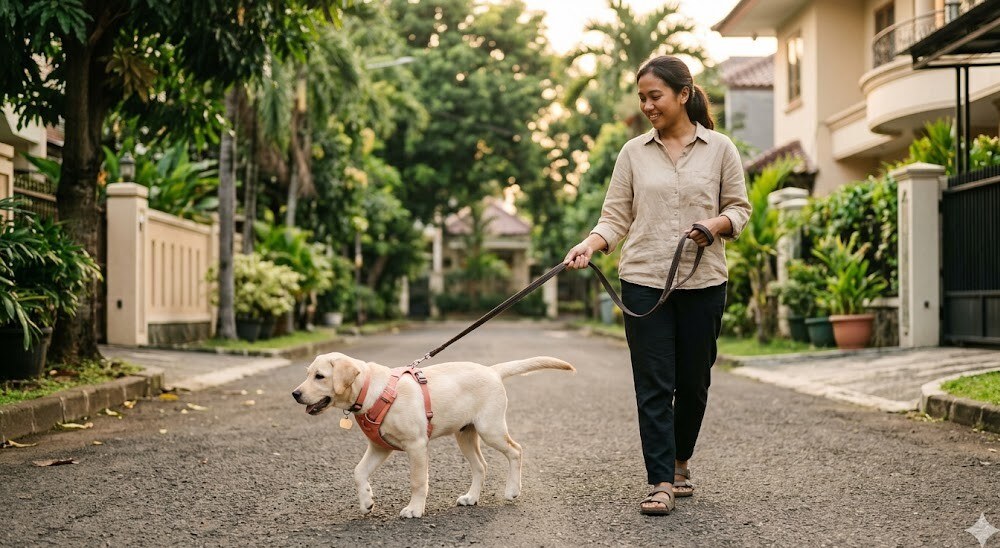

Of all the skills you can teach your dog, recall is the most important, literally a lifesaver. A dog that comes back 100% of the time when called is a dog that stays safe when the gate suddenly opens, when the leash snaps at the edge of a busy road, when it chases something out of sight, or when at a dog park it runs toward a reactive dog. Sit, paw, roll over, those are tricks. Recall, that is a safety net that can be the difference between a dog coming home healthy vs a tragic story in the neighborhood WhatsApp group.
But recall is also the skill owners most often unintentionally sabotage. The majority of adult dogs that "won't come when called" actually used to come back just fine, until the owner consistently associated recall with negative things (a bath, the leash going on to go home, scolding, being crated). The recall cue becomes "poisoned", the dog learns that coming back = end of fun, so it chooses to ignore it.
This article is a complete step-by-step guide to building a solid recall from puppyhood as well as retraining an adult dog that has gone "deaf" to its name. It includes the philosophy that is fundamentally different from punishment-based training, the common mistakes to avoid (many of them counterintuitive), the long-line transition protocol, and the reality of off-leash in an urban Indonesian context. Disclaimer: this is a general guide based on international behavior guidelines, not a substitute for a direct consultation for cases of extreme high prey drive, extreme fear, or a history of severe trauma.
Why recall = the #1 most important skill
An inconsistent sit = a dog that sits late for a photo. An inconsistent recall = a dog that runs onto the main road when the gate is accidentally left open.
Real scenarios where recall saves a life:
- The fence/gate accidentally left open, a delivery courier, a neighbor's child playing, a family member in a rush. A dog with a solid recall comes back when called before it gets too far.
- The leash snaps / slips from the handle at the edge of a main road. Without recall, the dog chases something (a passing cat, a motorbike, etc.) straight into traffic.
- A dog park / off-leash area where another dog is reactive or aggressively approaching, recall pulls your dog away before a physical conflict.
- Tracking a lost dog, a dog already lost in a complex or in the forest while traveling can often be pulled back with a familiar recall cue.
- Toxic ingestion incoming, a dog heading for a carcass/trash/toxic substance in a park, recall pulls it away before it bites.
Statistics in the veterinary literature note that vehicle trauma ("HBC, hit by car") consistently ranks in the top 5 causes of death and serious injury in pet dogs in urban areas, and the majority of cases involve a dog that got loose without direct supervision. A solid recall is not an absolute guarantee, but it is the strongest defensive layer you control.
Recall philosophy: a dog comes because it WANTS to, not out of fear
This is the fundamental difference that separates successful vs failed training. The majority of owners unknowingly use the "control via consequence" model, the dog comes back so it doesn't get scolded, hit, or crated. This model has 3 major problems:
- Unreliable in high-arousal moments, when the dog chases a cat/motorbike, the fight-or-flight drive overrides the memory of past punishment. A skill trained via fear collapses precisely in the most critical moment.
- The dog learns to avoid the owner, if "coming back = often a negative consequence," a rational dog will delay coming back or look for an escape. Many cases of "the dog ran away and won't be caught" are the result of punishment-based training.
- Cannot be relied on in an emergency, in the moment you most need recall (real danger), a dog confused between fear vs curiosity will freeze or run further.
The alternative model (per the AVSAB Position Statement on Reward-Based Veterinary Behavior Modification): a dog comes back because you have something more valuable than whatever it is chasing. Super high-value treats, a cheerful voice, a favorite toy, a party as if it just won the lottery. Recall becomes one of the most enjoyable experiences in the dog's day, so it chooses recall even when something else interesting is around.
This is not permissive parenting. It is behavioral realism: positive motivation is stronger and more stress-resistant than avoidance motivation. Force-free trainers and modern behavior vets (ACVB) consistently find that dogs that recall via positive reinforcement also recall in an emergency, while dogs that recall via punishment often fail precisely in the critical moment.
Step-by-step recall training protocol
Total duration to reach a "reliable recall in a busy outdoor environment": 6-12 months of consistency for most dogs. Recall is not a skill that is "finished", it is a skill you maintain throughout the dog's life with regular repetition.
Step 1: Choose a unique cue word
Do not use the dog's name alone as the recall cue, its name is used daily for many things (calling it to eat, calling it for a bath, getting angry because it chewed the sofa), so the association is inconsistent. Choose one specific cue that is only used for recall:
- "Come" or "Sini" (Indonesian), simple, easy to say consistently
- "Here", a clear alternative
- A short, firm whistle, great for long distances, not affected by the emotional tone of your voice
A good combination: the dog's name + the recall cue, "Bruno, come!", the name gets attention, the cue triggers the behavior.
After choosing the cue, the whole family must use the same cue. If you use "sini," your partner uses "come," and the helper uses "balik", the dog gets confused and no cue gets strongly reinforced.
Step 2: Indoor close range, charge the cue with high-value rewards
- First session: indoor, an enclosed room with no distractions, the dog no more than 2-3 meters from you.
- Say the cue ("Bruno, come!") once, in a cheerful tone, not a harsh command, but a joyful invitation.
- When the dog comes (or even just turns to look at you in the early sessions), party: 3-5 pieces of high-value treats (boiled chicken, cheese, small sausage), a cheerful voice "good boy! yes! good come!", a chest rub if it likes that.
- Repeat 5-10 times per session, 2-3 sessions a day in the first week.
- Goal: the recall cue becomes a predictor of amazing things, the dog hears the cue, and its brain releases dopamine in anticipation of a reward.
Step 3: Gradual distance increase
- Week 2-3: extend the distance, 5 meters, 10 meters, from another room.
- The dog cannot see you (calling from behind a wall), testing whether the cue is strong enough without a visual.
- Keep rewarding as in week 1 , high-value, party voice. DO NOT reduce the reward in Step 3; in fact, if there is an upgrade in difficulty, the treat upgrades too.
Step 4: Gradual distraction (at home)
- Week 4-6: add indoor distractions, a favorite toy in the middle of the room, a treat on the floor (not a reward from you), the TV on, other family members chatting on the sofa.
- Recall amid these distractions = harder. Start with the mild ones (TV on) and move to the heavy ones (a treat on the floor, the dog focused on the treat).
- If it fails the recall because the distraction is too strong, do not repeat the cue loudly. Step back to a milder distraction, build up gradually.
Step 5: Gradual environment (controlled outdoor)
- Month 2-3: outdoor with a long-line (5-10 meters, see the dedicated section below), backyard, a quiet alley in the morning, a park when it is empty.
- Natural sniffing session, let the dog explore, then cue recall when it is 3-5 meters away.
- Every successful recall = jackpot reward + cheer.
- Every failed recall = the dog is not yet at a distance/distraction level matching its training progress. Step back, do not force.
Step 6: Higher distraction environment (gradual)
- Month 4-6: other dogs in the distance (then nearby), busier areas, a public park on the weekend, a dog park.
- Still use the long-line for safety, if the recall fails amid high distraction, the line prevents the dog from getting too far or into danger.
- Extra high reward in this environment, you are competing with the sensory world outside.
Step 7: Lifetime routine practice
- Even after the recall is "solid," do 10+ repetitions a day in random contexts (the dog is sleeping in the bedroom, playing in the backyard, chewing a toy), each with a reward.
- Lifelong consistency prevents cue decay. A recall that hasn't been rehearsed for 6 months will weaken again.
Common mistakes that actually poison the recall
This section is the most important, because many well-intentioned owners actively damage their recall without realizing it. The seven most common mistakes:
1. Calling when the dog definitely won't come
The dog is chasing a cat across the yard. You call "Bruno, come!", it clearly ignores you. You call again, louder. And again. It keeps chasing the cat.
What just happened: the dog learned that the recall cue = optional. "Bruno, come!" heard repeatedly with no follow-through consequence (you can't physically enforce it from that distance) → the cue becomes background noise.
Solution: Never call if you can't enforce it. If the dog is chasing and you know it won't come back, don't shout the recall, chase physically or distract with another sound (a new whistle, the sound of a treat bag). The recall cue must stay "magic", always honored by the dog.
2. Calling for negative things
"Come, bath time!" The dog comes back hesitantly, immediately gets caught, and is carried to the bathroom (which it dislikes). "Come, leash on!" the dog comes, the leash goes on, the walk is over, into the house. "Come, into the crate!" the dog comes, gets locked up.
This pattern very quickly teaches the dog: recall = end of fun. It starts to delay coming, or avoids recall entirely.
Solution: recall must be 80-90% recall to pleasant things: treat, party, then released to play again. Only 10-20% of recalls end in something the dog doesn't love (bath, end of walk), and even for those, compensate with a super high-value treat so it isn't too net-negative.
For things the dog hates (bath, examination), do not use the recall cue at all. Go to it physically, put the leash on in place, or say a different cue (e.g. "let's go to the bathroom", a separate cue not linked to recall).
3. Getting angry when it finally comes
The dog escapes the gate, runs to the road. You chase it for 15 minutes, and it finally comes back on its own (or you manage to catch it). Out of frustration + fear, you scold it harshly, give a light smack, lock it in the crate.
From the dog's perspective: I came back → I got scolded. Its logic: next time, come back slower or don't come back at all. You just destroyed a lifetime of recall in one moment.
Solution: NEVER punish your dog when it comes to you, even if the process was a frustrating 30 minutes. The moment it is in front of you, party reward, positive voice. Your frustration is valid, but expressing it toward the dog = recall poisoned. Other measures (check the fence, preventive training) are the structural solutions, not punishing recall.
4. Recall while chasing = it becomes a game
The dog runs off into the yard. You chase. The dog thinks this is a game ("chase! the human is joining the play!") and runs faster. This pattern reinforces: dog runs → human chases = fun.
Solution: Run away from your dog, not toward it. The moment the dog runs off, turn 180° and run the opposite way while saying the cue cheerfully. Most dogs, because of the social bond + the instinct to follow, will instead chase you. Combine with a fun cheerful sound "let's go!" This method has saved many runaway dogs.
5. Repeating the cue → desensitize
"Bruno come! Come! Come! BRUNO COME!" 5× repeated to a dog that doesn't respond. What it learns: the recall cue = noise that can be ignored.
Solution: One cue, one chance. If it doesn't come after the first cue, don't repeat. Wait, while preparing a distractor (the sound of a treat bag, a favorite toy), or if it's on a long-line, reel it in slowly while calling once more from close range with an inviting voice. Repeating the cue loudly = desensitize.
6. A weak reward
The dog recalls, you give one piece of daily kibble. The dog learns: recall = effort for a mediocre reward. Low incentive, motivation drops.
Solution: the recall reward must be significantly better than the baseline daily reward. A special treat that only appears at recall (small chicken jerky, cheese, freeze-dried meat). The dog must think: "recall = jackpot moment".
7. Stopping training after the dog "knows" recall
Month 6, recall is solid. You stop training routinely. Month 12, recall starts becoming inconsistent. Month 18, the dog is "deaf" again.
Solution: lifelong recall maintenance. 10+ repetitions a week (ideally a day) with rewards, in random contexts, even for a senior dog that is already an "expert." This maintenance is cheap in time (1-2 minutes per repetition) but costly if skipped.
Proofing, recall that holds up against extreme distraction
"Proofing" is a trainer's term for testing a skill under increasingly difficult conditions, higher distractions, newer environments, and a more aroused emotional state in the dog. A recall that isn't proofed = a recall that collapses in an emergency.
Progressive proofing:
- Tier 1: indoor, no distractions, the dog relaxed
- Tier 2: indoor + mild distraction (a treat on the floor, a toy)
- Tier 3: backyard, no distractions
- Tier 4: backyard + distractions (a squirrel/gecko in sight, another dog behind the fence)
- Tier 5: outdoor quiet alley, long-line, no distractions
- Tier 6: outdoor + low-level distraction (a person passing 10 meters away, a slow car)
- Tier 7: public park on the weekend + medium distraction
- Tier 8: dog park with other dogs
- Tier 9: a simulated high-arousal scenario (a treat on the ground as the dog passes, or a "fake squirrel" toy deliberately dragged by a friend)
The key to proofing: every tier needs a treat upgrade. Tier 1 reward = kibble is OK. Tier 9 reward = the best treat in the dog's life. You are competing with the distraction it faces, and the reward must win.
Many dogs that recall "solidly" at Tier 1-4 turn out to fail completely at Tier 7+, because the owner never trained in that environment. Dogs do not generalize automatically, you must actively train across environments.
Long-line training: a safe transition to off-leash
A long-line is a 5-15 meter long leash (biothane/nylon, not retractable) used when training in open outdoor areas. Its functions:
- Safety net, the dog can't truly get loose (the line is still held by you or anchored)
- Simulating off-leash freedom, the dog has the freedom to explore 10 meters while learning recall
- Bridge between on-leash and off-leash, a safe intermediate stage
How to use it:
- Attach the long-line to a harness (not a collar, risk of neck injury during a sudden stop on a taut line).
- Choose a safe area: a spacious backyard, an empty field, a quiet path in the morning, a park when empty.
- Let the dog explore and sniff naturally. You hold the end of the line or tie it to a post/tree (if you want to be hands-free).
- Every 2-5 minutes, say the recall cue. Jackpot reward when it comes back.
- Release it to play again after the reward, recall is not "the end of fun," but "an interruption with a reward, then fun again."
- If it doesn't respond, slowly reel in the line while calling cheerfully. Do not jerk hard, what you are doing is helping it "remember" the direction, not punish.
Duration before being ready for off-leash: 6-12 months of long-line work in multiple environments, with a recall consistency of 95%+ at Tier 7-8 proofing. Without this data, off-leash in an unfenced area = a risky judgment.
The reality of off-leash in urban Indonesia
An important section often omitted in articles translated from Western content: the Indonesian context is different.
The reality on the ground:
- There are no formal fenced off-leash dog parks in most Indonesian cities, unlike the US/UK/Australia which have designated dog parks with full fencing.
- Sidewalks border directly on the main road with no buffer. A dog that chases a cat off the sidewalk = straight into the traffic lane.
- Many neighbors' pet dogs are unvaccinated or loose without supervision, a risk of uncontrolled interactions (bites, transmission of contagious disease, fights).
- Off-leash law varies between complexes and is inconsistently enforced, many complexes/neighborhoods prohibit off-leash dogs because of neighbor complaints.
- The sentiment of part of society toward loose dogs, reports to the neighborhood head, conflict cases, even (anonymous) poisoning attempts, a real social risk.
The consequence: for the majority of dog owners in urban Indonesia (Greater Jakarta, Bandung, Surabaya, etc.), off-leash in public areas is not a wise choice, even for a dog with a solid recall. Long-line + on-leash is the lifelong default, with off-leash only in a fully-fenced backyard or a private location (a friend's home with a safe yard, a villa while traveling) where the risk is controlled.
Still train recall, it saves a life in emergency scenarios (gate open, leash snapped). But don't make "the dog can go off-leash in a public park" the goal, that is an unrealistic goal for the urban Indonesian environment.
When you need professional help
Consult a vet or a certified trainer (force-free credential: Karen Pryor Academy CTP, IAABC, CCPDT or equivalent) if:
- Recall is stuck at Tier 4-5, already consistent for 3+ months with no progress
- The dog shows extreme high prey drive, chasing cats/birds/motorbikes to the point of obsession, recall completely failing when it is in that mode
- Fear-based avoidance, the dog doesn't come because it is afraid of you (perhaps due to prior punishment-based training, or trauma)
- The dog has gotten loose before and could not be caught for hours or days, a behavior pattern that needs special assessment
- A rescue dog with an unknown history that shows extreme resistance to recall
For cases of extreme reactivity or prey drive, a home visit behavior consultation is valuable, a vet or trainer can observe the actual setup (the home's fence, the walking route, the family dynamic, the specific triggers) and give realistic recommendations for your environment. A dog that is stressed at the clinic may appear "normal" but at home/on its walk displays the real problem.
Dog recall training FAQ
What is the ideal age to start recall training?
From the moment the puppy arrives home, usually 8-10 weeks. The primary socialization window (3-12 weeks) is ideal for charging the recall cue with a super positive association. But a dog of any age can be trained to recall, an adult or senior dog needs more time and more patience, but the protocol is the same: a new cue, jackpot reward, gradual proofing.
My dog already knows its name but often ignores it, do I need a new cue?
Highly recommended. If the name is already inconsistently associated (sometimes reward, sometimes scolding, sometimes calling to eat, sometimes calling for a bath), choose a new cue specific to recall ("come," "sini," whistle). Charge the new cue from scratch with jackpot rewards for 2-4 weeks before integrating it into the real context. The name is still used to get attention, the recall cue to trigger the come-back behavior.
Is a whistle better than the voice?
It depends on the situation. Whistle advantages: long distance (clearer than the voice), consistent (not affected by your emotion/tone when panicking), unique (the dog doesn't confuse it with everyday sounds). Whistle disadvantages: needing to always carry a whistle (can't improvise in an emergency without one). Many owners use both, voice indoors/close range, whistle outdoors/long range. Choose a short, firm whistle (not musical) so it stays consistent.
What about an e-collar / shock collar for recall?
Consistent with the AVSAB Position on Punishment guidelines and ACVB recommendations, aversive collars are not recommended. Many modern studies show that punishment-based training increases the risk of fear + aggression problems, and a recall built via aversives often collapses in high-arousal moments (precisely when it is most needed). Positive-reinforcement recall with jackpot rewards is proven reliable even in dogs with high prey drive, if trained consistently with proper proofing. For complex cases, consult a force-free certified behavior vet.
My dog is already an adult and its recall is poor, can it still be fixed?
Yes, but it needs 6-12 months of more patience compared to training from puppyhood. The approach: (1) replace the old "poisoned" cue with a new clean cue, (2) consistent jackpot rewards for 3-4 weeks at Tier 1-2, (3) be very careful not to repeat the 7 common mistakes above, (4) be patient with progress that is slower than a puppy's. Many "hopeless" adult dogs become reliable recallers within 1 year with an owner committed to the protocol. If stuck, involve a force-free certified trainer.
Can Prabasa Vet make a home visit for a behavior consultation?
Yes. For persistent recall problems, reactivity, or extreme prey drive, a home visit gives a significant advantage: the partner vet can observe the fence/home setup, the usual walking route, the family dynamic, and the dog's specific triggers in its own environment. The dog is also more relaxed at home than at the clinic, so the behavior assessment is more accurate. At the same time, a general health screen can rule out a medical component (pain, neurologic, endocrine) that sometimes contributes to a behavior problem. Contact us via WhatsApp, mention the breed + age + specific problem + your area, the team will schedule an evaluation with a local partner vet.
Closing
Recall training is not a trick, it is the biggest investment in your dog's lifelong safety. A dog with a solid recall is a dog that stays safe when the gate opens, when the leash snaps, when danger approaches at the park. A dog without recall = total dependence on the fence and leash, with a very narrow margin for error.
The foundation: a unique cue + consistent jackpot rewards, gradual proofing from indoor to busy outdoor, and, most importantly, avoiding the 7 common mistakes that actually poison the cue. Long-line training is the safe bridge for transitioning the skill. And in the urban Indonesian context, off-leash in public areas is not a realistic goal, but recall as a safety net remains essential.
What often causes failure: calling when the dog definitely won't come (cue desensitized), calling for negative things (recall = end of fun), getting angry when it finally comes (poison the cue), repeating the cue loudly (cue becomes noise), a weak reward (motivation drops), and stopping training after the dog "knows" (skill decay). Avoid these, follow the gradual protocol, and recall will become one of the most reliable skills your dog has.
Need a consultation or want to schedule a vet home visit for your dog's recall / behavior issue? Contact us via WhatsApp, mention the breed, age, and the situation you're facing, and our team will help schedule an evaluation with a partner vet in your area.
Read also: Puppy Crate Training: Step-by-Step, Benefits, and Avoiding Common Mistakes, Puppy Leash Training: Step-by-Step Positive Reinforcement, Adopting a Puppy: Complete New Owner Checklist, Pet Care Guide.
Medical references used in this article
This article was prepared with reference to the following sources, verified per clinical statement:
- AVSAB (American Veterinary Society of Animal Behavior) Position Statement on Reward-Based Veterinary Behavior Modification, the foundation of positive reinforcement vs aversives
- AVSAB Position Statement on Punishment in Dog Training, the risk of fear + aggression from aversive methods
- AVSAB Position Statement on Humane Dog Training, recommendation of force-free training
- AAHA (American Animal Hospital Association) Canine Behavior Management Guidelines, best practice for training puppies + adults, recall as a core skill
- ACVB (American College of Veterinary Behaviorists), clinical guidance for reactivity, fear, and recall training in dogs with a history of behavior problems
- Karen Pryor Academy Positive Reinforcement Training Principles, marker/clicker protocol, reward timing, proofing methodology
- Fear Free Pet Professional Education, force-free protocol, positive association, anti-aversive philosophy
- BSAVA Manual of Canine and Feline Behavioural Medicine 2nd Edition, recall training chapter, troubleshooting a poisoned cue, intervention for high prey drive
- McConnell PB. The Other End of the Leash, perspective on human-canine communication, common owner mistakes that sabotage cue training
- Overall KL. Manual of Clinical Behavioral Medicine for Dogs and Cats, clinical protocol for fear-based avoidance and recall failure
This article is a general guide based on international canine behavior guidelines. For your dog's specific condition, including breed, history before adoption, medical condition, and household dynamic, consulting a vet or a force-free certified trainer is the right step. Recall training is not a substitute for a secure fence, direct supervision, and appropriate equipment, it is an additional layer of safety that complements those preventive measures.