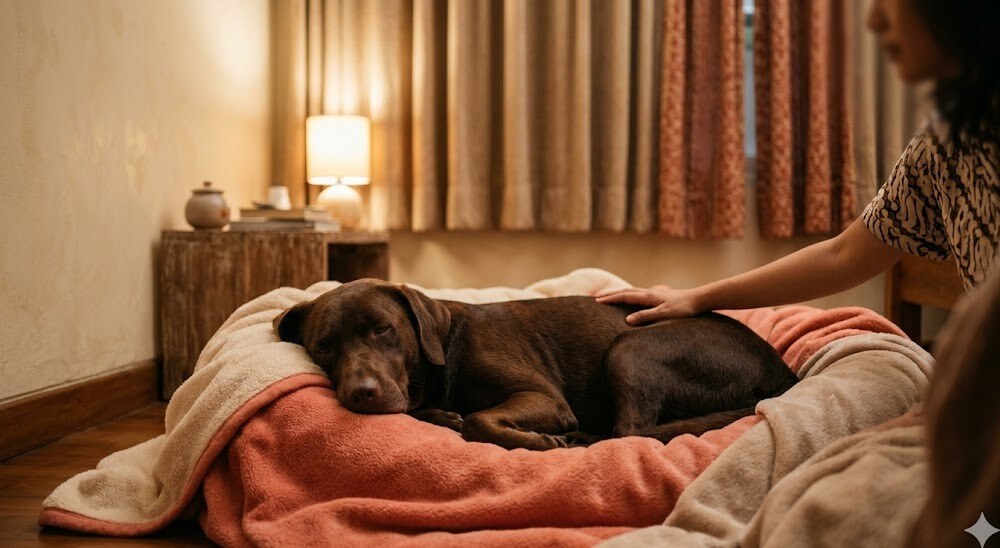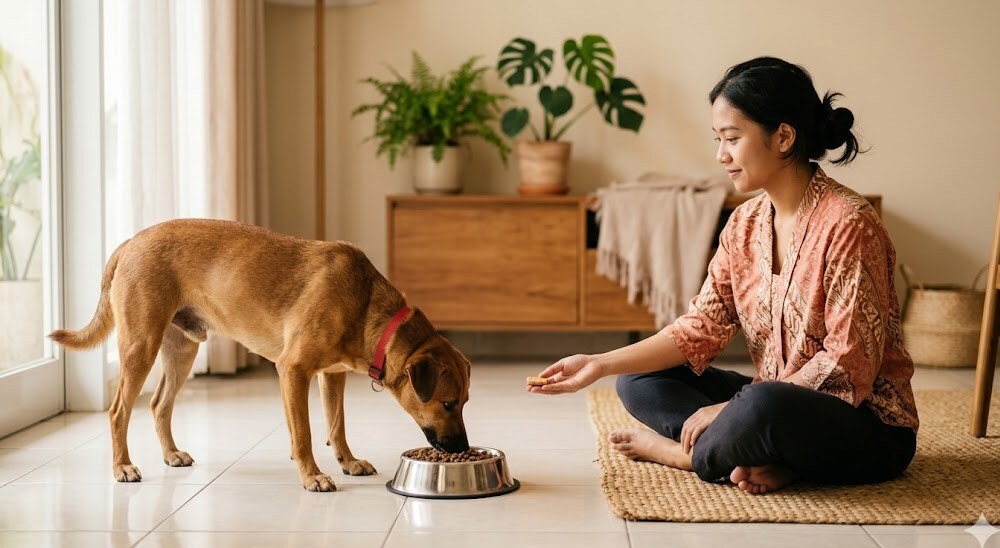

You come home from work to find the house in disarray, sofa cushions torn apart, a table leg chewed, poop on the floor even though your dog has been house-trained for years, plus a neighbor complaining your dog barked nonstop the entire time you were gone. Many first-time dog owners assume this is a "naughty dog" or "revenge for being left behind." In reality, this is often a symptom of separation anxiety, a clinical anxiety disorder that requires a structured approach to resolve.
This article is a diagnostic + solution guide for dog owners who suspect their dog has separation anxiety. It covers: clinical signs vs simple boredom, common causes, a gradual desensitization protocol, the role of crate training + enrichment, and when adjunct pharmacology may be considered by a veterinarian. Disclaimer: this is a general guide based on international behavior medicine guidelines, and does not replace a direct consultation with a veterinarian for your dog's specific condition.
What is separation anxiety in dogs?
Separation anxiety is a clinical distress response that occurs when a dog is separated from its attachment figure (usually the primary owner). Unlike the normal "not liking being left alone," separation anxiety is a panic response that can lead to self-injury, physical injury from escape attempts, or significant property damage.
Guidelines from the ACVB (American College of Veterinary Behaviorists) and the AVSAB (American Veterinary Society of Animal Behavior) categorize separation anxiety as a valid behavioral medicine diagnosis, not a "training" problem, not "disobedience," not "spoiled." Prevalence estimate: 14-17% of the household dog population globally experiences separation-related distress at some level (Sherman BL et al, Compendium Continuing Education for Veterinarians).
Clinical signs of separation anxiety
Signs appear when the owner is about to leave (anticipatory anxiety) or within the first 15-30 minutes after the owner departs. Importantly: these signs only appear when the dog is alone, if there is another person in the house, the dog seems normal.
1. Excessive vocalization
- Barking, howling, or whining continuously
- Starts within the first 5-15 minutes after the owner leaves
- Can last for hours, the leading cause of neighbor complaints in apartments
2. Destructive behavior
- Chewing furniture, cushions, shoes, door frames
- Scratching doors / windows / walls at exit points (the dog trying to "follow" the owner)
- Broken nails, damaged teeth, or muzzle injuries from the intensity of escape attempts
The hallmark that distinguishes this from boredom-driven destruction: focus on the exit door/window (not random chewing of whatever is interesting), and there is urgency to it, the damage is messy, there is excess saliva, sometimes blood.
3. Inappropriate elimination
- Pooping or peeing indoors despite previously being perfectly house-trained
- The location is often near the exit door or in a place that smells strongly of the owner (bed, sofa)
- Not revenge, but a panic response (sphincter loss during distress)
4. Pacing and inability to settle
- Pacing back and forth along the same route repeatedly (usually between the exit door and the dog's usual sleeping spot)
- Unable to lie down calmly even after 1-2 hours pass
- Drooling (excess saliva) that wets the carpet/floor
5. Anticipatory anxiety (before the owner leaves)
- The dog becomes restless, panting, following the owner everywhere upon seeing signs that the owner is about to leave (grabbing keys, putting on shoes, picking up a bag)
- Wide eyes, ears back, tail down
- Some severe cases even begin destructive behavior while the owner is still home but preparing to go out
Distinguishing separation anxiety from boredom-driven destruction
This is crucial, because the solutions are completely different. Many owners (and sometimes amateur trainers) misdiagnose "the dog is bored" when it is actually separation anxiety, and prescribe a toys + exercise solution that fails entirely because it doesn't address the root problem.
| Separation Anxiety | Boredom / Lack of Exercise | |
|---|---|---|
| Onset | Within the first 15-30 minutes after the owner leaves | Gradual, after several hours without stimulation |
| Damage target | Doors, windows, exit areas (escape attempts) | Random, whatever happens to be interesting, no toys available |
| Vocalization | Excessive, panic-pitch, for hours | Intermittent, usually in response to a trigger (outside noise) |
| Elimination | Frequent despite being perfectly house-trained | Rare if exercise + potty time are adequate |
| Response to toys | Not interested, too anxious to play | Interested when given a challenging enrichment toy |
| When another person is present | Calm even without the primary owner (if attachment is to a specific person), or anxious if attachment is to "humans in general" | Still destructive if bored, regardless of whether anyone is present |
Practical diagnostic tip: Set up a camera (an old phone, baby monitor, or Wi-Fi cam) that records your dog when you leave. The first 30-60 minutes are usually enough to see the pattern. This footage is also very helpful for a behavior veterinarian during consultation, more objective than the description of an already-panicked owner.
Common causes of separation anxiety
1. Lack of socialization during puppyhood
The most critical socialization window in a dog: 3-12 weeks. Puppies who do not get used to being left alone for short periods during this phase often develop an overly intense attachment to the owner. This is why dog trainers teach "settle training" from when a puppy is 8-10 weeks old, building tolerance for being alone in small, positive doses.
2. Major routine changes
- The owner returns to working away from home (post-pandemic effect, many pandemic puppies were only hit by the effect in 2024-2025 when owners began full work-from-office)
- The owner moves house / relocates to another city
- A family member leaves (a child going to college out of town, a partner working shifts)
- A companion dog passes away, anxiety emerges because the dog was used to being "kept company" by another dog at home
3. Past trauma
- A rescue dog from a shelter with a history of being abandoned by a previous owner
- A dog that was once lost and found again, some develop hypervigilance toward separation
- A dog that was once left for a long time at a pet hotel / boarding without preparation
4. Genetics and breed predisposition
Dog behavior research shows some breeds are more prone: Border Collie, Australian Shepherd, German Shepherd, Vizsla, Cocker Spaniel, Labrador Retriever. But breed is not an absolute determinant, individual temperament + early socialization are far more predictive than breed.
5. Underlying medical issues
In senior dogs or those that newly develop separation anxiety in adulthood without an environmental change, you need to rule out:
- Canine Cognitive Dysfunction (dog dementia), disorientation makes a senior dog anxious when the owner leaves
- Orthopedic disease / chronic pain, a dog in pain is more clingy
- Endocrine disorders (hypothyroidism, Cushing's), sometimes presenting as behavior change
- Declining vision / hearing
Desensitization protocol: gradual departure
This is the foundation of separation anxiety treatment. The goal: turn "the owner leaving" from a predictor of distress into a non-event. It takes 4-12 weeks of consistency for mild-moderate cases.
Phase 1: Decouple the "pre-departure cue" (1-2 weeks)
The dog has learned that "grab keys + put on shoes + pick up bag = owner leaving." This pre-departure cue itself triggers anxiety. Phase 1: perform the cue without actually leaving.
- Several times a day: grab the keys, jangle them, put them back. Put on shoes, take them off. Hold the bag, put it back.
- The dog will initially react (getting ready to be anxious), but because there is no follow-through, the signal weakens.
- Do this in a relaxed atmosphere, no dramatic eye contact. A treat is fine if the dog stays calm.
Phase 2: Very short departures (1-2 weeks)
Start by leaving for literally 1-5 seconds. Close the door, immediately open it. Yes, that short.
- Repeat 5-10 times per session, 2-3 sessions per day.
- Goal: the dog must stay 100% calm the entire time you are outside the door. If it starts whining even at 5 seconds, the duration is too long, drop it to 2 seconds.
- Gradually extend: 5 seconds → 15 seconds → 30 seconds → 1 minute → 2 minutes (don't jump more than double).
- When you return: be calm, not dramatic. Avoid a hyper greeting that reinforces "the owner's return is a big event."
Phase 3: Functional departures (2-4 weeks)
Once the dog can tolerate 10-15 minutes calmly:
- Extend to 30 minutes, 1 hour, 2 hours gradually.
- Start varying the exit route (front door → back door → garage) so it isn't a single cue.
- Begin combining with enrichment (see next section), give a puzzle feeder/frozen Kong exactly as you leave, take it away when you return. Association: "the owner leaving = a fun activity."
Phase 4: Real-life maintenance (ongoing)
- Random short departures in between normal working periods so the dog doesn't develop the pattern "the owner leaving is always for a long time."
- Every return remains calm, no over-the-top reunions.
- If you need to leave for a long duration that hasn't been trained yet, consider options: a midday dog walker, daycare 2-3× a week, or a visit from a family member.
Crate training: can help, can make it worse
A crate can be a calming safe space OR a prison that worsens panic. The differentiating factor: how it is introduced.
How to introduce a crate correctly
- Place the open crate in a main area (living room, near the family). Not in a remote corner.
- Soft bedding + your blanket that smells familiar.
- Throw treats into the crate several times a day, let the dog come and go freely.
- Feed meals inside the crate with the door still open for 1 week.
- Once the dog comfortably enters on its own, start closing the door briefly (5-10 seconds) with the dog inside, open it again before it gets distressed.
- Extend gradually, similar to the departure protocol, 5 seconds → 30 seconds → 1 minute → and so on.
Do NOT use a crate if:
- The dog has ever been physically injured from escape attempts in the crate (broken teeth, peeled nails, muzzle injury), use room confinement (a room with a door) instead
- The dog shows extreme panic in the crate (heavy drooling, non-stop vocalization, refuses to enter even with treats)
- As punishment, a crate must always be a positive association
For a dog with severe anxiety, a crate can make things worse because it is claustrophobic + offers no escape route. Consult a behaviorist before pushing crate training.
Enrichment and interactive toys
Enrichment is not a cure for separation anxiety, but it is an important adjunct:
- Frozen Kong with peanut butter (xylitol-free!) or wet food. Freeze it overnight, engagement lasts 30-60 minutes.
- Puzzle feeder / slow feeder, give breakfast via a puzzle, not from a normal bowl. Mental work is tiring; hunger satisfied = the dog naps.
- Snuffle mat, kibble scattered in a fringed mat, the dog has to search with its nose. High mental stimulation, lasts 15-30 minutes.
- Lickimat with plain yogurt / wet food. Repetitive licking action is shown to lower cortisol in dogs (canine behavior research).
- Audio enrichment, the "Through a Dog's Ear" Spotify playlist or a white noise machine. The evidence is mixed, but many owners report improvement.
Avoid xylitol in peanut butter or any candy, it is extremely toxic to dogs (fatal hypoglycemia). Always check for a "xylitol-free" label or use pure natural peanut butter.
When is pharmacology considered?
For moderate-severe cases that don't respond adequately to behavior modification, or cases whose severity is already dangerous (self-injury, physical injury, or urgency from neighbor/landlord complaints), a veterinarian may consider an anti-anxiety medication as an adjunct.
Dog behavior medications may ONLY be prescribed by a veterinarian after a thorough examination. Not bought online yourself, not borrowing a neighbor's prescription. The following are commonly considered (this information is for owner awareness, NOT dosing guidance, all specific doses depend on the case and the veterinarian):
- Fluoxetine, an SSRI, a daily long-term medication. Onset of effect 4-6 weeks. Often first-line for separation anxiety based on Plumb's 7e. Requires monitoring of behavior, appetite, and GI side effects.
- Clomipramine, a TCA, also long-term daily. One of the drugs with FDA approval for canine separation anxiety. Requires cardiac and liver monitoring.
- Trazodone, can be used situationally (before a long-duration departure) or as a daily adjunct. Faster onset (1-2 hours).
These medications are always combined with behavior modification, medication alone without a training protocol rarely solves a case. A veterinarian usually recommends a 4-12 week trial plan, with regular re-evaluation and tapering once behavior stabilizes.
When to see a vet (or call a vet to your home)
Consult a veterinarian if:
- The dog shows signs of severe separation anxiety (destruction leading to self-injury, non-stop vocalization for hours, escape attempts with injuries)
- You have tried behavior modification consistently for 4-6 weeks with no improvement
- Sudden onset in an adult/senior dog with no clear environmental trigger, need to rule out an underlying medical cause (cognitive dysfunction, chronic pain, endocrine)
- Neighbor / landlord complaints have reached the eviction-threat level, fast intervention is needed, including consideration of medication
- The owner is burned out and considering rehoming, owner well-being matters too, and a veterinarian can provide a realistic timeline + options
For separation anxiety cases, a home visit is very valuable because the veterinarian can directly observe the specific triggers in the home (exit door location, the dog's usual space setup, the dynamic with other family members) that are often missed when only described at a clinic. Plus, dogs with anxiety are often also anxious at the clinic, a home visit gives a more accurate baseline observation.
Dog separation anxiety FAQ
Can getting a second dog solve separation anxiety?
Rarely. Separation anxiety is generally an attachment to a specific human, not to "having another creature in the house." A second dog often doesn't help, sometimes it even develops anxiety too, from watching the first dog panic. It's better to resolve the existing dog's anxiety first before adding a new dog.
Can I use a CCTV / Wi-Fi cam to talk to my dog while I'm away?
Not recommended for a dog with separation anxiety. The owner's voice from a speaker that the dog cannot locate can actually worsen the panic, the dog is confused: "why can I hear the voice but there's no one here?" Using CCTV for you to observe patterns is OK, but mute the audio output to the dog.
How long does the desensitization protocol usually take to work?
Mild cases: 4-8 weeks with daily consistency. Moderate cases: 3-6 months. Severe cases (with adjunct pharmacology): 6-12 months for significant improvement, with long-term ongoing maintenance. What often causes failure: the owner skipping steps, extending duration too quickly, or being inconsistent, a dog with anxiety needs predictable progression.
Can CBD oil / herbal products work for dog separation anxiety?
The scientific evidence is still very limited. Some early studies suggest possible benefit for mild anxiety, but the quality control of CBD products in Indonesia varies (THC contamination can be toxic to dogs). Consult a veterinarian first, often a combination of standard treatment (behavior mod + Plumb's-listed medication) is far more predictable in its results than herbal experimentation.
Can a dog walker or daycare help in the meantime?
Yes, as part of a comprehensive plan. A midday dog walker breaks up the time alone. Daycare 2-3× per week provides socialization + exercise. But neither is a cure, if the dog still panics when left alone the next day after returning from daycare, the root cause of the anxiety hasn't been touched. Use them as an adjunct, not a replacement for behavior modification.
Can Prabasa Vet do a home visit for dog separation anxiety consultations?
Yes. Behavior cases, especially separation anxiety, benefit greatly from a home visit because the veterinarian can directly observe the specific triggers, home layout, pre-departure routine, and the dynamic with other family members. Contact us via WhatsApp, mention your dog's breed + age + the signs experienced + your area, the team will schedule a partner veterinarian for a medical evaluation + behavior assessment + a discussion of a realistic treatment plan for your home situation.
Closing
Dog separation anxiety is not a "naughty dog" and not "revenge." It is a clinical anxiety disorder that can be resolved with a structured approach, accurate diagnosis, consistent behavior modification, environmental enrichment, and sometimes adjunct pharmacology under veterinary supervision.
What matters: don't blame the dog or yourself. Many dogs develop separation anxiety even with very good and caring owners, a combination of genetics, an early socialization gap, and life changes are factors beyond your control. What is within your control: start the desensitization protocol as soon as possible, and ask a veterinarian for help if there is no improvement within 4-6 weeks.
Need a consultation or to schedule a house call vet for your dog's separation anxiety / behavior problem? Contact us via WhatsApp, mention the breed, age, and signs experienced, and our team will help schedule an evaluation with a partner veterinarian in your area.
Also read: How to Manage a Dog That Is Afraid of the Clinic, Adopting a Puppy: A Complete New Owner Checklist, Senior Dogs at 7 Years: Changes + Senior Care, Pet Care Guide.
Medical references used in this article
This article was prepared with reference to the following sources, verified per clinical sentence:
- AVSAB (American Veterinary Society of Animal Behavior) Position Statements, humane behavior modification, gradual desensitization protocols, avoidance of punishment-based methods
- Sherman BL, Mills DS. Canine Anxieties and Phobias: An Update on Separation Anxiety and Noise Aversions. Compendium Continuing Education for Veterinarians, 14-17% prevalence, diagnostic criteria, treatment protocol
- ACVB (American College of Veterinary Behaviorists) Practice Guidelines, separation anxiety diagnosis, differential from boredom/territorial behavior, indications for adjunct pharmacology
- Plumb's Veterinary Drug Handbook 7th Edition, fluoxetine, clomipramine, trazodone dosing for canine behavioral indications (clomipramine FDA-approved for canine separation anxiety)
- BSAVA Manual of Canine and Feline Behavioural Medicine 2nd Edition, gradual departure desensitization protocol, crate training do's and don'ts, enrichment strategy
- Overall KL. Manual of Clinical Behavioral Medicine for Dogs and Cats, standard textbook for veterinary behavior medicine, separation anxiety chapter
This article is a general guide based on international veterinary behavior medicine guidelines. For your dog's specific condition, including severity, medical history, household dynamics, and response to previous interventions, consulting a veterinarian is the right step. Anti-anxiety medication may only be prescribed by a veterinarian after a thorough examination.