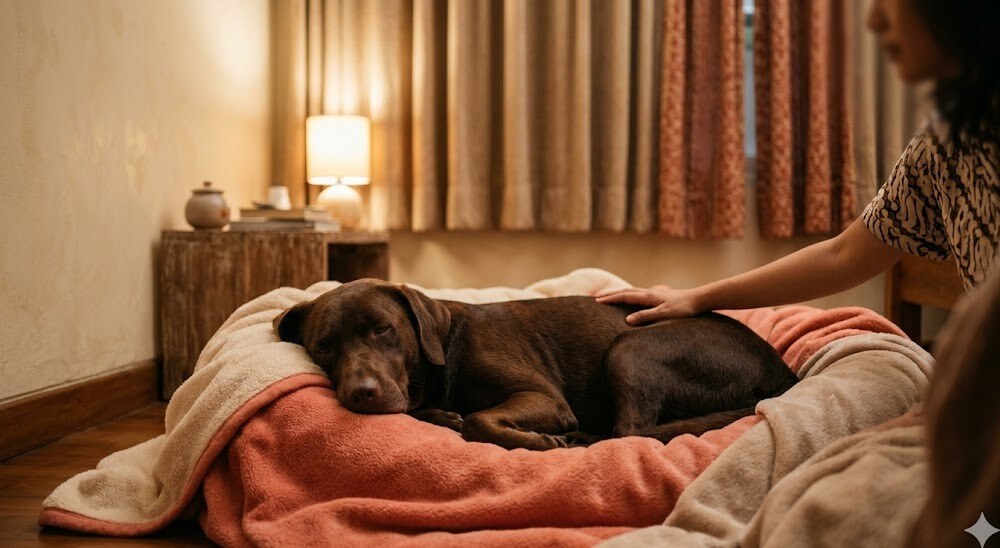

"Doc, my dog can't be approached while it's eating. It used to just give a faint growl, now it has snapped at my child's hand walking past. My in-laws say 'just ignore it, don't spoil it' or 'smack its mouth when it growls so it learns.' But it's getting worse, now it also guards its toys and its bed." A pattern like this, escalation from a faint growl to a snap to a real bite, is resource guarding (food aggression) handled the wrong way, which very often makes the problem worse.
The key thing to understand from the start: resource guarding is a natural instinct, not a sign that the dog is "bad" or "spoiled". Traditional handling methods (punishing the growl, alpha roll, force grabbing the food) are proven to make it worse and cause the dog to skip its warning and go straight to biting without notice. This article is a diagnostic + solution guide for owners struggling with resource guarding: recognize the escalation, avoid common mistakes, apply a gradual positive protocol, and know when to consult a veterinary behaviorist.
What is resource guarding?
Resource guarding is a natural behavior in which a dog defends a resource it considers valuable against a perceived threat (humans, other dogs, cats). It is not a sign of a broken dog, not disobedience, not dominance. It is adaptive behavior with evolutionary roots, in the wild, a dog that failed to defend food from a competitor did not survive.
Commonly guarded resources:
- Food, the food bowl, treats, bones, chews, food dropped on the floor
- Toys, a favorite the dog has invested emotional time in
- Bed, a mattress, sofa, a particular corner of the house
- The owner / family member, some dogs guard the owner from other dogs or strangers
- Found items, objects the dog has picked up and claimed as its own (socks, slippers, etc.)
Per the AVSAB (American Veterinary Society of Animal Behavior) Position Statement on Animal Welfare and Aggression, resource guarding is recognized as a valid behavioral medicine diagnosis that requires an approach based on learning theory and welfare-friendly intervention, NOT dominance theory or a punishment-based approach.
Estimated prevalence: a significant percentage of pet dogs show some level of resource guarding, most of it mild and not reaching the bite threshold. Vulnerable populations:
- Dogs from puppy mills or breeding farms with food competition
- Shelter dogs with a history of resource competition
- Rescue dogs with a trauma history (history of starvation, abandonment, or abuse)
- Multi-dog households with natural competition
- Puppies whose weaning was stressful (high sibling competition, low exposure to positive handling)
Ladder of escalation, recognize it before it escalates to a bite
Resource guarding almost never "suddenly bites." There is a gradual escalation (ladder of aggression), and when early signals are ignored or punished, the escalation gets faster until it finally reaches a bite. Recognize the stages:
Stage 1: Subtle body language (the faintest warning)
- Eating faster when someone approaches, the dog rushes to finish the food so it "can't be taken"
- Body tension, the body stiffens, eating but with the eyes watching
- Whale eye, the head stays toward the food but the eyes glance to the side (the whites of the eyes are visible)
- Stiffening, the body freezes for a moment when approached
Stage 2: Freeze
- The dog stops eating completely, body stiff, eyes fixed
- Tail stiff or tucked
- Ears back and flat
- This means "I'm asking you to keep your distance, I'm stressed"
Stage 3: Growl
- A sound from deep in the chest, often low-pitched
- May be accompanied by showing teeth (lip curl)
- THIS IS A VALUABLE WARNING, the dog is speaking, telling you it is uncomfortable with your closeness
Stage 4: Snarl / snap
- Snarl: growl + showing teeth + maximal lip retraction
- Snap: a lunge of the mouth with an air bite (the mouth closes in the air near the target, without contact)
- Serious escalation, an ignored signal
Stage 5: Inhibited bite
- A bite contacts the skin but does not penetrate, or penetrates but is not severe
- The dog still has bite inhibition (control over its bite force)
Stage 6: Uninhibited bite
- A bite penetrates the skin, with a hold and/or shake
- Bite inhibition is broken, often the result of a history of repeated punishment (the dog has learned its warnings are useless and attacks directly)
- Requires immediate behaviorist intervention
Critical insight: Every time an early stage is punished, the dog learns "a warning is not safe" and escalates to the next stage WITHOUT the preceding one. That is why a dog that "suddenly bites without warning" is almost always a dog that previously growled and was then punished for growling.
Common mistakes that MAKE resource guarding worse
This is the most important section, many traditional practices are proven to worsen the problem. Per the AVSAB, ACVB (American College of Veterinary Behaviorists) guidelines, and modern veterinary behavior literature:
1. Punishing the growl
"Smack its mouth when it growls," "scold it loudly," "scruff it for growling." This is the most common way to make it worse.
Consequence: the dog learns "growling = bad consequences from humans." But the reason it growls (stress from closeness to the resource) does not go away, what goes away is the warning. The dog skips stage 3 and goes straight to stages 4-5-6 at the next interaction. Many "no warning" bite cases are the result of past growl punishment.
The right way: treat the growl as valuable information. The dog is speaking. Give it space, do not punish, then begin a desensitization program.
2. Alpha roll and dominance-based correction
"The dog must know who is alpha," "pin it to the floor until it submits," "stare it down until it looks away."
Dominance theory from 1970s wolf pack studies has been debunked decades ago. Dr. David Mech (the researcher who originally proposed the alpha model) has retracted his theory, observations of wild packs show a family structure, not a dominance hierarchy. Domestic dogs are far more distant from wolves on the evolutionary timeline.
Per the AVSAB Position Statement on Use of Dominance Theory in Behavior Modification of Animals: a dominance approach is not recommended because it increases the risk of aggression, damages the owner-dog bond, and raises welfare concerns.
3. Force grabbing the food or "testing" while eating
"I have to be able to take its food any time," "test it by putting your hand in the bowl while it eats."
This is wrong twice over: (1) there is no natural reason for an owner to grab a dog's food while it is eating, and (2) it teaches the dog to anticipate a threat every time the owner approaches at mealtime → trust broken → guarding escalates.
The right way: respect the dog's space while it eats. If you need to take food away (for a medical reason), use the trade-up technique.
4. Hand-feeding every meal as a "dominance exercise"
Hand-feeding is sometimes recommended by lay trainers as a way to "teach the dog that food comes from you." In a dog that is already resource guarding, this often makes it worse:
- Intensive hand-feeding at every meal escalates food security anxiety
- The dog develops ambivalence: it needs the hand to eat, but the hand = a source of stress
- Occasional hand-feeding for training is OK, but NOT every meal for a dog with resource guarding
5. Pre-emptively taking food away to "show who's in control"
Some lay trainers suggest taking the bowl away while the dog is eating to "show dominance." This is the surest way to trigger escalation. Do not do it.
The positive protocol, what actually works
An evidence-based approach per the AVSAB, ACVB, and behavior science literature. The foundation: change the dog's emotional response to human closeness near a resource, from "threat" to "prediction of something good".
Pillar 1: Respect space first (if severity is moderate-severe)
Before the training program, reduce the triggers. For a dog with moderate-severe severity:
- Feed in a quiet, separate area, no foot traffic at mealtime, no small children nearby
- Leave it alone while it eats, return the bowl when it is done, do not grab it from the dog
- Manage the household, children are taught not to go near the bowl while the dog eats, no matter their age
- Control access to high-value resources, bones and chews are given only when the dog is in its crate or in a room alone (so the owner never has to approach to retrieve them)
Goal of pillar 1: stop reinforcing the guarding pattern. Each time the owner approaches at mealtime with no negative consequence for the dog, the behavior stabilizes and baseline anxiety drops.
Pillar 2: Classical conditioning, "a person approaching = a good thing arriving"
This is the cornerstone of the protocol. The goal: change the dog's mental association from "a person approaching = a threat" to "a person approaching = a high-quality treat appears."
How:
- While the dog eats from its normal bowl, you walk past at a distance that is still SAFE (a distance at which the dog does NOT growl, maybe 3-4 meters at first)
- As you pass, toss a high-value treat (a piece of boiled chicken, cheese, chicken liver, something far tastier than the kibble in the bowl) toward the dog, not into the bowl, onto the floor near it
- Keep walking, do not stop, do not look at the dog
- Repeat several times per meal, several meals per day
- After 1-2 weeks of consistency, the dog will look UP when you pass (anticipating a treat), instead of freezing or growling
- Gradually decrease the distance (3m → 2m → 1.5m) over weeks, do not skip ahead
Goal: the dog learns "a person approaching while I eat = HOORAY, a tasty treat is coming." A positive association replaces the defensive one. This is classic Pavlovian classical conditioning applied to resource guarding.
Important: don't rush. If the dog growls or stiffens, your distance is too close for the current stage. Step back to a comfortable distance and stay there longer. Forcing closer too fast = a setback.
Pillar 3: Trade-up, for taking an item without conflict
If you need to take an item from the dog (for example, it has picked up a sock or something dangerous), do NOT force grab. Use trade-up:
- Approach calmly, show a treat of HIGHER value than the item it holds (jackpot food: cooked chicken, freeze-dried liver)
- Offer it on the floor near the dog, slightly to the side
- When it drops the item to take the treat, calmly pick up the item
- Do not snatch your hand back hastily or dramatically
- Always give the item back if it is safe (to teach the dog that giving up does not mean losing it permanently)
Trade-up teaches: "giving to the owner = I get something better." The bond builds, conflict is avoided.
Pillar 4: Toys and the bed, apply the same protocol
Classical conditioning and trade-up also apply to:
- Toys, when the dog has a favorite toy, walk past while giving a treat (positive association), and trade up if you need to take it
- The bed, if the dog growls when you are near its bed, don't sit next to it on the sofa. Give it space. Toss treats from a distance. Gradually build trust
- Owner guarding, if it guards you from your partner / another dog, the situation is more complex, consult a behaviorist
Prevention during puppyhood, much easier than treatment in an adult
Resource guarding is far easier to prevent during puppyhood than to treat in an adult dog. The critical window: 3-12 weeks (puppy socialization).
1. Early positive handling around food
- While the puppy eats, occasionally (not every meal, that creates trust issues) toss an extra treat into its bowl, the association "a person near while eating = bonus treat"
- Add food to the bowl while the puppy is eating, not taking away, but adding. The association: a hand approaching = food increases, not decreases
- Hand-feed occasionally for a training session, not exclusively at every meal
2. Multiple safe resources
- In a multi-dog household, separate the feeding stations to reduce competition
- Have several toys available, not just one that the dogs fight over
- Multiple beds where possible
3. Teach "drop it" from puppyhood
- Start with trade-up for low-value toys (a sock, a toy it doesn't love much)
- Trade for a treat, give the toy back
- Once it understands, introduce the verbal cue "drop it" and reward immediately
- Goal: an adult dog that happily drops anything on request, trusting that giving up is safe
4. Bite inhibition
Puppies learn bite inhibition from the litter (a sibling yelping when bitten too hard). Puppy owners must continue this:
- When the puppy bites your hand during play, yelp loudly and stop the interaction for 10-20 seconds
- Resume when the puppy is calm
- A dog with good bite inhibition = in the future, if it ever snaps under stress, its force control is maintained (inhibited bite vs uninhibited)
When you need a veterinary behaviorist
Some cases are beyond the scope of a DIY home protocol. Consult a veterinary behaviorist (DACVB or a vet with behavior certification), not a lay trainer, if:
- There has already been a bite that penetrated the skin, high escalation risk, needs a formal assessment + intervention plan
- Multi-resource guarding, the dog guards food + toys + bed + owner all at once. A generalized pattern needs a more structured approach
- Fear-based aggression with a resource guarding component, a dog with a trauma history or general anxiety whose resource guarding appears within a broader fear context
- No response to 4-8 weeks of consistent positive protocol, may need a medical assessment (rule out pain triggering irritability) and possibly pharmacological adjunct (fluoxetine or others, always prescribed by a veterinarian after evaluation)
- A multi-dog household with escalation between dogs, serious dog-on-dog fight risk; household management needs special structuring
- Small children in the home, a different risk profile; the threshold for consulting a behaviorist is lower
Access to a DACVB veterinary behaviorist in Indonesia is still very limited. Some alternatives:
- A veterinarian with a special interest in behavior (sometimes available at referral clinics)
- Virtual consultation with an international behaviorist (many DACVBs offer telemedicine)
- A certified trainer (CPDT-KA, KPA-CTP, or equivalent) for hands-on training execution, with behaviorist supervision for the plan
Resource guarding FAQ
Can a dog that already has resource guarding "be cured"?
Resource guarding is usually managed, not completely cured. With a consistent positive protocol, many dogs show significant improvement: no more snapping or biting, perhaps still a little body tension when someone is near the resource (mild subclinical guarding). The realistic goal is to reach a safe and sustainable level, not to eliminate the instinct 100%.
Is a multi-dog household harder?
Yes, it is more complex because competition between dogs reinforces guarding behavior. Strategy: separate the feeding stations (different rooms/crates at mealtime), high-value treats only when the dog is isolated, and don't give items that could trigger competition (a big bone to share). Manage the household consistently, if one family member applies a rule, everyone must apply it.
My dog is a rescue with a trauma history, can its resource guarding go away?
Rescue dogs with a starvation or abandonment history often have deep-seated food insecurity. Improvement is possible but the timeline is longer (months to years) and baseline guarding sometimes stays subtle. Consistency and patience are key. Many rescue dogs with resource guarding live happily long-term with owners who understand and apply the protocol with respect.
Should anti-anxiety medication be considered for resource guarding?
For moderate-severe cases that do not respond enough to behavior modification, or cases with a general anxiety component, a pharmacological adjunct is sometimes considered by a veterinary behaviorist. SSRIs such as fluoxetine are sometimes used. Always prescribed by a veterinarian after a thorough examination, not bought online. Medication alone without behavior modification rarely solves the problem; it must be combined.
What about a "shock collar" technique to stop the growl?
Per the AVSAB Position Statement on Punishment for the Modification of Animal Behavior, aversive tools (shock collar, prong collar, citronella spray) are not recommended for aggression. The scientific evidence: aversives for aggression often trigger an escalated fear-based response, damage the owner-dog bond, and increase the risk of a no-warning bite. A positive reinforcement approach is far superior in long-term outcomes.
Should I rehome a dog with severe resource guarding?
For a small subset of cases (extreme severity, a household with multiple small children, a history of serious bites), rehoming is sometimes the compassionate choice for the dog's welfare and the family's safety. But before reaching that point, consult a behaviorist first, many cases that look "hopeless" at first actually respond to a structured protocol. Rehoming is also not a magic solution, the same dog with resource guarding will likely have the same issue in a new home.
How much does a behavior consultation for resource guarding cost?
The cost of a behavior consultation is not fixed, it varies widely depending on the facility, the session duration (typically 1-2 hours), the number of sessions needed, whether a follow-up plan is involved, and the consultation format (in person, virtual, or virtual with an international DACVB). A certified trainer for training execution also has its own range depending on experience and case complexity. Because every resource guarding case differs in severity, an accurate estimate can only be given after an initial assessment. Message Prabasa Vet on WhatsApp to ask about visit schedule and rates, and for suitable resources in your area.
Summary
Resource guarding (food aggression) is a natural canine instinct that can escalate from freeze → growl → snarl → snap → bite if handled wrongly. The most common mistakes that make it worse: punishing the growl (the dog learns to skip the warning), alpha roll and dominance theory (already debunked), force grabbing food (trust broken), and over-applied hand-feeding in a dog that is already guarding.
A positive protocol based on AVSAB / ACVB: (1) respect space when severity is moderate-severe, (2) classical conditioning, the owner approaching at mealtime = a high-value treat appears, (3) trade-up to take an item (offer something better, don't force), (4) prevention during puppyhood (positive handling, multiple safe resources, teach "drop it"). Realistic timeline: 4-12 weeks of consistency for significant improvement in mild-moderate cases.
When you need a veterinary behaviorist: a bite that penetrated the skin, generalized multi-resource guarding, a fear-based component, no response to 4-8 weeks of a home protocol, or the combination with small children at home. Rescue dogs with a trauma history need more patience but improvement is possible.
Does your dog growl or snap while eating? See the Prabasa Vet pet care guide or contact us on WhatsApp to discuss a behavior assessment plan and recommendations for a trainer or behaviorist in your area. Resource guarding can be resolved, the important thing is not to use obsolete methods that make it worse.
Read also: Separation Anxiety in Dogs, How to Help a Dog That Is Afraid of the Clinic.
Medical references used in this article
This article was prepared with reference to the following sources, verified per clinical statement:
- AVSAB (American Veterinary Society of Animal Behavior) Position Statement on Animal Welfare and Aggression, resource guarding as natural behavior, recommends welfare-friendly intervention, avoid punishment-based approach
- AVSAB Position Statement on the Use of Dominance Theory in Behavior Modification of Animals, dominance theory debunked, alpha roll and dominance correction not recommended
- AVSAB Position Statement on Punishment for the Modification of Animal Behavior, aversive tools (shock, prong, citronella) not recommended for aggression, escalation risk
- ACVB (American College of Veterinary Behaviorists) Practice Guidelines, diagnostic criteria for resource guarding, treatment protocol of classical conditioning + counter-conditioning, indications for pharmacological adjunct
- Donaldson J. Mine! A Practical Guide to Resource Guarding in Dogs, a step-by-step owner-implementable program, classical conditioning approach
- Karen Pryor Academy, positive reinforcement training, trade-up technique, building bite inhibition during puppyhood
- BSAVA Manual of Canine and Feline Behavioural Medicine, 2nd Edition, staging aggression, behavior modification protocol, indications for referral to a behaviorist
- Overall KL. Manual of Clinical Behavioral Medicine for Dogs and Cats, standard veterinary behavior medicine textbook, resource guarding chapter, ladder of escalation
This article is general guidance based on the international AVSAB and ACVB veterinary behavior medicine guidelines. For your dog's specific condition, including severity, history, household dynamics, and response to previous interventions, consulting a veterinarian and, where possible, a veterinary behaviorist is the right step. Cases with a bite history need a formal assessment before any DIY protocol.