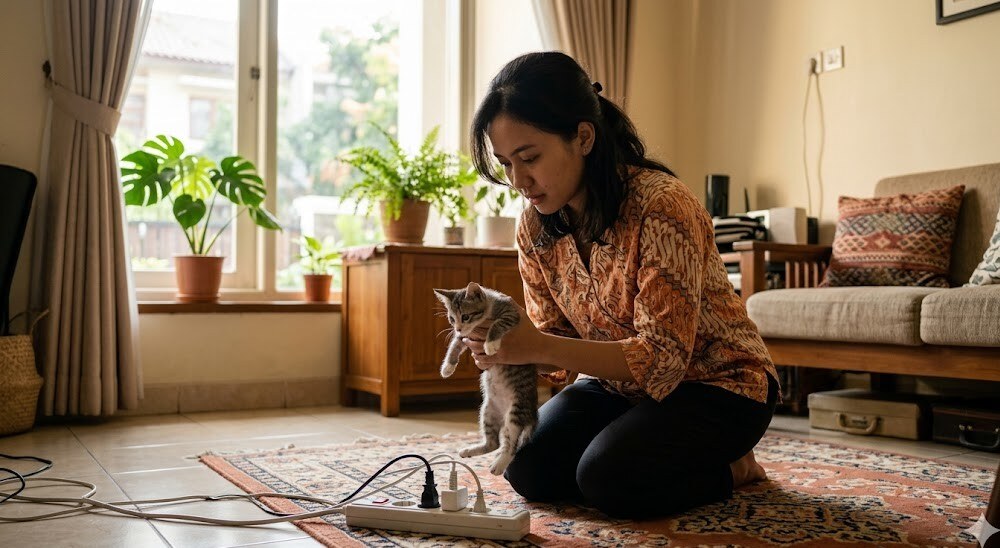

"My dog just got hit by a motorbike in front of the house. Now it won't stand up, and its right hind leg looks bent at a strange angle. How do I lift it?" Fractures (broken bones) in dogs and cats, usually from vehicle accidents, falls from a height (feline high-rise syndrome from apartment balconies), or bites from a large animal, are an emergency that needs prompt evaluation at a 24-hour clinic. What owners often misjudge: the fracture appears to be the most obvious problem, but it is often not the most life-threatening one. Thoracic injuries (pneumothorax, lung contusion, diaphragmatic rupture) or abdominal injuries (liver/spleen rupture, urinary tract trauma) that are not visible from the outside can be more dangerous.
This article is a practical guide: recognize the signs of a fracture, how to safely approach and transport an animal with a suspected fracture (why a homemade splint often makes things worse), why a fracture = a 24-hour clinic with radiology and orthopedic capacity, and what the veterinarian does at the clinic. Plus the factors that determine treatment cost.
Clinical signs of a bone fracture
A fracture is often clear from the trauma history + clinical presentation. Main signs:
- Severe limping or non-weight bearing, the dog/cat will not put any weight on the affected leg, often holding it up high
- Visible deformity, the leg bent at a strange angle, an unusual angle, asymmetric with the contralateral side. In a closed fracture without a wound, a subtle deformity may be detectable only with careful palpation
- Open (compound) fracture, the bone protrudes through the skin, an open wound over the fractured area. A high emergency because of the risk of osteomyelitis
- Severe local swelling, progressive swelling at the fracture site within the first hours after trauma
- Crepitus, a "grinding" sound or sensation when the area is palpated (do not deliberately test for this at home, it is very painful for the animal)
- Intense pain, the animal vocalizes (a dog yelps, a cat groans), is aggressive when the area is touched, holds a protective posture
- Weak pulse distal to the fracture if the blood vessels are compromised, a high emergency to salvage the limb
- The animal refuses to move, especially for spinal, pelvic, or multiple fractures
Most common fracture locations
- Femur (thigh bone), the most common, especially from vehicle trauma
- Tibia, the second most common
- Pelvis, often bilateral, often with urinary trauma complications
- Mandible (lower jaw), symphyseal separation in feline high-rise syndrome
- Hard palate, in feline high-rise syndrome
- Radius-ulna (forearm), small dogs that fall from someone's arms
- Spinal vertebrae, a neurological emergency, needs separate evaluation
Why a fracture = a 24-hour clinic, not a house call
Several critical reasons:
- The trauma that causes a fracture often causes additional unseen injuries: pneumothorax (air in the pleural cavity), lung contusion (bruised lung), diaphragmatic rupture (abdominal organs entering the thorax), hemoabdomen (internal bleeding from a liver/spleen rupture), uroabdomen (bladder/ureter rupture), head or spinal trauma. These injuries are often more life-threatening than the fracture itself. Thoracic + abdominal radiographs + a quick ultrasound (FAST scan) at the clinic are mandatory for screening
- Diagnosing a fracture requires a radiograph, the fracture type (transverse, oblique, comminuted, displaced), the exact location, and the treatment plan can only be determined with X-rays
- Pain management requires IV opioids, a fracture is very painful, NSAIDs are inadequate, and IV access and injectable drugs (morphine, methadone, fentanyl) are needed
- Initial stabilization often requires sedation to place an appropriate splint or bandage
- Pre-operative workup if surgery is needed: CBC, biochemistry, coagulation, ECG if age/comorbidities are relevant
- Orthopedic surgery requires special facilities, an orthopedic kit, an image intensifier (C-arm) for complex fractures, a surgical team with long-anesthesia capacity
A house-call setup does not have radiography, inpatient facilities for monitoring + IV analgesia, or orthopedic surgical capacity. A suspected fracture = refer to a 24-hour clinic with orthopedic capacity.
How to safely approach and transport an animal with a suspected fracture
Step 1: personal and animal safety
- Approach calmly and slowly, an animal in pain can bite defensively even at its own owner
- Use a large towel or blanket as a support sling to lift it, do NOT lift by the fractured leg
- For a cat: use towel restraint, place it in a carrier with a firm base (a wooden board, a tray) so it cannot move much
- For a large dog: you need 2 people, one supporting the front and one the rear, using a blanket as a stretcher if needed
- Muzzle the dog if possible, even the gentlest dog can bite during severe pain (improvise with a triangular cloth or gauze if you have no muzzle)
Step 2: minimum stabilization
The goal of home stabilization is to prevent additional movement until you reach the clinic, NOT to reset the fracture or apply a definitive splint.
- For a distal limb fracture (below the knee/elbow): wrap the leg with a soft towel + secure it with tape or a loose bandage, do NOT make it tight
- For a proximal limb fracture (femur, humerus): do not splint, a homemade splint on a proximal fracture often makes things worse because it does not immobilize the joint above. Just minimize movement by laying the animal on a firm surface
- For a suspected spinal/pelvic fracture: do NOT lift by the limbs, use a wide wooden board or a large towel as a stretcher. Keep the animal in the position it was found
- For an open fracture (bone protruding): cover it with a clean cloth (clean cotton, sterile gauze if available), do NOT try to push the bone back in. A loose bandage to minimize contamination
What NOT to do
- Do NOT apply a splint made of a broom, wood, or stiff cardboard directly to the fracture without adequate padding, it can cause ischemia, pressure sores, and worsen the deformity
- Do NOT try to reset the fracture yourself, risk of additional damage, bleeding, and iatrogenic injury
- Do NOT give human medications, paracetamol is toxic to cats, ibuprofen is toxic to dogs. NSAIDs are not enough for fracture pain and can interfere with the kidneys if the animal is dehydrated from trauma
- Do NOT give food or water before the clinic evaluation, if sedation or surgery is needed later, the animal must be fasted
- Do NOT wait a few days "to see whether it can walk", a fracture does not heal on its own without intervention, and delayed treatment adds risk of complications (malunion, nonunion, osteomyelitis if open)
What the veterinarian does at the 24-hour clinic
Triage and systemic stabilization
- Check vital signs + signs of shock (pulse, MM color, CRT, temperature, mentation)
- Place an IV catheter + fluids if there are signs of shock or hypovolemia
- IV analgesia, methadone or fentanyl first-line for severe pain
- Oxygen if there is a thoracic concern
- Thoracic + abdominal radiographs are MANDATORY to screen for unseen injuries, whatever fracture is suspected, systemic screening comes first
- A FAST scan (Focused Assessment Sonography for Trauma) to quickly check for free fluid in the abdomen/thorax
- CBC + biochemistry + coagulation pre-operatively
Fracture radiography
- 2-view X-rays (lateral + craniocaudal/AP) of the fracture area
- An X-ray of the contralateral side for normal comparison if needed
- Classify the fracture: location, type (transverse/oblique/spiral/comminuted), displacement, articular involvement
- Plan treatment based on the classification
Treatment options
Depending on location, type, the animal's age, comorbidities, and the owner's budget:
- External coaptation (splint or cast), for stable, non-displaced distal limb fractures, or in very young animals. Cheaper, less invasive, but limited to certain fractures
- Intramedullary pin (IM pin), a metal pin inserted into the medullary canal of a long bone. Often combined with cerclage wire. For simple transverse or oblique fractures of the femur, humerus, tibia
- Plate-screw fixation, the gold standard for many fractures, a metal plate screwed to the bone. Rigid stabilization, faster post-op weight bearing. Expensive but the best outcome for complex fractures
- External skeletal fixation (ESF), transcutaneous pins + an external frame. For open or contaminated fractures, or as an adjuvant to another fixation
- Locking plate, a modern generation of plate with locking screws, more stable especially for osteopenic bone or complex fractures
- Symphyseal cerclage, for mandibular symphyseal separation (feline high-rise syndrome)
- Conservative (strict cage rest), for certain stable fractures (greenstick in a young animal, some pelvic fractures with minimal displacement), not an option for all cases
Post-operative
- Continued multimodal analgesia (IV opioid tapered to oral, NSAID if the kidneys are OK)
- Antibiotics if the fracture is open or the intervention was invasive
- Strict cage rest for 6-8 weeks
- Progressive restricted activity (no jumping, no running, short leash walks)
- Control X-rays at 2, 4, 6 weeks to evaluate healing
- Rehabilitation (physical therapy) to recover muscle mass and ROM
What determines fracture treatment cost
Fracture treatment cost varies widely and cannot be generalized, because it depends on several factors:
- The treatment method chosen, external coaptation (splint/cast) for a stable fracture is the simplest and least invasive option, while surgical fixation (IM pin, plate-screw, external skeletal fixation) involves surgery + anesthesia + an implant
- The complexity and location of the fracture, a simple non-displaced fracture is far easier to manage than a comminuted, displaced, or multiple fracture
- The quality and type of implant, for plate-screw, the plate choice (local vs imported, locking vs conventional) affects the cost
- Pre-operative workup and hospitalization, initial screening (thoracic + abdominal X-rays + basic labs) and management of secondary injuries if present
- Post-operative care, analgesia, antibiotics, control X-rays, and rehabilitation
Because every case is different, an accurate estimate can only be given after an evaluation and a radiograph. Contact us on WhatsApp for a free consultation about an orthopedic referral and a cost picture suited to your animal's condition.
Animal fracture FAQ
My dog is limping but can still walk a little. Can I wait until tomorrow to see the vet?
Not ideal. A dog that can still partially weight-bear after trauma may not have a complete fracture, but it could have an incomplete fracture (greenstick), a fissure, a sprain, or a ligament injury, all of which need evaluation with a radiograph. Plus, without thoracic screening, unseen secondary injuries (pneumothorax, lung contusion) can develop dangerously in the following hours. It is best to go to a 24-hour clinic immediately after the trauma.
My cat fell from a 5th-floor balcony and is now hiding under the sofa. Does it still need the clinic?
Yes, it is mandatory. Feline high-rise syndrome often has a combination of: hard palate fracture, mandibular symphyseal fracture, limb fractures, pneumothorax, lung contusion, and abdominal trauma. Many cats appear to "run and hide normally" but have serious internal trauma. Every cat that falls from a height of > 1 floor = a 24-hour clinic.
Can I apply a splint myself at home using a broom and tape?
Not advised except as minimal stabilization for transport. A homemade splint is often: too tight (causing ischemia), failing to immobilize the proximal joint it should, causing pressure sores, and delaying definitive treatment. Just wrap the leg with a soft towel + secure it loosely to minimize movement during the trip.
Can a fracture have "conservative treatment" without surgery?
Possible for some cases (greenstick in a young kitten/small dog, some stable non-displaced fractures), but the majority of fractures need surgical fixation for proper healing and a return to function. The orthopedic veterinarian will assess case by case based on the radiograph, age, location, and systemic condition.
How long is recovery after fracture surgery?
It depends on the location and method. Generally 6-12 weeks for baseline bone healing + 2-4 months for full recovery to normal activity. Young animals heal faster (4-6 weeks). Plus rehabilitation/physiotherapy greatly helps an optimal return to function.
Summary
Bone fractures in dogs and cats, usually from vehicle trauma, falls from a height (feline high-rise syndrome), or animal aggression, are a 24-hour clinic emergency, not a house call. The trauma that causes a fracture often causes additional unseen injuries (pneumothorax, diaphragmatic rupture, hemoabdomen, uroabdomen) that are more life-threatening than the fracture itself.
Every suspected fracture needs: thoracic + abdominal screening, IV opioid analgesia (not NSAIDs), 2-view radiographs of the fracture area, pre-operative workup, and a treatment plan (external coaptation for simple cases, IM pin/plate-screw/ESF for surgery). None of these can be done at home.
When trauma occurs: clear environmental hazards (traffic), approach calmly, transport with a towel/board as a stretcher without lifting by the fractured leg, avoid a tight homemade splint, do NOT give human medications, do NOT wait, call a 24-hour clinic and refer immediately.
Has your animal just had trauma with a suspected fracture? Contact us on WhatsApp for an initial consultation and direction to the nearest 24-hour clinic with orthopedic capacity. For an animal with signs of shock, heavy bleeding, difficulty breathing, or unconsciousness, do NOT wait for a consultation, go straight to the nearest 24-hour clinic.
Read also: Electrocuted Pets: Emergency, Nosebleed: Emergency, Pet Emergency Guide.
Medical references used in this article
This article was prepared with reference to the following sources, verified per clinical statement:
- Fossum TW. Small Animal Surgery (5th edition), Fracture management overview chapter, fracture classification, treatment indications per method (external coaptation vs IM pin vs plate-screw vs ESF), orthopedic pre-operative workup
- BSAVA Manual of Canine and Feline Musculoskeletal Disorders / BSAVA Manual of Small Animal Fracture Repair and Management, fixation method selection protocol, post-operative care, radiographic healing timeline monitoring
- ACVS (American College of Veterinary Surgeons) Small Animal Resources, Animal Health Topics on Fracture Management: clinical assessment, diagnostic imaging requirements, surgical approach selection criteria
- Drobatz KJ, Hopper K, Rozanski EA, Silverstein DC. Textbook of Small Animal Emergency Medicine, Trauma triage chapter: identification of concurrent injuries (pneumothorax, abdominal trauma, urinary trauma) that often co-exist with fractures, FAST scan screening protocol
- Plumb's Veterinary Drug Handbook, 7th edition, monographs for methadone + fentanyl + buprenorphine (post-trauma IV/CRI analgesia), cefazolin/amoxicillin-clavulanate (perioperative antibiotics for open fractures), meloxicam/carprofen (post-op NSAIDs if kidneys are OK)
This article is general guidance based on standard veterinary orthopedic surgery sources (Fossum, BSAVA, ACVS). For a specific assessment of your animal's condition, a bone fracture is an indication for referral to a 24-hour clinic with radiology and orthopedic capacity, not a house call. Home stabilization is limited to minimizing movement for safe transport.