
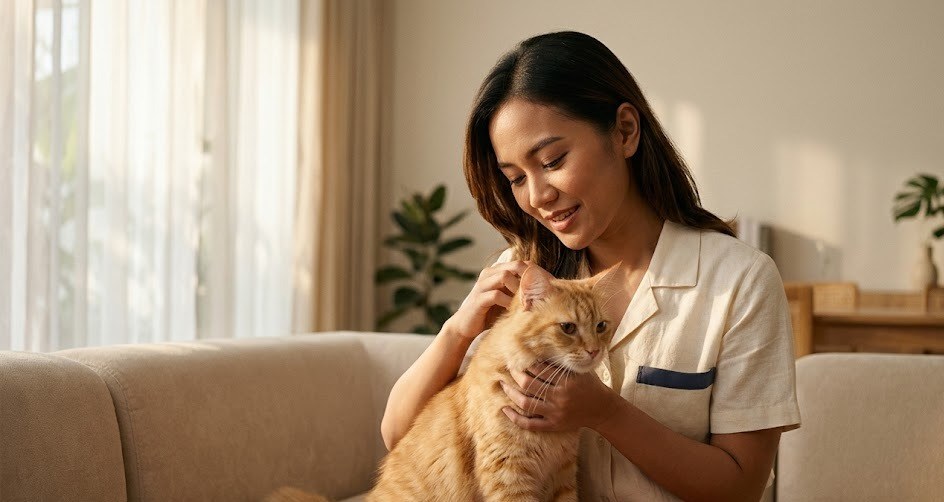
Quick summary: Most cats are already excellent at cleaning themselves, so the heart of grooming at home is really regular brushing, not frequent bathing. A bath is only needed when your cat is genuinely dirty, has gotten into something sticky or harmful, or when your vet advises it. Use only cat-specific shampoo, lukewarm water kept low, a non-slip surface, and short, calm sessions. Also care for the nails, ears, and eyes gently. If you find problem skin, wounds, fleas, or a cat so stressed it cannot be handled, it is best to stop and call a vet. Your first consultation with the Prabasa Vet team is free on WhatsApp.
Many owners want to bathe and tidy their cat at home, but after just a moment the cat is struggling, scratching, and running off to hide. You may have felt caught in the middle: leave the fur alone and it gets matted and dirty, or force a bath and end up with a traumatized cat and scratches on your arms.
Forced the wrong way, grooming can turn into a tense ordeal for the cat and an exhausting one for you. A cat that has been bathed in a panic often becomes harder to handle next time, and eventually you start putting off grooming until the fur clumps up or the skin runs into trouble. The good news is that with the right approach, grooming at home can be done calmly and can even become a comfortable moment for the two of you. Let us go through it step by step.
First, understand that cats are reliable self-groomers
Unlike dogs, cats spend a large part of their waking hours licking and tidying their own fur. Their slightly barbed tongue works like a natural comb that lifts away dirt and loose hair. That is why most healthy cats do not need frequent baths. In fact, bathing too often can disturb the natural oils in the skin and leave it dry.
So the core of a home grooming routine is not bathing, but simpler and gentler things:
- Brushing the coat to prevent matting, reduce swallowed hair, and keep the skin healthy.
- Checking and caring for the nails so they do not grow too long.
- Checking the ears and eyes to make sure they are clean with no signs of trouble.
- Bathing only when necessary, not as a weekly routine.
Brushing: the most important habit
Brushing is the part of grooming that is most often needed and the easiest to turn into a habit. For short-haired cats, brushing a few times a week is usually enough. For long-haired cats such as Persians or Maine Coons, brushing every day or almost every day helps a lot to prevent tangled clumps of fur.
A few things that make a brushing session more comfortable:
- Choose a time when the cat is calm, for example after a meal or when it is sleepy, not while it is actively playing.
- Start with the areas it likes such as the cheeks, chin, and back, then slowly move to more sensitive spots like the belly and base of the tail.
- Brush in the direction the fur grows with gentle pressure, and do not yank hard if you hit a tangle.
- Keep sessions short, just a few minutes at first, then increase the length gradually as the cat gets used to it.
- End with something pleasant, such as praise or a favorite treat, so the cat associates grooming with a positive experience.
If you find a clump of fur that is already matted and stuck to the skin, do not cut it off carelessly yourself. A cat's skin is very thin and easy to nick. A mat that is pulling on the skin is better teased apart slowly or handled by a vet or an experienced groomer.
When your cat really does need a bath
Because cats are already good at cleaning themselves, a bath is only needed in certain situations, not on a fixed schedule. You might consider bathing your cat when:
- The coat is heavily soiled with mud, waste, or something sticky that the cat cannot clean off on its own.
- It has gotten into a substance that would be harmful if licked, such as oil, paint, or chemicals. In that case, rinse carefully and contact a vet right away to make sure the cat is not poisoned.
- The cat is very long-haired or a hairless breed that genuinely needs more regular skin care.
- Your vet advises a bath as part of managing a particular skin condition.
- The cat is elderly, overweight, or unwell and struggles to reach its whole body.
How to bathe your cat at home without the stress
If a bath is truly needed, good preparation makes the process far calmer. Get everything ready first so you never have to leave the cat halfway through.
Prepare your supplies first
- Cat-specific shampoo. Never use human or dog shampoo. A cat's skin is different, and some ingredients that are safe for people or dogs can be harmful to cats.
- A non-slip mat at the bottom of the basin or tub so the cat does not slip and panic.
- Lukewarm water kept low, about up to the cat's belly, rather than submerging the whole body.
- Plenty of soft towels for drying.
- A favorite treat to reassure the cat and leave a positive impression.
Bathing calmly, step by step
- Brush the fur first before it gets wet, so loose and tangled hair is lifted out beforehand.
- Wet the body slowly from the neck backward using a small scoop or a gentle spray. Avoid pouring water directly onto the face.
- Apply the shampoo with gentle massaging strokes in the direction of the fur, avoiding the eyes, inner ears, and nose.
- Rinse until completely clean. Leftover shampoo can make the skin itchy and irritated.
- Clean the face with a damp cloth using only water, without pouring water or letting it into the ears.
- Wrap in a towel right away and dry thoroughly. A cat that is still damp can easily get cold.
Keep the session short and calm. Speak in a soft voice, and do not shout or restrain the cat roughly. If the cat panics badly, it is better to stop and try another time, or to ask a professional for help, rather than pushing until the cat is traumatized or you are deeply scratched.
Caring for nails, ears, and eyes
Grooming is not only about the coat. Other areas need attention too, but with a very gentle touch.
- Nails. Trim only the sharp tip and avoid the pink part inside the nail, because that is where the blood vessel and nerve are. If in doubt, trim just a little, or ask a vet to show you first.
- Ears. Clean only the visible outer part with cotton or a soft cloth. Never push a cotton bud into the ear canal, as it risks injury. Ears that smell, look red, have a lot of dark discharge, or are scratched often should be checked by a vet.
- Eyes. Wipe discharge from the corners of the eyes with a separate damp cotton pad for each eye. Eyes that keep watering, look red, or have discharge should be examined.
Tips to reduce stress during grooming
The key to drama-free grooming is patience and pleasant repetition, not speed. A few tips that help:
- Introduce it early and gradually. Let the cat sniff the brush or towel before you use it.
- Break it into small sessions. Five minutes of brushing every day is better than one long session that overwhelms the cat.
- Choose a quiet room with no loud noises, other animals, or people passing by.
- Read its body language. Flattened ears, a hard-swishing tail, or tense meowing are signs the cat is getting uncomfortable. Give it a break.
- Always end on a positive note, such as a treat or a short play, so the last impression is a pleasant one.
- Do not punish a cat that struggles. Fear will only make the next session harder.
Common mistakes to avoid
- Using human or dog shampoo on a cat. This is one of the most common mistakes and risks irritating the skin or harming the cat.
- Bathing too often when the cat is not actually dirty, which can dry out the skin.
- Water that is too high or too cold, which makes the cat panic and get chilled.
- Cutting mats off carelessly and accidentally nicking the thin skin.
- Forcing a long session when the cat is clearly already frightened.
When you should call a vet
Routine grooming can indeed be done yourself at home, but there are conditions that signal you should stop and ask a vet for help rather than pushing on alone:
- Problem skin. There is redness, scabs, bald patches, scaly or crusty skin, a bad smell, or the cat is scratching and licking excessively. This can point to allergies, infection, fungus, or parasites that need an examination.
- A wound is present. You find a cut, lump, swelling, or the cat is in pain when a certain area is touched.
- Fleas or other parasites. You see fleas, flea dirt like black specks, or ticks. Choosing an anti-parasite product that is safe for cats should be done with a vet's guidance, because some products meant for dogs are dangerous for cats.
- Severe matting that is pulling on the skin, especially in long-haired cats, which is safer handled by a professional.
- Severe stress. The cat is panting with its mouth open, is very aggressive, or cannot be handled at all. A cat breathing through an open mouth is not normal and needs attention, so stop grooming and calm the cat down.
- The cat is unwell, elderly, pregnant, or a kitten, so it needs to be handled more carefully.
Grooming and a health check, right at your home
One of the main reasons cats get stressed during grooming is the journey and the unfamiliar setting. This is exactly where a home-visit service can help so much. Prabasa Vet offers home-visit cat grooming across the Greater Jakarta (Jabodetabek) area, so your cat can be groomed in the place it is most comfortable, without being forced into a carrier and taken on a trip that leaves it tense. We also provide home-visit pet grooming for both cats and dogs.
Grooming is also the perfect moment to check the condition of the skin and coat at the same time. If you notice redness, scabs, bald patches, or fleas, a Prabasa vet can carry out an at-home skin check to find the cause and put together a suitable care plan. Not sure whether your cat's condition needs to be examined? You can start with a free online consultation first.
If you would like to schedule a calm grooming session at home, or a grooming session together with a health check, please message Prabasa Vet on WhatsApp. Tell us about your cat's condition and needs, and we will help arrange a suitable visit. The initial consultation is free of charge, and if there are signs of problem skin or another condition that needs further care, we will honestly recommend the most appropriate step for your cat's comfort and health.
Notes & references
This article is educational and general in nature, and does not replace a direct examination by the vet handling your case. Bathing frequency, the choice of grooming products, and the handling of skin problems and parasites should follow a vet's advice, because some ingredients that are safe for people or dogs can be harmful to cats. Conditions such as infected skin, wounds, poisoning from a substance stuck in the coat, or severe stress require medical care and are best not forced upon yourself alone.


