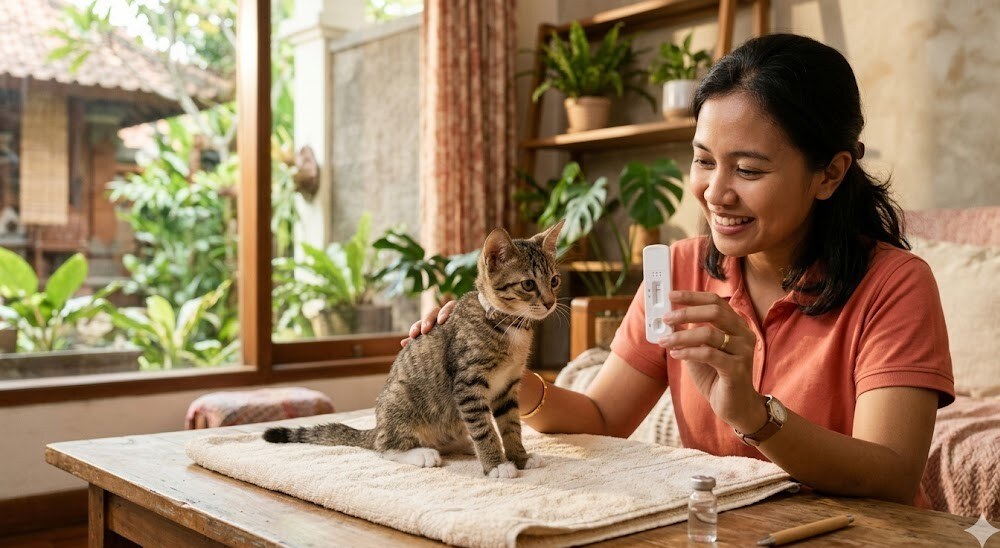

"Doctor, next month I have to move to Singapore, can my dog come along? If so, how does the vaccination process work?" This question comes up quite often, expats returning to their home country, Indonesian professionals on an overseas assignment, or families relocating for study or work. The long answer: yes, but it requires serious preparation and a long timeline.
International travel with a pet is not like a plane ticket, something you can arrange this week for next week. Every destination country has different vaccine, microchip, laboratory test, and document requirements, and most need 3–6 months of preparation minimum. This article explains what you need to prepare, the most logical order of steps, and what can go wrong if the timeline isn't well managed.
Why international travel needs special requirements
Every country in the world protects its domestic animal + livestock + wildlife populations from diseases not yet present in its territory. The most scrutinized: rabies, because it is fatal and zoonotic. Countries that are already rabies-free (Australia, New Zealand, the United Kingdom, Japan, Hawaii, most of Western Europe, parts of Singapore) have strict protection so that their rabies-free status is not disturbed.
Indonesia is not a rabies-free country, there are still endemic zones (especially Sumatra, Bali, Sulawesi, NTT). Because of this, an animal taken out of Indonesia is by default classified as "high-risk origin", and the destination country will ask for comprehensive proof that the animal has been vaccinated + has no natural rabies antibodies indicating virus exposure.
As an owner, your targets:
- Prove the animal's identity permanently (microchip)
- Prove actual and effective rabies vaccination (certificate + antibody test)
- Prove the animal is healthy at departure (health certificate)
- Follow all the pre-arrival documents + protocols the destination country requires
Microchip, the foundation of all travel documents
A microchip is the first and most fundamental requirement. Without a microchip that reads to an international standard, all other documents are invalid, because there is no way to prove the rabies vaccine certificate is linked to the actual animal in front of you.
Mandatory standard: ISO 11784/11785 , 134.2 kHz frequency, 15-digit code. This is the standard read by scanners at airports, quarantine, and clinics in most countries. Avoid a non-ISO microchip (the old 125 kHz frequency), risk of not being read at the destination.
The crucial order:
- Implant the microchip first
- Rabies vaccine afterward (or on the same day, but the microchip is implanted before the vaccine injection)
If the order is reversed, rabies vaccine first then microchip, many countries consider that vaccine invalid for travel purposes. The vaccine certificate must list the microchip number that is already implanted.
The microchip is implanted with a special needle in the subcutaneous area between the left/right shoulders. The procedure is quick (~10 seconds), needs no anesthesia, and most animals are only startled briefly. After implantation, re-scan to confirm it reads.
Rabies vaccine + RNAT titer test
After the microchip is implanted, the rabies vaccine is the second component. But the vaccine alone is not enough, many destination countries ask for proof that the vaccine actually produced protective antibodies. This is the function of the RNAT, Rabies Neutralizing Antibody Titer.
What is RNAT
RNAT (also called FAVN, Fluorescent Antibody Virus Neutralization, or RFFIT, Rapid Fluorescent Focus Inhibition Test) is a laboratory test that measures the concentration of rabies antibodies in the animal's blood. The common passing threshold: ≥ 0.5 IU/mL, below that is considered insufficient protection.
The timeline you need to understand
This is what often causes miscalculation:
- The blood sample for RNAT is taken at least 30 days after the rabies vaccine (so antibodies have time to develop)
- The sample is sent to an internationally accredited lab (in Indonesia, via a clinic or the Quarantine Center; the destination lab is usually in Asia/Europe/Australia)
- Results come out 2–4 weeks later
- Most countries require a 3–6 month waiting period after the blood sample date (not after the vaccine) before the animal may enter their territory
Total timeline from the start of vaccination to being able to fly: 4–6 months minimum for strict countries, 1–3 months for more lenient ones. If you only remember 1 month before departure, the animal will most likely have to follow later or use a quarantine option at the destination.
Country-specific requirements, the most frequently asked
Every country has its own authority and protocols. Here is a summary for common destinations from Indonesia. Note: regulations can change, always check the destination country's official authority website + consult a clinic experienced in pet export before starting the timeline.
Australia + New Zealand, the strictest category
- Authority: Department of Agriculture, Fisheries and Forestry (DAFF) Australia / MPI New Zealand
- Indonesia is in the Group 3 / high-risk category for Australia
- Required: microchip → rabies vaccine (min. age 12 weeks) → RNAT titer ≥ 0.5 IU/mL → wait 180 days after the blood sample date → DAFF import permit → post-arrival quarantine (duration depends on pre-arrival completeness)
- Historically a long 6-month quarantine, now with complete pre-arrival documentation it can be cut drastically to 10 days at the Melbourne Post Entry Quarantine facility
- Start planning 9–12 months before departure
European Union (EU Pet Passport / EU Animal Health Certificate)
- Authority: EU Commission, regulated under EU Regulation 576/2013 + 577/2013
- Indonesia is in the third country category, requires more complex documents
- Required: ISO 11784/11785 microchip → rabies vaccine (min. age 12 weeks) → RNAT titer minimum 30 days after the vaccine → wait 3 months after the blood sample → EU Animal Health Certificate from the Indonesian authority (Quarantine Center) within a 10-day window before departure
- After the animal arrives in the EU, it can obtain an EU Pet Passport for subsequent intra-EU travel
- Applies to all EU member states + the UK (the post-Brexit UK has a separate but similar protocol)
Singapore (AVS, Animal & Veterinary Service)
- Authority: Animal & Veterinary Service Singapore (under the National Parks Board)
- Indonesia is in the Category D (high-risk rabies)
- Required: microchip → rabies vaccine → RNAT titer → wait 6 months after the blood sample → AVS import license → vet health exam + parasite treatment + certificate → mandatory 10-day quarantine at the Sembawang Animal Quarantine Station
- A popular destination for Indonesian professional relocations, but the protocol remains formal
USA (APHIS)
- Authority: Animal and Plant Health Inspection Service (APHIS), under the USDA + CDC
- There is no national quarantine for a dog with a valid rabies vaccine from a high-risk country, but the CDC requirement for dogs from high-risk rabies countries (including Indonesia) became considerably stricter since 2024, it needs a CDC Dog Import Permit + proof of RNAT + microchip + entry only via approved airports
- For cats: simpler, requires a rabies vaccine certificate + health certificate, entering via most airports
- States such as Hawaii have a separate protocol similar to Australia (strict quarantine or a "5-day-or-less" program with complete pre-arrival)
Japan
- Authority: Animal Quarantine Service under MAFF
- Indonesia is in the regulated category
- Required: ISO microchip → 2 doses of rabies vaccine (30 days apart) → RNAT titer ≥ 0.5 IU/mL → wait 180 days after the blood sample → advance notification to the Japan Animal Quarantine Service → quarantine of up to 12 hours at the airport if documents are complete, or up to 180 days if incomplete
- Total timeline minimum 7 months
Indonesia BIM + Animal Quarantine Center, the export side
On the Indonesian side, the authority handling pet export is the Animal, Fish, and Plant Quarantine Center (under the Indonesian Quarantine Agency / BIM), located at international airports (Soekarno-Hatta, Ngurah Rai, etc.) and major seaports.
Documents that must be prepared from the Indonesian side:
- Health Certificate from an authorized veterinarian (authorized to sign export documentation)
- Complete vaccination record, especially rabies with date + product + microchip number
- Official RNAT lab report from an internationally accredited lab
- Import permit from the destination country (if required)
- Pre-departure parasite treatment per the destination requirement (usually 1–5 days before departure)
- Export certificate from the Quarantine Center at the point of departure
The Quarantine Center process in Indonesia usually needs an appointment 5–10 days before departure. Bring the animal to quarantine for a visual inspection + microchip verification + document check, then the Quarantine Center issues an official export certificate that will be checked at the airport + at the destination.
Timeline planning, the realistic version
For strict destinations (Australia, NZ, Japan, Hawaii):
| Time before departure | What to do |
|---|---|
| 12 months | Research country requirements, choose a clinic experienced in pet export |
| 9–10 months | Implant the microchip (if not yet done), first rabies vaccine |
| 8 months | Rabies booster (if the protocol requires), blood sample for RNAT |
| 7 months | RNAT results come out, apply for the import permit to the destination country |
| 1–2 months | Book the cargo flight / IPATA agent, train the animal with the travel crate |
| 10–14 days | Vet exam + pre-departure parasite treatment + Quarantine Center appointment |
| 3–5 days | Export certificate issued |
| Departure day | Cargo / cabin check-in (depending on the airline) |
For more lenient destinations (the EU with a complete document package, some ASEAN countries), the timeline can be trimmed to 4–5 months. Still, never assume it can be arranged in less than 2 months for any country that requires RNAT.
Domestic travel, between Indonesian provinces
Travel between provinces within Indonesia itself also needs attention, especially if you are moving to or from a rabies endemic zone (Sumatra, Sulawesi, Kalimantan, Bali, NTT, NTB, Maluku, Papua) to a rabies-free zone (Java, Madura). Inter-island Quarantine rules may require:
- An active rabies vaccine certificate
- A health certificate from a veterinarian
- A certificate from the Quarantine Center at the point of origin + destination
- Some regions require RNAT for animals from an endemic zone to a free zone
By plane: Indonesian domestic airlines (Garuda, Citilink, Lion, Batik) have their own pet-carriage policies, mostly via cargo, a small portion in the cabin for small animals. Check the airline's requirements + Quarantine Center documents at least 2 weeks before departure.
Travel stress-reduction preparation
Besides documents, there is the animal welfare side that is often forgotten. International travel = hours in a crate + loud airport noise + temperature changes + cargo-hold cabin pressure. For many animals, this is significant stress.
What you can prepare:
- Crate training well before departure, so the travel crate becomes a safe place, not something newly encountered on departure day. Start 1–2 months before departure. Leave the open crate at home with a blanket + favorite toy + treats inside
- Choose an IATA-standard crate, sized for the animal to stand + turn around + lie down comfortably
- Practice a short fast before the flight, last meal 4–6 hours before check-in to avoid motion sickness
- Use calming pheromones (Feliway for cats, Adaptil for dogs), spray in the crate a few hours before departure
- Avoid heavy drug sedation, most airlines + the American Veterinary Medical Association do not recommend routine sedation for flights because of the risk of respiratory compromise under cargo cabin pressure. Discuss with your vet if your animal has a history of severe anxiety, sometimes a mild oral medication such as gabapentin (cats) or trazodone (dogs) is safer than a long-acting sedative
- Bring water from home, there is a water bottle attached in the travel crate, fill it with the water the animal usually drinks at home (a sudden water change can trigger diarrhea)
- Use a pet relocation agent if possible, an IPATA member agent in Jakarta can handle door-to-door logistics, documents, and the connection with the destination clinic. The cost is significant but it saves significant stress for first-timers
FAQ on pet vaccines + travel
My pet is 10 weeks old, can it start the travel procedure right away?
Most protocols require a minimum age of 12 weeks for the rabies vaccine. The microchip can be implanted earlier (age 8 weeks+). Start with the microchip first, wait until old enough for the rabies vaccine.
I vaccinated my dog for rabies 2 years ago, is it still valid for travel?
It depends. Many countries accept a rabies vaccine still within the booster period (usually 1 or 3 years depending on the product). But RNAT still has to be done and you still have to wait a period after the blood sample. Bring the original vaccine certificate + microchip record to the vet for a case-by-case evaluation.
My cat is rarely vaccinated, and now has to travel in 4 months, is there still time?
Very tight, possibly not enough time for strict destinations (Australia, Japan, Hawaii minimum 6–7 months). For more lenient destinations (most non-island Asia) it is still possible. Consult immediately with a clinic that regularly handles pet export to evaluate a realistic timeline.
What is the total cost of exporting a pet abroad from Indonesia?
It varies greatly depending on several factors: the destination, the animal's size, and whether a relocation agent is used. The cost components involved include the microchip, vaccine, RNAT lab, certificate, Quarantine Center, airline cargo, and import duty. For Australia it is usually more complex because of post-arrival quarantine. A pet relocation agent provides a quote based on the specific destination. For an overview of the cost components and local steps before starting the procedure, ask Prabasa Vet on WhatsApp for a free consultation.
Can my pet fly in the cabin or is cargo mandatory?
It depends on the airline + destination + animal size. Many international airlines do not accept animals in the cabin (besides service animals and emotional support animals with special documents). Small dogs/cats can fly in the cabin on some airlines (certain Lufthansa, KLM, Singapore Airlines flights). Medium-to-large animals go in cargo (climate-controlled hold).
What if my pet doesn't pass RNAT (titer below 0.5 IU/mL)?
It means the vaccine did not produce a sufficient antibody response. Solution: booster vaccine, wait 30 days, repeat RNAT. The travel timeline will be pushed back. In some animals with an unusual immune system, further evaluation with a veterinarian is needed.
I have an exotic pet (rabbit, hamster, bird), is the protocol the same?
Different. Most of this article's protocols are for dogs + cats. Exotic pets have their own regulations (CITES for protected species, special requirements per country for birds due to avian influenza, etc.). Consult specifically with an exotic-animal veterinarian + the Indonesian Quarantine Center for species-specific requirements.
What is the cost of a travel-procedure consultation in Jakarta?
It varies depending on the clinic and the scope of the consultation (timeline evaluation + document check). The more significant costs are the clinical procedures themselves: microchip, vaccine, RNAT lab, certificate, plus the agent fee and airline cargo. Ask Prabasa Vet on WhatsApp for a free consultation + an estimate for your area.
Summary
International travel with a pet requires a minimum of 3–6 months of preparation for standard destinations and 9–12 months for the strictest destinations (Australia, NZ, Japan, Hawaii). The components that cannot be skipped: an ISO 11784/11785 microchip (implanted before the rabies vaccine), a rabies vaccine at the minimum age the protocol requires, an RNAT titer ≥ 0.5 IU/mL, the waiting period after the blood sample, the destination import permit, a health certificate + the Indonesian Quarantine Center export.
Every country has its own authority and protocols, initial research + choosing a clinic experienced in pet export is a very worthwhile investment of time. For a first-time relocation, consider an IPATA-member pet relocation agent in Jakarta to handle door-to-door logistics.
Besides documents, don't forget animal welfare: crate training 1–2 months before departure, avoid heavy sedation during the flight, use calming pheromones, and discuss your pet's specific condition with your veterinarian.
Want an initial consultation on whether your pet's vaccine schedule + documents are ready for a travel plan? See Prabasa Vet's home vaccination service or contact us on WhatsApp, we help evaluate the timeline + local steps before you start the formal procedure.
Read also: Complete Pet Vaccination Guide, Puppy + Adult Dog Vaccination Schedule, Complete Cat Vaccination Schedule.
Medical + regulatory references used in this article
This article was prepared with reference to the following sources, verified per clinical statement + regulation:
- Squires RA, et al. WSAVA Guidelines for the Vaccination of Dogs and Cats. Journal of Small Animal Practice 2024 , rabies vaccine section (core), schedule, titer interpretation
- World Organisation for Animal Health (WOAH, formerly OIE), Terrestrial Animal Health Code, chapter on rabies and international movement of pets, standard RNAT methodology
- European Commission Regulation (EU) No 576/2013 + Implementing Regulation 577/2013 , non-commercial movement of pet animals, EU Pet Passport + EU Animal Health Certificate format, third country requirements
- USDA APHIS Pet Travel section, US import requirements for dogs from high-risk rabies countries (revised 2024) + CDC Dog Import Permit
- Department of Agriculture, Fisheries and Forestry (Australia), Group 3 country import requirements, Post Entry Quarantine Melbourne
- Animal & Veterinary Service Singapore (NParks), Category D import requirements, Sembawang Animal Quarantine Station
- MAFF Japan Animal Quarantine Service, pet import requirements, 180-day waiting period post-RNAT
- Indonesian Quarantine Agency (Animal, Fish, and Plant Quarantine Center), pet export protocol, health certificate, coordination with the destination authority
- American Veterinary Medical Association (AVMA), position statement on sedation for air travel
- International Pet and Animal Transportation Association (IPATA), IATA Live Animal Regulations, travel crate standards
This article is general guidance based on current international regulations + clinical literature. Destination country regulations can change, always check the official authority websites (DAFF Australia, EU Commission, APHIS USA, AVS Singapore, MAFF Japan, etc.) + the Indonesian Quarantine Center, and consult a clinic experienced in pet export before starting the timeline. For animals with special medical conditions (senior, chronic disease, severe anxiety), individual welfare considerations need an in-depth discussion with the attending veterinarian.