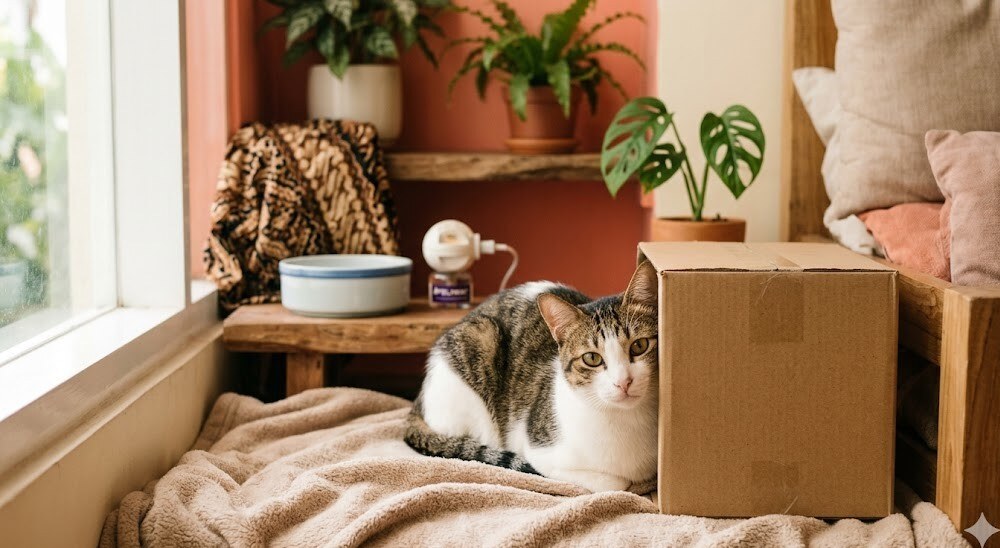

Cats are often considered "mysterious" because owners are not trained to read their body language, which is actually very informative. Unlike dogs that are overtly expressive (tail wag = happy), cats communicate via subtle and multi-modal signals: tail position, ear orientation, pupil dilation, body posture, and whiskers. Owners who can read these signals can avoid bites/scratches, identify stress earlier, and build deeper trust with their furry friends.
This article covers cat body language by body region, signal combinations that distinguish specific moods, the difference between acute and chronic stress, and red flags that require medical or behavioral evaluation. Disclaimer: this is a general guide and does not replace a veterinary consultation for cats with sudden behavior changes that may have an underlying medical cause.
Tail: the most informative
A cat's tail is the clearest indicator of emotion. Its position and motion indicate:
- Tail erect vertically (high tail, often with a slightly curved tip), confident, friendly greeting. A cat greeting its owner usually does so with an upright tail. This is a sign of positive social intent.
- Erect tail with rapid vibrations (quiver), excitement, often appearing during a greeting of a favorite owner or anticipating something pleasant. Intact male cats sometimes quiver their tails with urine marking, different context.
- Tail in the middle / horizontal, neutral, the cat is engaged but not hyper-aroused.
- Tail tucked (between back legs or pressed against the belly), fear, submission, or pain. A threatened, sick, or very anxious cat often tucks its tail.
- Tail twitch / lash (rapid back-and-forth movement), irritation, predatory focus (cat watching prey), or over-stimulation. When a cat is being petted and the tail starts to twitch, it's a signal: "stop, I've had enough", ignoring this can lead to a bite/scratch.
- Tail puffed (bottle-brush, fur standing up), fear/defensive. The cat appears larger to intimidate a predator. Often combined with an arched back.
- Tail wagging slowly at the tip, focus (when watching a bird at the window).
- Tail wrapped around body or paws while sitting, comfortable, settled, maybe slightly cool. Not in distress.
Ears: orientation = direction of attention
- Forward, erect, curious, engaged, attentive to something in front. Neutral positive.
- Slightly to the side, "airplane ears", anxious, conflicted, or split focus. A cat being called but also monitoring another stimulus might show airplane ears.
- Sideways (ears to the side, not flat), alert but cautious, sometimes slight discomfort.
- Flattened back (full "airplane ears" back, almost against the head), defensive, fear, or anger. A pre-attack escalation point. Stop the interaction.
- Twitching individual ear, environmental scanning (sound from a certain direction), or ear irritation (medical issue if persistent, otitis, ear mites).
- One ear forward, one to the side, focus divided between 2 stimuli.
Eyes and pupils
- Slow blink ("cat kiss"), sign of trust and affection. A cat that slow blinks at its owner is secure and friendly. Reciprocate with a slow blink, many cats will return it; it's a way to build trust.
- Half-closed eyes ("squint"), relaxed, content. Often while lying down near a favorite owner.
- Wide open with normal pupils (slits in bright light), alert, engaged, neutral.
- Pupils dilated (round, large), multiple meanings depending on context:
- Playful excitement (new toy, treat)
- Fear/stress (light hasn't changed but pupils dilated suddenly)
- Pain
- Predatory arousal (watching a bird)
- Medical: hypertensive (especially senior cats with CKD/hyperthyroid), neurological
- Pupils very slit in low lighting (anisocoria, different left-right pupils), medical red flag, needs evaluation (uveitis, neurological, Horner's syndrome).
- Direct staring without blinking, a challenge or predatory focus. A cat staring directly at another cat is usually pre-fight.
Whiskers
- Forward (whiskers directed forward, fanned out), curious, engaged, hunting mode.
- Neutral (whiskers relaxed, slightly to the side), calm.
- Pulled back (whiskers close to the face, not as visible as usual), fear, anxiety, defensive. Often combined with flat ears.
Whisker fatigue ("whisker stress"), a cat eating from a bowl that is too narrow/deep so the whiskers constantly touch the bowl walls. Signs: cat reaches with a paw to take food from the bowl, or is reluctant to eat from deep bowls but loves flat plates. Switch to a shallow, wide bowl.
Body Posture
- Loaf position (sitting with paws tucked underneath), settled, no intent for rapid movement. Comfortable.
- Lying on side / belly exposed, very relaxed, trust. But belly exposure does not necessarily mean an invitation to pet, many cats will claw if the belly is touched. Belly exposure = sign of trust, not an invitation.
- Crouched (low body, paws tucked tensely), fear, attempting to become small, no intent for confrontation.
- Arched back with fur standing up, defensive display, fear escalating to fight-or-flight.
- Sideways orientation with fur standing up (Halloween cat), extreme defensive, appearing larger for intimidation. Pre-attack escalation point.
- Standing tall with upright tail, confident greeting.
- Belly up with dilated pupils + paws extended, defensive posture (looks playful but actually prepared to claw).
Vocalization
- Meow, primary communication to humans (adult-to-adult cats rarely meow at each other). Meaning range: greeting, attention seeking, hunger, complaint.
- Purr, usually content, but sometimes a sign of pain or stress ("solicitation purr" or purring during distress). Context-dependent.
- Trill / chirrup, friendly greeting, often from a mother cat to kittens.
- Growl, warning, "give me space." Respect this.
- Hiss, defensive warning, fear-based. Not predatory aggression, but "I'm scared and will attack if you come any closer."
- Yowl, distress, pain, or territorial (intact cat). Senior cats yowling at night may have cognitive dysfunction or hypertension.
- Caterwauling, in heat (intact female), territorial, or medical (sometimes a hypertensive crisis in senior cats).
- Chattering (while watching birds), predatory frustration, can't reach prey.
- Silent meow, subtle communication, often more affectionate.
Signal Combinations: Specific Moods
A single signal is less informative, the combination is what matters. Some classic combinations:
Relaxed and content
- Tail wrapped around the body or relaxed to the side
- Ears forward or neutral
- Eyes half-closed, slow blink
- Loaf position or lying on side
- Soft purring
Curious and engaged
- Tail upright or horizontal
- Ears forward
- Eyes wide but normal pupils
- Whiskers forward
- Standing alert or approaching
Stressed / anxious (subtle)
- Tail tucked or slow lash
- Airplane ears (slight side)
- Pupils slightly dilated
- Crouched position
- Hide-seeking, decreased social interaction
Fear / defensive (escalating)
- Tail puffed or tucked tight
- Ears flat back
- Pupils very dilated
- Body arched or sideways
- Hissing or growling
- Whiskers pulled back
Angry / pre-attack
- Tail lashing fast or puffed
- Ears flat back
- Pupils constricted (in normal lighting) or dilated
- Direct stare
- Growling, hissing
- Body tense
Pain (often subtle)
- Hunched posture
- Hiding more than usual
- Decreased grooming (unkempt coat)
- Reluctance to jump or move
- Vocalization when certain areas are touched
- Purring (paradoxical, sometimes a sign of distress, not content)
- Dilated pupils
Acute vs. Chronic Stress
It's important to distinguish between types of cat stress:
- Acute stress (new visitor, vet visit, loud noise), clear signals: piloerection, hiding, tail tuck, hissing. Resolves after the trigger is removed.
- Chronic stress (undiagnosed multi-cat conflict, environmental, post-trauma), signals are more subtle: over-grooming to the point of baldness (psychogenic alopecia), urinary issues (FLUTD/FIC often stress-related), decreased appetite, withdrawal, slight behavior changes. Often missed by owners due to slow onset.
Chronic cat stress is serious, it can contribute to disease (stress-induced FIC, IBD exacerbation, immunosuppression). Identifying and resolving the underlying stressor (multi-cat conflict, environmental changes, lack of vertical space, litter box issues) is vital.
Red flags: when to seek evaluation
- Sudden behavior changes (a normally friendly cat suddenly hides or becomes aggressive), often has an underlying medical cause (pain, hyperthyroid, hypertension).
- Anisocoria (different left-right pupils).
- Pupils persistently dilated without context (low light dilation is OK, but sustained dilation in normal lighting is concerning).
- Excessive grooming + bald patches (psychogenic alopecia or dermatologic).
- Hiding more than usual + decreased appetite.
- Yowling at night in senior cats (cognitive dysfunction syndrome, hypertension, hyperthyroid).
- Sudden aggression toward household members who are usually familiar.
Cat body language FAQ
My cat purrs while being petted but suddenly bites, why?
This is "petting-induced aggression", over-stimulation. Many cats have a lower petting tolerance threshold than humans expect. Warnings before the bite: tail lash, airplane ears, skin twitching on the back, dilated pupils, and finally a redirected bite. Solution: learn to read the early warnings, end the petting before the threshold, and respect a cat that moves away after a short session. Not all cats like long petting, accept individual preferences.
My cat always hides when guests come, is it abnormal?
It's not abnormal, being shy is a normal personality variation, especially if not well-socialized during the critical period (2-7 weeks as a kitten). Provide safe hiding spaces, don't force interaction with guests, and time will usually bring improvement. But if it's extreme (cat doesn't eat/drink while guests are over, or hides even from familiar owners), a behavioral evaluation + medical workup is recommended.
What does it mean when a cat kneads (treads with paws)?
Kneading ("making biscuits") is behavior from kittens that stimulates milk flow from the mother. Adult cats knead when content and secure, often combined with purring, slow blinking, and settling down for sleep. It's a sign of trust and comfort. Some cats knead with claws extended which can hurt, provide a protective blanket and accept this as a sign of affection.
My cat's tail twitches while sitting still, is it healthy?
Mild tail twitching while focused on watching something (a bird at the window) is normal. However, persistent tail twitching without a clear stimulus, or a twitch that escalates to lashing with other stress signs, signals over-stimulation or anxiety. If persistent + accompanied by behavior changes, a medical evaluation is needed to rule out neurological issues (especially in senior cats) or pain.
Can Prabasa Vet consult on stressed or aggressive cat behavior?
Yes. The home visit advantage is significant for cat behavior, a cat stressed at the clinic might appear "normal" but will display its true patterns at home. At the same time, we can screen for medical issues (hyperthyroid, hypertension, FIC, dental disease) that often underlie behavioral changes in senior cats. For multi-cat conflict, the doctor can observe room dynamics + resource distribution. Contact us via WhatsApp; mention the cat's age + behavior patterns + household situation.
Closing
Cats are not "mysterious", they communicate consistently via multi-modal body language. Owners trained to read these signals have a great advantage: avoiding bites/scratches, identifying stress earlier, and building deeper trust. Most importantly, read signal combinations (tail + ear + pupil + posture + vocalization), not single indicators, and respect the "stop" signals (tail twitching while petted, growl, flat ears), do not push past the warnings.
Slow blink reciprocation, respect for space, and acceptance that every cat has individual interaction tolerances are the foundations of a healthy relationship. For sudden behavior changes, especially in senior cats, always do a medical workup first before assuming it's purely behavioral.
Want to consult on cat behavior or schedule a home visit for medical screening + behavior assessment? Contact us via WhatsApp, mention the age, concerning patterns, and home situation.
Read also: Multi-Cat Household: Stress and Introduction Protocol, Vet Anxiety: Pre-Visit Protocol Fear-Free, Cat Litter Box Training, Pet Care Guide.
Medical references used in this article
This article was compiled referring to the following sources, verified per clinical sentence:
- ISFM (International Society of Feline Medicine) Cat Friendly Guidelines, body language interpretation, stress recognition.
- AAFP / ISFM Feline Behavior Guidelines, communication signals, fear recognition, handling recommendations.
- Fear Free Pet Professional Education, feline body language module, low-stress handling.
- Bradshaw JWS. The Behaviour of the Domestic Cat, scientific basis of feline communication, evolution from solitary ancestors.
- Turner DC, Bateson P. The Domestic Cat: The Biology of its Behaviour, chapter on vocalization + body language communication.
- BSAVA Manual of Canine and Feline Behavioural Medicine 2nd Edition, chapter on feline assessment, differentiating stress vs. medical.
- Heath S. Feline aggression, body posture, fear vs. offensive classification.
- Overall KL. Manual of Clinical Behavioral Medicine for Dogs and Cats, clinical interpretation of feline body language.
- Rodan I, Heath S. Feline Behavioral Health and Welfare, handling, environmental enrichment.
This article is a general guide based on international behavior guidelines. For sudden behavior changes in cats, especially seniors, a medical workup is vital to rule out underlying pathology before assuming it is purely behavioral. Consulting a veterinarian is the right step.