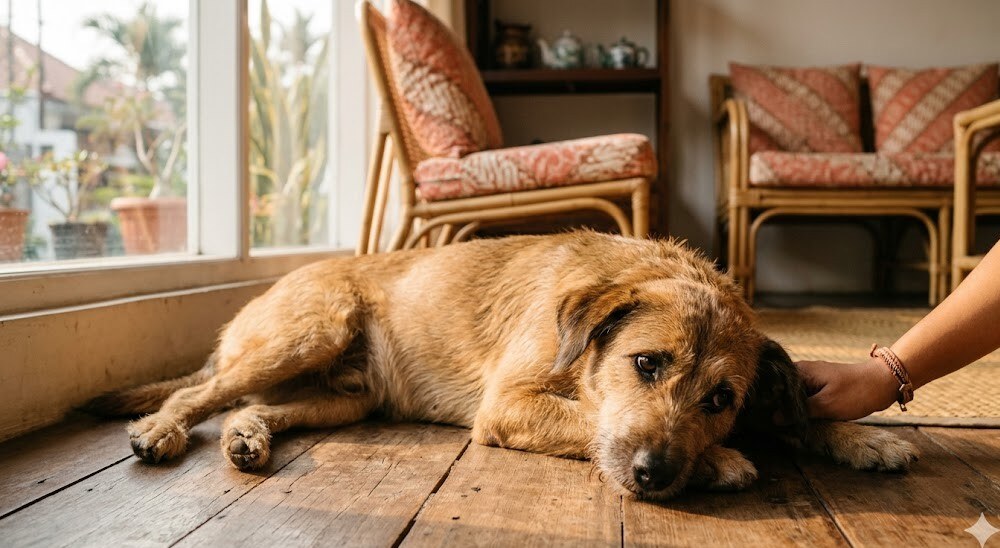

"Doctor, my dog just got home from boarding, and now he has this dry cough as if he's choking. Is that normal?" This question comes up almost every time after a long holiday season, dogs are boarded, they return home, and a few days later, they start that characteristic cough that sounds like a laughing goose. Most likely, you're dealing with kennel cough.
Kennel cough is one of the most common dog diseases found in Jakarta and other major cities, especially for socially active dogs, those that often go to daycare, dog parks, grooming, boarding, or dog shows. This article explains what Bordetella is, why kennel cough isn't actually caused by just one germ, the typical symptoms, vaccine options, the schedule based on your dog's risk level, and when you need to see a doctor.
What are Bordetella and kennel cough?
The term "kennel cough" is actually an old name. Veterinarians now more often use the term CIRDC (Canine Infectious Respiratory Disease Complex) or ITB (Infectious Tracheobronchitis), because this disease isn't caused by a single germ, but rather a combination of several agents that infect the dog's upper respiratory tract.
Some germs often involved in the CIRDC complex:
- Bordetella bronchiseptica, bacteria often serving as the primary cause or co-infection. This is the one for which vaccines are widely available in Indonesia.
- Canine parainfluenza virus (CPIV), a virus, usually included in the DHPP/DHPPi dog vaccine.
- Canine adenovirus type 2 (CAV-2), a virus, also included in the core DHPP vaccine.
- Canine respiratory coronavirus (CRCoV), a virus; a vaccine is not yet commercially available in Indonesia.
- Mycoplasma cynos, co-infecting bacteria.
- Canine influenza virus (CIV) H3N2/H3N8, common abroad; cases in Indonesia are rare.
Because the cause is multi-agent, the Bordetella vaccine alone does not 100% prevent all kennel cough, but it still significantly reduces risk + severity if the dog gets infected, especially against the most common Bordetella agent.
Kennel cough symptoms, typical signs and what to watch for
The most characteristic symptom of kennel cough is a paroxysmal dry cough, a repeating cough in short bursts, sounding like "honking" (the sound of a goose) or like the dog is choking on an object. Many owners panic, thinking there's a bone stuck in the throat.
Common symptoms of kennel cough:
- Dry cough in bursts, triggered when the dog exercises, pulls on the leash, or is excited to see you.
- Retching or gag reflex, sometimes ending with the expulsion of foam or clear mucus.
- Occasional sneezing, runny nose.
- Mild fever (sometimes no fever at all).
- Appetite is usually still good in mild cases.
- Energy levels are normal to slightly decreased.
Distinguishing it from other coughs:
- A heart cough usually appears when the dog is resting or at night, in senior dogs or predisposed breeds (Chihuahua, Pomeranian, Cavalier King Charles).
- Cough from a collapsing trachea, toy breeds, "goose-honk" sound but chronic not acute, triggered by excitement or pulling on the leash.
- Pneumonia cough is usually accompanied by a high fever, significant lethargy, and fast breathing.
Situations needing an immediate veterinary consultation (possible progression to bronchopneumonia):
- High fever (rectal temperature above 39.5°C).
- Severe lethargy, total loss of appetite.
- Fast breathing or shortness of breath (more than 30 breaths per minute while resting).
- Thick green or yellow nasal discharge.
- Coughing up blood.
- Puppies under 6 months old, senior dogs, or dogs with weak immune systems.
Transmission, why socially active dogs are at most risk
Bordetella and CIRDC viruses spread through aerosols (breath droplets) and direct contact with infected dogs or contaminated surfaces (water bowls, toys, cages). The incubation period is short, usually 2 to 10 days after exposure.
High-risk settings:
- Pet boarding / kennels, dogs from various sources gather in one location, often with limited ventilation.
- Dog daycare, daily intensive contact.
- Dog parks, unknown dogs in close contact while playing.
- Grooming salons, especially those with crowded queues + shared grooming tables.
- Dog shows / competitions, dogs gathering from many areas, high stress + exposure.
- Busy vet clinics, waiting rooms with poor ventilation (Prabasa Vet provides home visits to reduce this risk).
Dogs that never leave the house and have no contact with other dogs have low risk, but not zero, as you or guests can bring germs from outside (on clothes, shoes).
Bordetella Vaccine, options and administration
The Bordetella vaccine is a non-core vaccine according to 2024 WSAVA guidelines, meaning it is given based on the risk level of exposure, not for all dogs. Three administration routes are available, each with its pros and cons:
Intranasal vaccine
- Administered by dripping into the nostrils, not injected.
- Provides mucosal immunity (on the surface of the respiratory tract) that directly confronts germs at the entry point.
- Fast onset of protection (about 72 hours post-vaccination).
- No initial booster needed (1 dose is enough to start).
- Suitable for dogs that will be boarded soon (e.g., 1 week before boarding).
- Cons: some dogs are fussy about nose drops; occasionally sneezing or runny nose 1-2 days post-vaccination.
Oral vaccine
- Administered by dripping into the dog's cheek or gums.
- Similar principle to intranasal, mucosal immunity.
- Easier application for dogs with a phobia of nose drops.
- Protection onset similar to intranasal (about 72 hours).
- Suitable for dogs that are resistant to the intranasal route.
Injectable vaccine
- Injected subcutaneously like other vaccines.
- Provides systemic immunity (antibodies in the blood), not focused on the respiratory mucosa.
- Requires 2 initial doses 2-4 weeks apart to start protection.
- Protection onset is slower (about 2-3 weeks after the second dose).
- Suitable for dogs very resistant to mucosal routes or those with a history of severe reactions post-intranasal.
Which is most used in Indonesia? The intranasal vaccine (most common, products like Nobivac KC), due to its fast onset and practicality for dogs scheduled for boarding or grooming. Discuss with your veterinarian, local availability may vary.
Bordetella vaccine schedule based on risk
High-risk dogs (annual booster)
For socially active dogs, regularly at daycare, often boarded, monthly grooming, regular dog parks, joining dog shows, or living in dog-dense areas:
- Initial vaccine: at 8 weeks old (intranasal/oral) or 16 weeks old (injectable, needs 2 doses).
- Annual booster, every 12 months.
- For boarding/grooming facilities requiring proof of recent vaccination, many ask for the Bordetella vaccine within the last 6-12 months.
Low-risk dogs (only when needed)
For purely home dogs that rarely contact other dogs, no boarding, no daycare, grooming at home, only short walks near home:
- Consider the vaccine only when needed, before a high-risk event (e.g., first-time boarding, attending a dog community event).
- No need for routine annual boosters.
- Discuss with your veterinarian for your dog's specific risk profile.
When is the best time to vaccinate before boarding?
- Intranasal/oral vaccine: at least 1 week before boarding (ideally 2-4 weeks for a safety margin).
- Injectable vaccine: at least 3-4 weeks before boarding after the second dose.
- Do not vaccinate on the same day as boarding, the dog's body needs time to develop antibodies.
Kennel cough treatment, supportive first, antibiotics if needed
Good news: most kennel cough cases resolve on their own within 1-3 weeks with supportive home care. This includes cases where the cough is quite bothersome, a dog's body can control the infection if the immune system is normal.
What you can do at home (supportive care):
- Rest, reduce heavy exercise. Walking is fine, but avoid activities that leave the dog panting or overexcited (as it triggers coughing fits).
- Humidifier or steamy bathroom, moist air softens respiratory tract irritation. You can bring the dog into a bathroom that has just finished a warm shower for 10-15 minutes, 2-3 times a day.
- Switch collar to harness, pulling on a leash with a collar can trigger worse coughing.
- Ensure enough water, water helps thin the mucus.
- Normal nutrition, if the dog's appetite is low, offer wet food with a more attractive aroma.
- Isolate from other dogs at home, kennel cough is highly contagious between dogs (humans do not catch it).
When does a doctor prescribe antibiotics?
Antibiotics are not given for all cases, since many kennel coughs are caused by viruses (which do not respond to antibiotics). Indications for antibiotics are usually:
- Coughing lasts more than 7-10 days without improvement.
- High fever or systemic symptoms (lethargy, significant appetite loss).
- Nasal discharge turns thick yellow/green (sign of secondary bacterial infection).
- Suspected bronchopneumonia.
- Puppies or immunocompromised dogs (preventive).
Commonly used medications (Plumb's Veterinary Drug Handbook recommendations):
- Doxycycline, first-line antibiotic for Bordetella and Mycoplasma, usually for 7-14 days.
- Amoxicillin-clavulanate, a broad-spectrum alternative.
- Anti-tussive (cough suppressant), given if the cough severely disrupts the dog's rest, e.g., butorphanol (prescription only). Not given if pneumonia is suspected (as coughing helps clear mucus).
What NOT to do without a doctor's consultation: give human cough medicine (many contain dextromethorphan, paracetamol, or ingredients toxic to dogs), give leftover antibiotics from an old prescription, or immediately assume pneumonia without an exam.
Prevention, combining vaccines + exposure management
The best prevention is a combination of:
- Bordetella vaccine according to the risk schedule (see above section), combined with core DHPP vaccines that already cover CPIV + CAV-2.
- Choose boarding/grooming/daycare facilities that require Bordetella vaccination, if a facility doesn't ask for vaccine proof at all, all dogs there are at risk (including yours).
- Avoid taking your dog to crowded areas during an outbreak, local dog owners usually inform each other in dog community WhatsApp groups.
- Isolate new dogs for 1-2 weeks if you just adopted a dog from a shelter or breeder, so that if there's an infection, it doesn't spread to old dogs.
- Hygiene, wash bowls, toys, and bedding regularly, especially after contact with other dogs.
Bordetella and kennel cough FAQ
Can kennel cough spread to humans?
Risk is very low. Bordetella bronchiseptica can theoretically spread to humans, but only those with weak immune systems (HIV, chemotherapy, organ transplant). For healthy dog owners, the risk is practically zero.
My dog has a dry cough but never leaves the house, kennel cough?
It's possible, but the differential diagnosis is broad. Other causes of dry cough: collapsing trachea (toy breeds), heartworms (rare in Indonesia but possible for dogs that have been outdoors), foreign objects, allergies, early heart disease. Consult a veterinarian for a proper exam, minimal heart + lung auscultation, sometimes a chest X-ray is needed.
How long does kennel cough take to heal?
Mild cases without complications: 1-3 weeks. Cases with bacterial co-infection or weak immune systems: can take up to 4-6 weeks. As long as the dog eats well and has no fever, the recovery process usually proceeds even if the cough remains for a few weeks.
Can my 3-month-old puppy get the Bordetella vaccine?
Yes. The intranasal/oral Bordetella vaccine can generally be given starting at 8 weeks old. Discuss with your veterinarian, it's usually combined with the ongoing core DHPP vaccine schedule.
My dog just came home from boarding 5 days ago and is now coughing, Bordetella?
Very likely, matching the 2-10 day incubation period. Isolate from other dogs at home, supportive care. If there's no improvement in 7-10 days or fever/lethargy/fast breathing appears, see a doctor immediately. Contact owners of other dogs who were at the boarding as well so they are aware.
Are there severe side effects to the Bordetella vaccine?
Rare. Common ones: mild sneezing or runny nose 1-2 days post-intranasal/oral (because the live attenuated vaccine works on the mucosa). Severe allergic reactions (anaphylaxis) are very rare. For injectable vaccines, a slight swelling at the injection site may occur. If there are concerning reactions, consult a doctor immediately, details in the article Vaccine Side Effects: Normal vs. Concerning.
How much does the Bordetella vaccine cost in Jakarta?
The cost of the Bordetella vaccine isn't a single figure, it depends on the vaccine type (intranasal/oral/injectable), the product available at the clinic, your dog's breed and size, and whether it's bundled into a vaccine package or a home visit service (which adds the doctor's visit fee to your area). Because there are so many variables, the most accurate way is a direct consultation. Ask Prabasa Vet on WhatsApp for a free consultation and a specific estimate for your area.
Summary
Kennel cough is a highly contagious respiratory disease in dogs most common in socially active dogs. Caused by a combination of several germs (Bordetella bronchiseptica + parainfluenza virus + adenovirus + Mycoplasma), not a single agent. Typical symptoms are bursts of dry cough like a goose honking, with retching at the end of a fit.
For dogs regularly at boarding/daycare/grooming, an annual Bordetella vaccine is highly recommended. For purely house dogs, consider the vaccine only before high-risk events. Most cases resolve on their own in 1-3 weeks with rest + humidifier + switching to a harness. Antibiotics (generally doxycycline) are given if there are signs of secondary bacterial infection or systemic symptoms.
Want to vaccinate your dog for Bordetella at home without going to a crowded clinic (which is often a source of exposure)? See Prabasa Vet's home vaccination service or contact our WhatsApp for a free consultation and cost estimate specific to your area.
Read also: Complete Pet Vaccination Guide, Puppy + Adult Dog Vaccine Schedule, First Time Pet Vaccination: Complete Preparation.
Medical references used in this article
This article was compiled referring to the following sources, verified per clinical sentence:
- Squires RA, et al. WSAVA Guidelines for the Vaccination of Dogs and Cats. Journal of Small Animal Practice 2024 , Bordetella as a non-core (risk-based) vaccine, administration routes (intranasal/oral/injectable), annual schedule for high-risk dogs.
- AAHA Canine Vaccination Guidelines (latest), Bordetella protocols by risk profile + protection onset per vaccine route.
- Plumb's Veterinary Drug Handbook, 7th Edition, monographs for doxycycline (first-line for Bordetella + Mycoplasma cynos), amoxicillin-clavulanate, butorphanol as an anti-tussive.
- Reagan KL, Sykes JE. Canine Infectious Respiratory Disease. Veterinary Clinics of North America: Small Animal Practice, CIRDC multi-agent etiology, incubation period, clinical management.
- Nobivac Bordetella product literature (Intervet/MSD), 72-hour intranasal protection onset, dosing by age, contraindications.
This article is a general guide based on international WSAVA guidelines and current clinical literature. For your dog's specific condition, including vaccination history, current health, and exposure risk level, consulting a veterinarian is the right step. Any dog coughing for more than 7-10 days or showing high fever/lethargy/fast breathing must be examined directly to exclude pneumonia or heart disease.