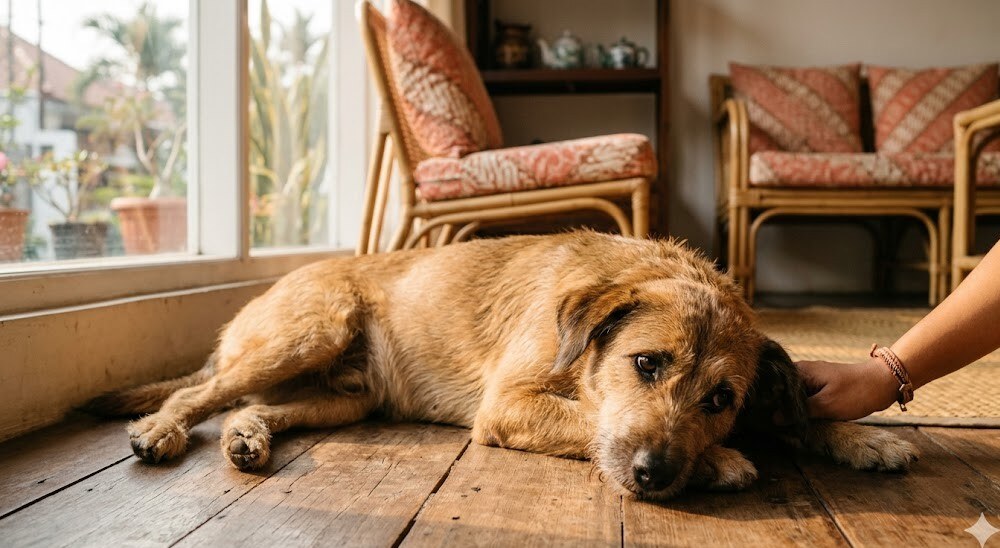

"My 10-year-old dog has been peeing so much lately, even having to go in the middle of the night, and he won't stop drinking. His belly looks more and more saggy like a ball, even though he's eating normally. His fur is also falling out on both sides of his body, and the skin looks thin. Why is that?" This question is frequently received by the Prabasa Vet team. One of the most common answers: Cushing's syndrome (hyperadrenocorticism), an endocrine disease where the body produces excessive cortisol hormone.
Cushing's is often called the "late-detected old dog disease" because symptoms appear gradually over months, and many owners mistake them for "natural signs of aging." However, the combination of PU/PD (increased peeing + drinking), a pendulum-like belly, and bilateral alopecia is a classic signal highly suggestive of Cushing's.
This article helps you recognize the Cushing's symptom cluster, understand the two main types (PDH vs. ADH), know how doctors diagnose it through LDDST and ACTH stim tests, and understand the medical treatment options (trilostane) available in Indonesia.
What is hyperadrenocorticism (Cushing's syndrome) in dogs?
Hyperadrenocorticism is a condition where the body is continuously exposed to excessive cortisol levels. Cortisol is normally a "stress" hormone that helps regulate blood sugar, blood pressure, immune response, and fat/protein metabolism. When chronically excessive, all body systems are impacted, from the skin, muscles, kidneys, and liver to the immune system.
Most veterinary endocrinology references (including the BSAVA Manual of Canine and Feline Endocrinology and the ACVIM Consensus Statement on Diagnosis of Spontaneous Canine Hyperadrenocorticism 2022) divide canine Cushing's into two main spontaneous forms:
1. Pituitary-dependent hyperadrenocorticism (PDH), about 80-85% of cases
The cause: a benign tumor (adenoma) in the pituitary gland (in the brain) that produces excessive ACTH (adrenocorticotropic hormone). This excess ACTH constantly "orders" the adrenal glands above the kidneys to produce cortisol, so cortisol rises due to orders from above, not because the adrenals themselves are damaged.
2. Adrenal-dependent hyperadrenocorticism (ADH), about 15-20% of cases
The cause: a tumor in the adrenal gland itself (usually unilateral, on one side). This tumor produces cortisol autonomously, regardless of ACTH signals from the pituitary. About half of these adrenal tumors are malignant (carcinoma), while the rest are benign (adenoma).
There is also a third form called iatrogenic Cushing's, occurring due to long-term steroid administration (prednisone, dexamethasone) for treating other diseases. This is not a tumor and is reversible by carefully tapering off steroids under a doctor's supervision. DO NOT stop steroids suddenly.
Certain dog breeds and ages are more prone to Cushing's
Spontaneous Cushing's almost always appears in senior dogs, usually 8 years and older, with a peak diagnosis at 10-12 years. It is very rare in young dogs (if young, it's usually iatrogenic or an aggressive adrenal tumor).
Breeds with higher prevalence (per BSAVA Endocrinology Manual 4th ed):
- Poodles (Toy + Miniature), significantly overrepresented.
- Dachshunds, especially minis.
- Beagles
- Boston Terriers
- Yorkshire Terriers
- Schnauzers (mini)
- German Shepherds and Labradors, often cases of adrenal tumors (ADH).
For mixed-breed dogs, Cushing's is still possible, what matters is the combination of age 8+ years with the classic symptom cluster. Don't eliminate Cushing's just because the dog isn't one of the above breeds.
Classic Cushing's symptom cluster, recognize the "old dog that suddenly pees and drinks a lot"
Cushing's symptoms appear gradually over months to years. Many owners only realize when it's quite severe because it was dismissed as "just old age." A typical cluster:
Polyuria/Polydipsia (PU/PD), often the first noticed
The dog suddenly drinks a lot (sometimes 3-4x more than normal), pees a lot, and starts peeing inside the house even if previously perfectly housetrained. The reason: excess cortisol suppresses the ADH (anti-diuretic hormone) response in the kidneys, the kidneys cannot retain water effectively, resulting in dilute and voluminous urine. The dog drinks a lot to compensate.
Check at home: measure daily water consumption. A normal dog drinks about 50-100 ml/kg/day. If consistently far above that (especially >100 ml/kg/day), this is a red flag requiring medical evaluation.
Polyphagia (increased appetite)
the dog becomes ravenous, frequently begging for food, perhaps stealing food, or becoming possessive of their bowl. Cortisol acts as a strong appetite stimulant. However, due to catabolic metabolism (breaking down muscle and skin), weight distribution changes, the belly enlarges while muscles in the legs and back shrink.
Pendulous abdomen (sagging potbelly)
This is the most visual and characteristic sign of Cushing's. The dog's belly appears sagging, round, and "low", like a balloon filled with water. The cause is a combination of:
- Enlarged liver (hepatomegaly) due to glycogen accumulation and steroid hepatopathy.
- Weakened abdominal muscles (catabolic effect of cortisol on muscle protein).
- Fat redistribution to the central abdomen.
If your senior dog has a "hunched old" posture with a clearly sagging belly visible from the side, this isn't just normal aging; it's a highly suggestive Cushing's signal.
Symmetric bilateral alopecia (hair loss on both sides)
Hair loss on the trunk, flanks, or perineum, usually symmetrical left and right. The head and legs often remain furry. The underlying skin looks thin, sometimes hyperpigmented (dark), or shows blackheads and calcinosis cutis (calcium deposits in the skin that feel hard to the touch).
Unlike skin allergies which usually cause intense itching and are asymmetric, Cushing's alopecia is typically not itchy unless there's a secondary infection.
Excessive panting, even in a cool home
Cushing's dogs often pant even when the AC is on or they haven't exercised. The cause is a combination of: respiratory muscle weakness, hepatomegaly pressing on the diaphragm, and direct cortisol effects on thermoregulation.
Muscle weakness and exercise intolerance
The dog appears sluggish, has trouble climbing stairs or jumping onto the sofa as they used to, has weak hind legs, and a "swayback" (lordosis). This is the catabolic effect of cortisol on skeletal muscle.
Frequent recurrent secondary infections
- Recurrent UTI (urinary tract infection), often without clinical symptoms (asymptomatic bacteriuria) because cortisol suppresses the inflammatory response. Regular urinalysis + urine culture is mandatory.
- Pyoderma (skin infection) and recurrent demodicosis.
- Slow wound healing, immunosuppressive effect of cortisol.
Other signs that may appear
- Calcinosis cutis, calcium deposits in the skin, feeling hard/granular, often in the back and inguinal areas.
- Large blackheads (comedones) in the belly and armpit areas.
- Testicular atrophy in unneutered males, or anestrus in unspayed females.
- Paradoxical lethargy, the dog looks tired despite a high appetite.
If you notice 3-4 or more of the above symptom clusters in a senior dog, don't wait. The longer Cushing's goes untreated, the higher the risk of secondary complications: hypertension, diabetes mellitus (a common comorbidity), thromboembolism (blood clots), pancreatitis, and accelerated kidney damage.
For senior dog owners in Jakarta and Jabodetabek who have difficulty bringing an old dog to a clinic (Cushing's dogs often have arthritis and muscle weakness making travel painful), WhatsApp Prabasa Vet for an initial discussion.
How doctors diagnose Cushing's: LDDST, ACTH stim test, and abdominal ultrasound
A Cushing's diagnosis should not be made from symptoms alone, and not from a single test alone. Per the ACVIM Consensus Statement 2022, a combination of history + clinical signs + screening tests + confirmatory tests + imaging is the standard approach.
Baseline blood panel + urinalysis
The first mandatory tests before specific Cushing's tests. Typical patterns:
- Very high ALP (alkaline phosphatase), often 3-10x the upper limit of normal. This is a specific induction of the steroid isoform (steroid-induced ALP), highly suggestive of Cushing's but not diagnostic on its own.
- Moderately elevated ALT.
- High cholesterol.
- Blood glucose upper-normal or mildly high (diabetes is a common comorbidity).
- Low USG (urine specific gravity), often <1.020 (dilute urine).
- Elevated UPC ratio (secondary proteinuria is common).
- Urine culture, mandatory because asymptomatic UTIs are often present.
Low-Dose Dexamethasone Suppression Test (LDDST), the preferred screening test
The LDDST is the most sensitive screening test for canine Cushing's. Procedure: take a baseline blood sample → inject a low dose of intravenous dexamethasone → check cortisol at hour 4 and hour 8.
In a normal dog, dexamethasone will suppress cortisol production for 8 hours. In Cushing's, suppression fails or is only temporary. The result pattern can also help distinguish PDH vs. ADH in some cases.
Pros: Very sensitive (catches 90%+ of Cushing's cases), available in many Indonesian labs.
Cons: Specificity drops in dogs with other concurrent illnesses (non-Cushing's illness can cause false positives), requires 8 hours at the clinic for sampling.
ACTH stimulation test, confirmatory + monitoring
ACTH stim test: take a baseline blood sample → inject synthetic ACTH (cosyntropin/tetracosactide) → take a sample 1 hour later.
In a normal dog, cortisol rises moderately. In Cushing's, post-ACTH cortisol rises excessively (hyperresponsive). This test is more specific but less sensitive than the LDDST for initial diagnosis.
Primary uses of the ACTH stim test:
- Confirming Cushing's when LDDST is equivocal.
- Distinguishing iatrogenic Cushing's (suppressed response) vs. spontaneous (elevated response).
- Monitoring trilostane treatment response, this is the routine test used throughout the dog's life once therapy begins.
Urinary Cortisol:Creatinine Ratio (UCCR), at-home screening
A simple screening test: collect morning urine at home for 2 consecutive days (to avoid clinic stress false positives) and send to a lab. If the UCCR is normal, Cushing's can almost be eliminated (high sensitivity). If high, confirmation with LDDST/ACTH stim is still needed due to low specificity.
Abdominal Ultrasound, distinguishing PDH vs. ADH
Once Cushing's is confirmed via blood tests, an abdominal ultrasound is mandatory to:
- Check both adrenal glands, in PDH, both adrenals are symmetrically enlarged (bilateral hyperplasia). In ADH, one adrenal has a large mass and the other is atrophied (due to suppressed low ACTH).
- Check for metastasis if an adrenal mass is present (especially to the vena cava or liver).
- Check for hepatomegaly + screening for comorbidities (gallbladder mucocele is common in Cushing's).
MRI/CT of the pituitary (if radiation is planned or neurological signs are present)
Rarely used routinely in Indonesia due to limited access. Indication: PDH dogs with neurological signs (seizures, behavior changes, circling) suggestive of a pituitary macroadenoma (a large pituitary tumor pressing on the brain). For dogs planning radiation therapy.
Treatment of Cushing's: Trilostane (Vetoryl), the primary choice
Plumb's Veterinary Drug Handbook 7e lists trilostane as the primary medical treatment for canine hyperadrenocorticism, both PDH and non-resectable or metastatic adrenal tumors. ACVIM 2022 also consensus trilostane as first-line medical therapy.
Trilostane (Vetoryl), mechanism and dosing
Trilostane is an inhibitor of the 3β-hydroxysteroid dehydrogenase enzyme in the adrenal glands, blocking cortisol production at the adrenal level. Unlike mitotane which destroys adrenal tissue, trilostane is reversible: if stopped, cortisol production returns.
Administration: Oral, usually with food for optimal absorption. Many modern protocols use twice-daily (BID) dosing with lower doses compared to once-daily, proven to provide more stable cortisol control. The exact dosing is a doctor's decision based on weight and response.
Pros:
- Reversible, if side effects occur, it is stopped and the adrenals recover.
- Effective for PDH (majority of cases) and non-operable ADH.
- Many dogs show symptom improvement within 2-4 weeks (PU/PD drops, appetite normalizes, energy improves within 1-3 months).
Cons:
- Lifelong commitment, not a cure, only control.
- Intensive monitoring: ACTH stim tests at 1 week, 4 weeks, and 12 weeks post-start, then every 3-6 months routinely. Plus regular blood panels + electrolytes.
- Risk of iatrogenic hypocortisolism (over-suppression): if the dose is too high, cortisol drops too low → Addisonian symptoms (vomiting, diarrhea, severe lethargy). This can be fatal if not handled immediately, requires stopping trilostane + steroid replacement and an emergency vet visit.
- Must not be used in dogs with severely compromised kidneys or liver, or during pregnancy.
- Trilostane (Vetoryl) in Indonesia, limited availability, may need importing through specific prescription distributors.
Mitotane (Lysodren), an alternative rarely used now
Mitotane is an older drug that works by destroying (chemoablation) the adrenal layers that produce cortisol. It involves an "induction" phase (high loading dose for 7-14 days) followed by "maintenance" (low weekly doses).
Pros: Relatively cheaper than trilostane, available at some veterinary labs/pharmacies.
Cons: Higher risk of Addisonian crisis than trilostane (adrenal damage can be excessive), more complex monitoring; many doctors now prefer trilostane due to its safety profile.
The choice between trilostane vs. mitotane is a doctor's decision based on availability, budget, and patient profile.
Surgical adrenalectomy, when it's considered
For unilateral ADH cases (adrenal tumor on one side) without metastasis in a relatively healthy dog, surgical removal of the tumorous adrenal gland can be curative.
Pros: Curative for benign adrenal tumors without metastasis. No lifelong medication needed after recovery.
Cons: Heavy general anesthesia on often comorbid senior dogs, high intraoperative bleeding risk (vascular adrenals), vena cava invasion requires vascular surgery expertise, post-op requires steroid replacement until the other adrenal recovers (months to years), not many doctors in Indonesia routinely perform this surgery.
Treating iatrogenic Cushing's, tapering off steroids
Unlike spontaneous Cushing's, iatrogenic Cushing's does not require trilostane. The treatment: gradually tapering off steroids under a doctor's supervision. Sudden stoppage can trigger an Addisonian crisis because the dog's long-suppressed adrenals are not ready to produce their own cortisol.
Monitoring after starting trilostane
General monitoring scheme (adjust to specific doctor instructions):
- 1 week post-start: ACTH stim test 4-6 hours post-dose + blood panel + electrolytes. Adjust dose if over- or under-suppressed.
- 4 weeks post-start: ACTH stim test + clinical signs re-assessment.
- 12 weeks post-start: ACTH stim test + full blood panel.
- Every 3-6 months routinely (lifelong): ACTH stim + blood panel + blood pressure + annual abdominal ultrasound.
- At any time if alarm symptoms appear: vomiting, diarrhea, severe anorexia, extreme weakness, collapse → STOP trilostane and visit an emergency vet immediately (suspected Addisonian crisis).
Monitoring compliance determines the outcome. Cushing's dogs monitored routinely with well-adjusted doses can live several years with a good quality of life.
Cushing's dog FAQ
Can canine Cushing's be cured completely?
Only the ADH form with successful surgical adrenalectomy can be curative. PDH (the majority of cases) cannot be medically cured, it can only be controlled for life with trilostane. Pituitary tumors are rarely operated on in dogs in Indonesia (radiation or hypophysectomy are not widely available).
How long can a Cushing's dog live after diagnosis?
Highly variable depending on the type (PDH vs. ADH), age at diagnosis, monitoring compliance, and presence of comorbidities. Well-controlled PDH dogs can often live 2-4 years or more from diagnosis. ADH with successfully operated benign tumors can live several years with a normal quality of life. ADH with metastatic carcinoma has a much more guarded prognosis.
Why did my dog, who initially improved on trilostane, suddenly have PU/PD recurrence?
It could be because: (a) the dose needs to be adjusted upwards due to disease progression, or (b) an ACTH stim test shows cortisol drift (Cushing's escape). A doctor visit for re-evaluation and possible dose adjustment is mandatory. DO NOT double the dose yourself, risk of over-suppression Addisonian crisis.
Can I use herbs or supplements for canine Cushing's?
There are no herbs or supplements scientifically proven to treat Cushing's. "Natural cure" claims for Cushing's are invalid marketing. Relying on herbs while not treating with trilostane = the dog remains exposed to high cortisol → complications (diabetes, thromboembolism, pancreatitis) will continue to develop.
What is the link between Cushing's and canine diabetes mellitus?
Excess cortisol causes insulin resistance → diabetes mellitus is a common comorbidity with Cushing's. An estimated 10-15% of Cushing's dogs will develop diabetes, and conversely, diabetic dogs that are hard to control sometimes turn out to have hidden Cushing's. If your diabetic dog needs high insulin doses but blood sugar remains unstable, the doctor may screen for Cushing's as well.
How much does monthly Cushing's management cost in Jakarta?
Costs vary and depend on several factors: the dog's size (the trilostane dose depends on BW, which determines the amount of medication), drug availability (Trilostane/Vetoryl in Indonesia has limited availability and sometimes needs importing), the frequency of ACTH stim tests for monitoring (more often at first, then every 3-6 months), and routine blood panels. Because of these variables, the most accurate estimate comes after knowing your dog's weight and monitoring plan. Free consultation via WhatsApp Prabasa Vet for an estimate tailored to your dog's condition. For an overview of routine at-home monitoring, see our 2026 home visit service breakdown for South Jakarta.
Can Cushing's be prevented?
There is no current prevention strategy for spontaneous Cushing's (PDH/ADH) as the cause is spontaneously occurring adrenal/pituitary tumors. What can be done: routine senior screening for dogs 8+ years (especially predisposed breeds) so that if it appears, it's detected early when treatment is most effective. For iatrogenic Cushing's, use steroids at the lowest effective dose for the shortest duration under medical supervision.
Closing
Cushing's syndrome is a serious but very manageable endocrine disease if diagnosed and treated correctly. Many well-managed Cushing's dogs can return to better energy, controlled PU/PD, and a good quality of life for several years from diagnosis.
The main key: do not ignore the PU/PD + potbelly + bilateral alopecia cluster in senior dogs. This is not a "natural sign of aging." Untreated Cushing's increases the risk of potentially fatal secondary complications, thromboembolism, diabetes, pancreatitis, and hypertension.
Diagnosis requires a layered approach (LDDST + ACTH stim test + USG), and medical treatment (trilostane) requires intensive monitoring, especially in the first 12 weeks. Owner commitment to routine monitoring is the largest factor determining the outcome.
For senior dog owners in Jakarta and Jabodetabek who have difficulty bringing an old dog to a clinic (Cushing's dogs often have arthritis and muscle weakness making travel painful), WhatsApp Prabasa Vet for an initial discussion, we help assess the situation and schedule visits for blood and urine sampling at home.
Read also: Senior Cat Hyperthyroidism: Signs, T4 Diagnosis, and Treatment Options, Senior Dogs: Changes and Senior Care, Signs of Dog Sickness Requiring a Vet, Complete Pet Care Guide.
Medical references used in this article
This article was compiled referring to the following sources, verified per clinical sentence:
- Behrend EN, Kooistra HS, Nelson R, Reusch CE, Scott-Moncrieff JC. Diagnosis of Spontaneous Canine Hyperadrenocorticism: 2012 ACVIM Consensus Statement (Small Animal), updated framework 2022 , diagnostic algorithm, LDDST + ACTH stim test interpretation, and USG criteria for PDH vs. ADH.
- Mooney CT, Peterson ME (eds). BSAVA Manual of Canine and Feline Endocrinology 4th ed, PDH vs. ADH pathophysiology, breed predisposition, clinical sign clusters, and treatment modality comparisons.
- Feldman EC, Nelson RW, Reusch CE, Scott-Moncrieff JC. Canine and Feline Endocrinology 4th ed, comprehensive endocrinology reference, trilostane and mitotane protocols, and surgical adrenalectomy considerations.
- Plumb's Veterinary Drug Handbook 7e, trilostane (Vetoryl) dosing for dogs, contraindications, monitoring requirements (ACTH stim test schedule), mitotane (Lysodren) protocol, and iatrogenic hypocortisolism management.
This article is a general guide based on the ACVIM Consensus Statement + veterinary endocrinology textbooks. For a Cushing's diagnosis and treatment plan specific to your dog, including LDDST/ACTH stim result interpretation, trilostane vs. mitotane choices, dose and monitoring schedules, and integration with other comorbidities, consulting a veterinarian is the right step.