
The aquatic turtle, often called the "Brazilian turtle" in Indonesian animal markets, is one of the most commonly mis-kept reptiles. A coin-sized baby is sold cheaply at the market or online with a small bowl + decorative rocks, with no mention that within 3–5 years they will need a large 100+ gallon aquarium, a strong filter, a dry basking dock, and a special UV-B lamp. As a result, many aquatic turtles in Indonesian homes suffer shell rot, MBD (metabolic bone disease), or ear abscess from vitamin A deficiency, all preventable with correct husbandry.
This article is a guide for those of you who are new to keeping an aquatic turtle or are considering adoption, the common species, the legal status you should understand first, the minimum aquarium setup, a balanced diet, the common problems you must recognise, and the Salmonella zoonosis that is so often overlooked. Disclaimer: this is general guidance based on international reptile husbandry principles, not a substitute for a direct consultation with an exotic vet for your specific turtle's condition.
Tell apart aquatic turtles (terrapins) vs land tortoises
Misidentification is the most fatal early mistake. A land tortoise forced to swim for long periods can drown; an aquatic turtle kept in a dry enclosure without a pool will dehydrate and slowly die.
- Aquatic turtle / terrapin, webbed feet, a flatter and more streamlined shell, needs a deep water pool (able to swim) + a dry dock for basking. Examples: Red-Eared Slider, Yellow-Bellied Slider, Map Turtle.
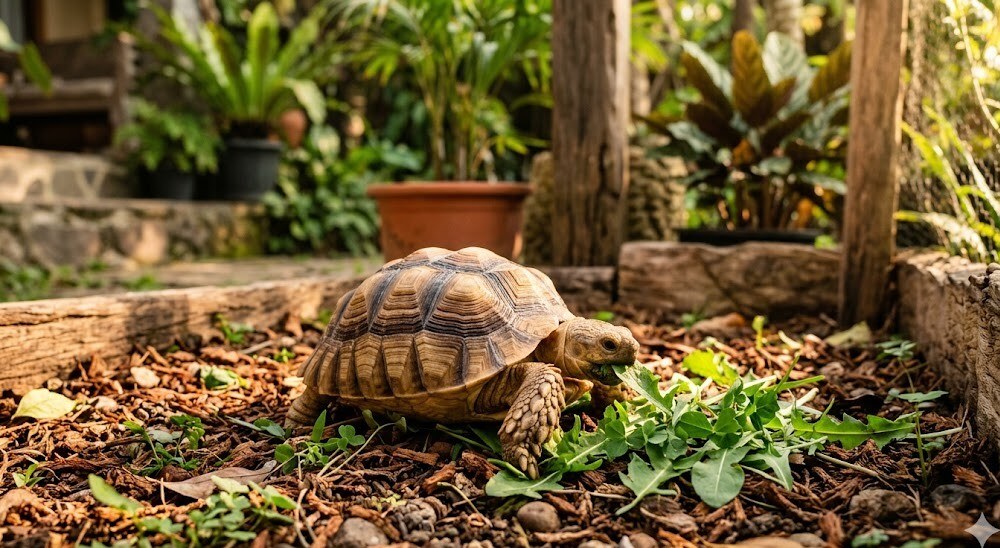
- Tortoise (land tortoise), elephant-like feet, a tall domed shell, 100% terrestrial, only needs a shallow soaking bowl. Examples: Sulcata, Indian Star, Russian, Hermann's.
If you bought a small turtle with a "pool + rocks" package at the animal market, that is almost always a Red-Eared Slider (RES) or its close cousin, not a tortoise. Check the species first before building the setup. For a land tortoise guide, read Keeping a Land Tortoise: Types, Food, and Enclosure.
Popular aquatic turtle species in Indonesia
1. Red-Eared Slider (RES), "Brazilian Turtle"
- Adult size: 25–30 cm shell length (males are usually smaller than females).
- Origin: Central/South America and the southeastern United States, not from Brazil, despite the popular name in Indonesia.
- Lifespan: 20–30 years (many reports of 40+ years with good care).
- Markings: a distinctive red stripe on both sides of the head near the ears (very bright in juveniles, fading in adults).
- Invasive status: the RES is one of the most aggressive invasive species in the world because so many owners release them into rivers/lakes when they can no longer care for them. They dominate local habitats and displace native turtles. Some countries (the European Union, several US states) ban ownership, trade, or release into the wild. In Indonesia the regulation is not yet that strict, but NEVER release a pet aquatic turtle into Indonesian rivers/lakes/ponds, it is illegal and ecologically damaging.
2. Yellow-Bellied Slider
- Adult size: similar to the RES, 20–30 cm.
- Markings: a bright yellow belly (plastron) with a black pattern, no red stripe on the head (the head is more yellow-brown).
- Lifespan: 20–30 years.
- Note: husbandry needs are almost identical to the RES, often sold together at markets and sometimes hybridised between the two species. Both are likewise invasive species outside their natural habitat.
3. Map Turtle
- Adult size: females 18–25 cm, males far smaller at 8–13 cm (strong sexual dimorphism).
- Origin: North American rivers, especially the Mississippi basin.
- Markings: a shell pattern resembling map contours (hence the name), a prominent keel (ridge along the shell).
- Note: more sensitive to water quality than the RES, needs stronger filtration. More basking time than sliders. Diet leans more carnivorous (insects, small fish, snails).
Legality and ethics before adoption
A few things you should understand before buying an aquatic turtle:
- Source of origin: most baby RES in Indonesian markets come from large-scale farm breeding in Southeast Asia (Malaysia, Vietnam, Thailand). Some lots are smuggled wild-caught animals, with a very high post-transport mortality rate. Ideally choose captive-bred animals from a reputable breeder/reseller, even though the price is usually higher.
- Invasive status: the RES is a global invasive species. Some countries restrict or ban it. In Indonesia the legal status is still broad, but ownership comes with responsibility, a commitment to care for the animal's whole life (20–30 years), and NEVER release it into the wild when you can no longer cope.
- Verify local regulations before buying, local government / Agricultural Quarantine rules can differ for ownership, inter-province transport, and trade. Check the latest update before committing.
- Some other species (Indian Roofed, Pig-Nosed Turtle, Mata Mata): are protected or CITES-listed in many jurisdictions, DO NOT buy if the status is unclear.
Aquatic turtle aquarium setup
Tank size, FAR larger than you think
The international reptile community's rule of thumb: minimum tank size = 10 gallons of water per inch of adult shell length (or ~38 litres per 2.5 cm of shell length). For an adult RES at 25 cm = 100 gallons (~380 litres) minimum.
- Juvenile (shell < 10 cm): a 75–100 litre tank is enough for the first 6–12 months
- Sub-adult (10–18 cm): upgrade to 150–250 litres
- Adult (> 18 cm): minimum 380 litres, ideally 500+ litres or an outdoor pond
- Multiple turtles: add 50% volume per additional turtle, monitor aggression (adult male RES can be territorial)
The small tank often sold in a package with a baby is suitable only for the first 3–6 months. Regular upgrades = part of the commitment of keeping an aquatic turtle.
Filtration, an aquatic turtle is a "messy eater"
Aquatic turtles defecate in the water and often spill food when eating. Without strong filtration, the water quickly becomes cloudy, ammonia levels rise, and the turtle is exposed to pathogenic bacteria that trigger shell rot and respiratory infection.
- A canister filter with a capacity of 2–3× the tank volume per hour (for a 200-litre tank → minimum 500 litres/hour flow rate)
- Mechanical + biological + chemical media (sponge, ceramic, activated carbon)
- A partial water change of 25–50% per week if the filter is adequate; more often if under-filtered
- Use a dechlorinator for tap water before it goes into the tank
- Monitor water parameters: ammonia ≈ 0, nitrite ≈ 0, nitrate < 40 ppm, pH 6.5–7.5
Basking dock, a dry area is mandatory
An aquatic turtle must be able to climb onto a dry surface to bask and dry its shell, if not, shell rot and skin infection are almost certain. The basking dock must be:
- Completely dry (not flooded with water when the turtle climbs up)
- Large enough for all turtles in the tank to climb up together without jostling
- Easily accessible from the water (a ramp, steps, or a floating dock)
- Stable, an adult turtle can weigh 2–3 kg, and a flimsy dock can collapse
UV-B lighting, non-negotiable
Just like a land tortoise, an indoor aquatic turtle needs a UV-B lamp to synthesise vitamin D3 and absorb calcium. Without adequate UV-B = MBD = a soft shell, deformation, and early death.
- A UV-B lamp specifically for reptiles (10–12% UV-B output, T5 HO or T8 format with a reflector)
- Duration of 10–12 hours per day (a timer makes it easier)
- Lamp-to-basking-spot distance: 25–40 cm (check the brand's specifications, too far = useless)
- Replace the bulb every 6–12 months even if it still lights up, UV-B output drops sharply before the bulb visibly dies
- Outdoor with direct sunlight for 1–2 hours/day = better than any lamp (use an outdoor pond setup if possible)
Heat lamp, the basking spot must be warm
Besides UV-B, you need a heat lamp for the basking spot because reptiles depend on external temperature to regulate their metabolism:
- Basking spot: 32–35°C (check with a digital thermometer, don't guess)
- Water temperature: 24–27°C for an adult RES/Slider, use a submersible aquarium heater
- Baby turtles: warmer water at 26–28°C
- Night temperature: the water must not drop below 22°C
Aquatic turtle diet, omnivore, not pure carnivore
The classic new-owner mistake: feeding only small fish or shrimp every day because "an aquatic turtle = eats fish." But the RES and its relatives are opportunistic omnivores, in the wild they eat fish, insects, snails, and tadpoles, but also aquatic vegetation and plants. A fish-only diet = a deficiency in vitamins (especially A) + thiamine deficiency + obesity.
Ideal diet composition for adults
- 50% quality commercial aquatic turtle pellet, a balanced base diet (Mazuri, Tetra ReptoMin, Hikari are often recommended by the community)
- 25% animal protein, whole small fish (smelt, silverside) whose bones are swallowed too (calcium), whole shrimp, crickets, mealworms. Avoid pure fish fillet or live goldfish (high thiaminase)
- 25% aquatic vegetation and greens, duckweed, water lettuce, water hyacinth, romaine lettuce, dandelion leaves, hibiscus leaves. Avoid iceberg lettuce (zero nutrition)
- Frequency: an adult only needs to eat 3–4× per week (overfeeding causes obesity and poor water quality); a juvenile daily with a portion the size of its head
What MUST be avoided
- A pellet-only diet, even if balanced, monotonous → gradual deficiency
- A fish/shrimp-only diet, vitamin A deficiency → ear abscess + eye infection, or thiaminase → vitamin B1 deficiency
- Mammal meat (chicken, beef), too high in fat for reptiles, causes fatty liver
- Milk, cheese, bread, reptiles are not adapted to these processed products
- Iceberg lettuce, excessive spinach, low nutrition / high oxalate (blocks calcium)
Supplementation
- Cuttlebone floating in the water, an ad libitum calcium source
- Calcium powder without D3 dusted thinly over the pellets 2× per week (if outdoor + sunlight) or more often if full indoor
- A reptile multivitamin 1× per week, avoid over-supplementing vitamin A (overdose is toxic)
Common aquatic turtle health problems
1. Shell rot
A bacterial/fungal infection of the keratin shell, often appearing as white/yellow patches, small pits, or a lifted scute with a foul smell. Causes: poor water quality, no dry basking dock, or an undetected small wound. Without quick intervention, the infection can spread to the shell bone (osteomyelitis), which is hard to treat. Needs exotic vet evaluation for debridement + antiseptic + systemic antibiotics if severe.
2. Ear abscess (vitamin A deficiency)
A telltale sign: a firm swelling on both sides of the head near the ears, which can grow to the size of a bean. The main cause: a diet lacking vitamin A (too much fish, not enough vegetation). Treatment usually requires surgical drainage + long-term diet correction + vitamin A supplementation, not a condition that can be "left to heal on its own."
3. MBD (Metabolic Bone Disease)
A deficiency of calcium or vitamin D3 causes a soft shell (a healthy carapace is hard), weak legs, and long-term shell deformation. Causes: no adequate UV-B, a diet lacking calcium, or a UV-B bulb whose output has expired (common because it is not replaced regularly). An emergency that needs an exotic vet for diet correction + supplementation + husbandry reset.
4. Respiratory infection (RI)
Noisy breathing (wheeze), bubbles at the nose, frequently open mouth, listing to one side when swimming, lethargy. Common causes: a drop in water temperature, poor water quality, a drafty enclosure. RI needs antibiotics from an exotic vet (often injectable because reptile oral absorption is slow), it cannot be ignored.
5. Eye infection
Swollen, closed eyes, with discharge. Often a combination of vitamin A deficiency + poor water quality. Needs exotic vet evaluation for eye drops + diet correction + husbandry improvement.
6. Internal parasites
A turtle that is originally wild-caught almost certainly has worms and protozoa. A faecal exam with an exotic vet within the first 1–2 months after adoption is highly recommended for proper deworming (don't just use cat/dog dewormers, the wrong dose can be toxic).
Salmonella zoonosis, important for families with children
Reptiles, especially aquatic turtles, are natural shedders of Salmonella bacteria without showing illness. These bacteria are present in the faeces, the aquarium water, and on the turtle's body surface. In humans they can cause severe gastroenteritis, particularly dangerous for small children, pregnant women, the elderly, and people with weakened immunity.
The standard prevention protocol per international public health guidelines:
- Wash your hands with soap every time after handling the turtle, cleaning the tank, or handling tank equipment
- DO NOT kiss the turtle or bring it near your face
- DO NOT clean the tank or accessories in the kitchen (the dishwashing sink or a food-preparation basin), use a dedicated basin or do it outdoors
- Children < 5 years old, pregnant women, and immunocompromised individuals should not handle aquatic turtles in line with international public health guidelines
- An aquatic turtle is not an ideal pet choice for a home with a toddler, consider carefully before adopting if there are small children
This is not to frighten you, an aquatic turtle can be kept safely with consistent hygiene. But families with small children must be aware of this risk from the start.
Why an aquatic turtle needs an exotic vet
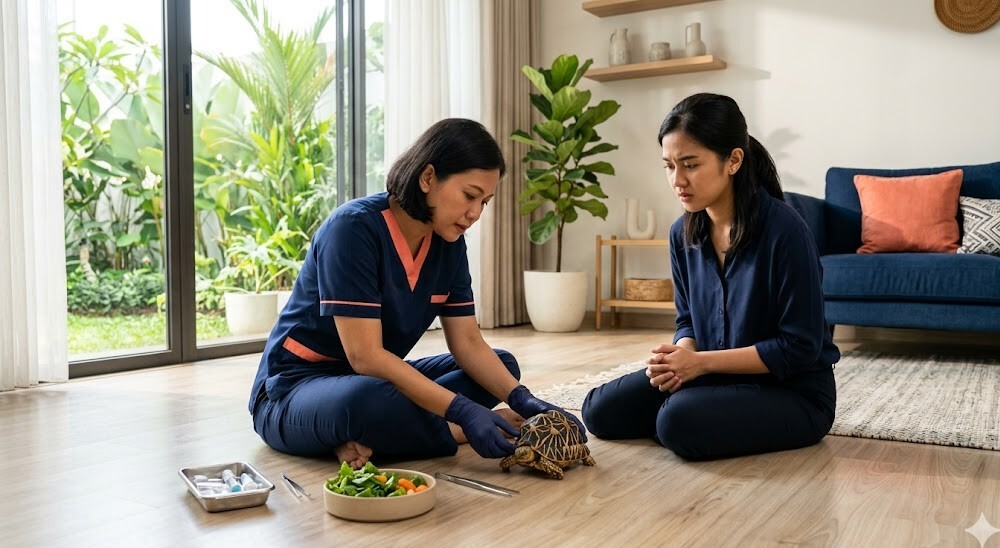
Reptiles have anatomy, physiology, and drug responses that differ greatly from mammals. Reptiles call for species-specific experience to handle correctly.
- Reptile antibiotic and antiparasitic doses are very different, extrapolating from mammals can be toxic (reptiles metabolise far more slowly)
- Reptile anaesthesia needs special adjustment (turtles have no diaphragm, incorrect anaesthesia can be fatal)
- Surgical drainage of an ear abscess or debridement of shell rot needs specific chelonian techniques
- Reptile blood work has very different normal ranges from mammals, a misinterpretation can miss a serious diagnosis
For aquatic turtle owners in Greater Jakarta, an exotic vet house call can be a practical option, a large turtle with a heavy tank is very difficult to bring to a clinic, and transport stress can worsen its condition.
FAQ
How long does an aquatic turtle live?
The Red-Eared Slider and Yellow-Bellied Slider average 20–30 years, with many reports of 40+ years with good care. The Map Turtle is 15–25 years. This is a very long-term commitment, often longer than the average marriage. Think about a succession plan (who will care for it if you can't) before adopting.
Can I keep an aquatic turtle in an apartment?
You can, but with limits, a 100+ gallon tank for an adult RES needs space and a strong floor structure (a 100-gallon tank with water alone is already 400 kg+). Consider a smaller species like a male Map Turtle (adults only 10–13 cm), which is more realistic for an apartment. Or set up an outdoor pond if you have a balcony/terrace with sun access.
Why is my turtle's shell peeling?
Shedding scutes (the outer keratin layer) is normal in aquatic turtles as they grow, the old scute peels off like a thin transparent piece of plastic and a new scute appears beneath. What is NOT normal: a fragile scute, a foul smell, redness/whiteness underneath (= shell rot), or upward growth like a pyramid (= pyramiding from a diet too high in protein). If in doubt, consult an exotic vet for evaluation.
My turtle won't eat, why?
Common causes: (1) the water or basking spot temperature is too low (a turtle won't eat if its body temperature is below optimal), (2) the UV-B bulb's output has expired, (3) internal parasites, (4) respiratory infection, (5) overfeeding in the previous period (turtles have an appetite cycle), (6) natural winter cooling (rare in Indonesia, but it can happen if the temperature drops). If it goes more than 1–2 weeks without eating + lethargy + other signs (swollen eyes, noisy breathing), consult an exotic vet immediately.
Is it safe to keep an aquatic turtle if there are small children at home?
International public health guidelines recommend that families with children < 5 years old, pregnant women, or immunocompromised individuals should not handle reptiles, including aquatic turtles, because of the risk of Salmonella shedding. This does not mean it is forbidden entirely, but the hygiene protocol must be very strict (wash hands after handling, don't clean the tank in the kitchen, children should not handle the turtle directly). Consider carefully before adopting if there is a toddler at home.
Can Prabasa Vet make a house call for an aquatic turtle?
Yes. An adult aquatic turtle with a large tank actually benefits greatly from a home visit, the turtle does not have to endure transport stress to a clinic (which can cause RI or shell cracks), and the vet can observe your tank setup directly and suggest relevant husbandry tweaks. When you message on WhatsApp, mention the turtle species, size/age, the condition you are concerned about, and your area, our team will find a partner vet with experience handling reptiles.
Closing
Keeping an aquatic turtle can be very rewarding, they are active, expressive, and have a unique personality that develops over the years. But they are not the cheap/easy pet their reputation in Indonesian markets suggests. A correct initial setup (a large tank, strong filtration, a dry basking dock, a UV-B + heat gradient, a balanced omnivore diet), hygiene to prevent zoonosis, and access to an exotic vet when their condition worsens are investments that pay for themselves with a healthy turtle living its full lifespan of two decades or more.
Need a consultation or to schedule a vet house call for your aquatic turtle? Contact us via WhatsApp, mention the turtle species, size/age, the condition you are concerned about, and your area, and our team will find a partner vet with experience handling reptiles.
Read also: Keeping a Land Tortoise: Types, Food, and Enclosure, Keeping a Green Iguana: Enclosure, Diet, and Mandatory UV-B, Pet Care Guide, Exotic Vet House Call.
Medical references used in this article
This article was compiled with reference to the following sources, verified per clinical statement:
- Girling SJ, Raiti P (eds). BSAVA Manual of Reptiles 2nd ed., chapters on chelonian husbandry, aquatic turtle nutrition, shell rot, ear abscess from vitamin A deficiency
- Mader DR, Divers SJ (eds). Mader's Reptile and Amphibian Medicine and Surgery 3rd ed. Elsevier, chelonian medicine, UV-B requirements, diagnostic approach to common diseases
- ARAV (Association of Reptile and Amphibian Veterinarians), clinical guidelines on aquatic turtle husbandry, faecal exam protocol, vitamin A correction
- LafeberVet exotic pet care references, aquatic turtle diet (50/25/25 framework), tank sizing 10-gallon-per-inch rule, water quality parameters
- CDC (Centers for Disease Control and Prevention) reptile-associated salmonellosis guidelines, public health precautions, handwashing protocol, high-risk populations
- IUCN Red List + invasive species literature, RES global invasive status, ethical ownership considerations
This article is general guidance based on international reptile husbandry and public health principles. For your turtle's specific condition, including an abnormal shell, difficulty breathing, or not eating for more than a week, a consultation with an exotic vet is the right step.