
Land tortoises are often considered an "easy pet", put it on the terrace, give it vegetables, done. Yet this assumption is exactly the main reason land tortoises in Indonesia suffer shell pyramiding, MBD (metabolic bone disease), or die young in their first year. Land tortoises need the right UVB lighting, an enclosure heat gradient, and a very specific high-fibre diet, and many problems only become visible once the condition is already chronic.
This article is a guide for those of you new to keeping a land tortoise or considering adoption, which popular type suits you, the difference between a land tortoise and an aquatic turtle, what an ideal enclosure looks like, the correct diet, and the warning signs you must recognise. Disclaimer: this article is general guidance based on reptile husbandry principles, not a substitute for a direct consultation with an exotic vet.
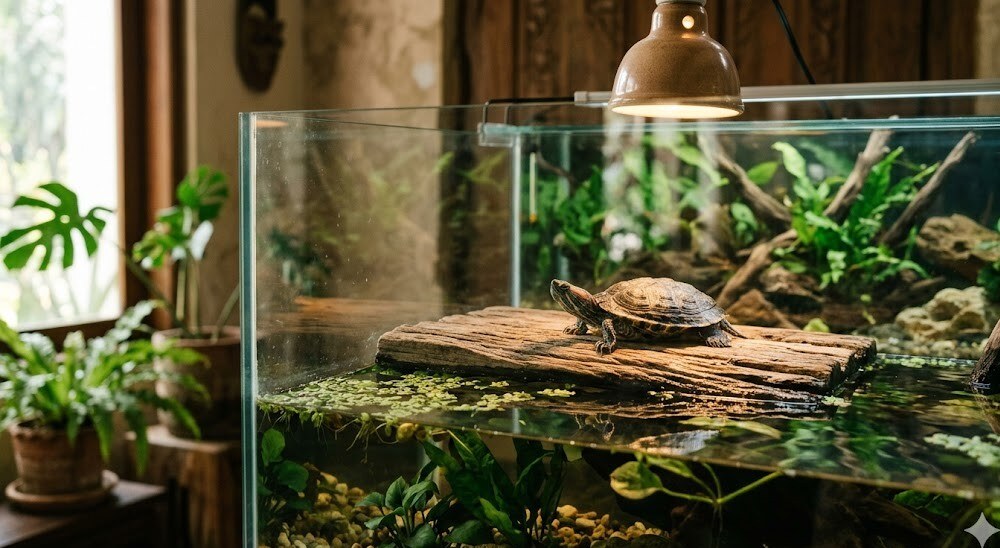
Tell apart a tortoise (land) vs a terrapin (semi-aquatic)
One of the most fatal mistakes for new owners in Indonesia: misidentifying the type of turtle, then giving it the wrong setup. A tortoise forced to swim can drown; a terrapin kept dry without water can become severely dehydrated.
- Tortoise (land tortoise), elephant-like feet, a tall domed shell, 100% terrestrial, only needs a shallow soaking bowl. Examples: Sulcata, Indian Star, Russian, Hermann's, Aldabra.
- Terrapin (semi-aquatic), webbed feet, a flatter shell, needs a water pool. Examples: Red-Eared Slider (RES), the "Brazilian turtle" popularly sold cheaply at animal markets.
- Sea turtle, fully aquatic, never legally kept (a protected species).
If you bought a "turtle" at the market and were given a water pool without any land, it is most likely a RES/terrapin, not a tortoise. Make sure you identify the type before building the enclosure.
Getting to know popular land tortoise types in Indonesia
1. Sulcata Tortoise (African Spurred Tortoise)
- Adult size: giant, 50–80 kg, shell length 60–80 cm. The third largest in the world after the Galapagos and Aldabra.
- Origin: the sub-Saharan African savanna, very well suited to Indonesia's tropical climate.
- Lifespan: 50–80 years (there are even reports of 100+ years).
- Note: a baby Sulcata sold the size of a cup can grow to the size of a washing machine within 10–15 years. A multi-generational commitment (often outliving its owner).
- Challenge: needs a large outdoor enclosure as an adult (10+ m² minimum), and digs burrows powerfully up to 3 metres deep.
2. Indian Star Tortoise
- Adult size: small to medium, 20–30 cm shell length.
- Origin: India, Sri Lanka, Pakistan, tolerant of a humid tropical climate.
- Lifespan: 30–80 years.
- Note: a yellow star pattern on the carapace = its signature, very popular in Asian markets. CITES Appendix I since 2019, international trade is heavily restricted, and many Indian Stars in Indonesia have a grey legal status.
- Sensitivity: susceptible to cold temperatures and the wrong humidity, shell pyramiding is very common with poor husbandry.
3. Russian Tortoise (Horsfield's Tortoise)
- Adult size: small, 15–25 cm.
- Origin: Central Asia (Russia, Kazakhstan, Afghanistan), accustomed to a semi-arid climate.
- Lifespan: 40–50 years.
- Note: in the wild it hibernates in winter, in tropical Indonesia it does not need to hibernate (in fact it can be stressed if forced to). More susceptible to constant high humidity (risk of respiratory infection).
4. Hermann's Tortoise
- Adult size: small to medium, 15–25 cm.
- Origin: the Mediterranean (Italy, Greece, the Balkans).
- Lifespan: 50–75 years.
- Note: similar to the Russian in size but with a more contrasting yellow-black shell pattern. Better suited to a beginner who is consistent with UVB + heat lamp and does not want something as large as a Sulcata.
5. Aldabra Giant Tortoise
- Adult size: the second largest in the world, 100–250 kg, shell 90–120 cm.
- Origin: the Aldabra Atoll (Seychelles).
- Lifespan: 100–150+ years.
- Note: very rare in Indonesia, usually only in zoos or private collections with special permits. CITES Appendix II. A very large financial and spatial commitment, not a starter pet.
Legality and ethics of ownership
Several popular land tortoise types in Indonesia are on the CITES (Convention on International Trade in Endangered Species) list, international trade and ownership are restricted. The Indian Star (Appendix I), Aldabra (Appendix II), and some Hermann's subspecies are also protected. Make sure the animal's origin is clear and documentation (if any) is available before buying. Many baby tortoises in Indonesian animal markets are wild-caught with a high mortality rate, if possible, choose a captive-bred animal from a reputable breeder.
The ideal enclosure for a land tortoise
The small plastic enclosure often sold at pet shops for baby tortoises is really only suitable temporarily (1–2 months). A tortoise confined to a cramped space shows signs of chronic stress and long-term shell development problems.
Outdoor vs indoor, Indonesia's climate is an advantage
Indonesia is one of the best places in the world to keep a land tortoise outdoors because of the tropical climate. If you have a yard or terrace with direct sunlight access, make the most of it:
- Outdoor preferred, sunlight = the best natural UVB source, free, and far stronger than a commercial UVB lamp
- A strong fence / enclosure at least 30–50 cm tall (tortoises climb better than you think), with the base buried or a barrier going downward (for Sulcata that like to dig)
- A shade area, important so it can choose for itself when to bask vs shade (natural thermoregulation)
- A roofed section over at least part of it (for sudden tropical rain)
- Avoid grass recently sprayed with pesticide, toxic to tortoises
Minimum indoor size
If an outdoor setup is not yet possible (an apartment, extreme weather), the indoor enclosure must be at least:
- Minimum 4× the adult carapace length × 2× the width for a baby/juvenile
- For a Russian/Hermann's juvenile: minimum 120 × 60 cm
- For a Sulcata juvenile: minimum 150 × 80 cm (it will grow fast, prepare for regular upgrades)
- An adult Sulcata: MUST have an outdoor pen of 10+ m² minimum, there is no viable indoor alternative
Safe substrate
The substrate is the base layer the tortoise walks, digs, and thermoregulates on. The wrong substrate choice can trigger intestinal impaction or a respiratory issue:
- Cypress mulch, the most popular choice, retains moisture well, safe if a little is swallowed
- Coco coir / coconut fibre, good for humidity, soft on the feet
- An organic topsoil mix with coarse sand, a natural feel, good for tortoises that like to dig (especially Sulcata)
- Sphagnum moss in the hideout for high local humidity
- AVOID pure sand (especially fine sand), a risk of intestinal impaction when swallowed with food, which can be fatal especially in babies
- AVOID small gravel, the same impaction risk
- AVOID cedar or pine shavings, aromatic phenols are toxic to reptiles
- AVOID newspaper bedding/synthetic carpet, too dry, no burrowing opportunity
UVB lighting, MANDATORY for indoor
UVB lighting is a non-negotiable element for an indoor tortoise. Without adequate UVB, the tortoise cannot synthesise vitamin D3 → cannot absorb calcium → MBD (metabolic bone disease) → shell deformation, brittle bones, early death.
- A UVB lamp specifically for reptiles (T5 HO 10.0 or T8 10.0), not an ordinary UV lamp
- Duration: 10–12 hours per day, simulating a natural tropical cycle
- Lamp-to-tortoise distance: 25–40 cm depending on the type (check the brand's instructions)
- Replace the bulb every 6–12 months even if it still lights up, UVB output drops well before the bulb visibly dies
- Outdoor in direct sunlight for 1–2 hours per day = better than any lamp
Heat gradient
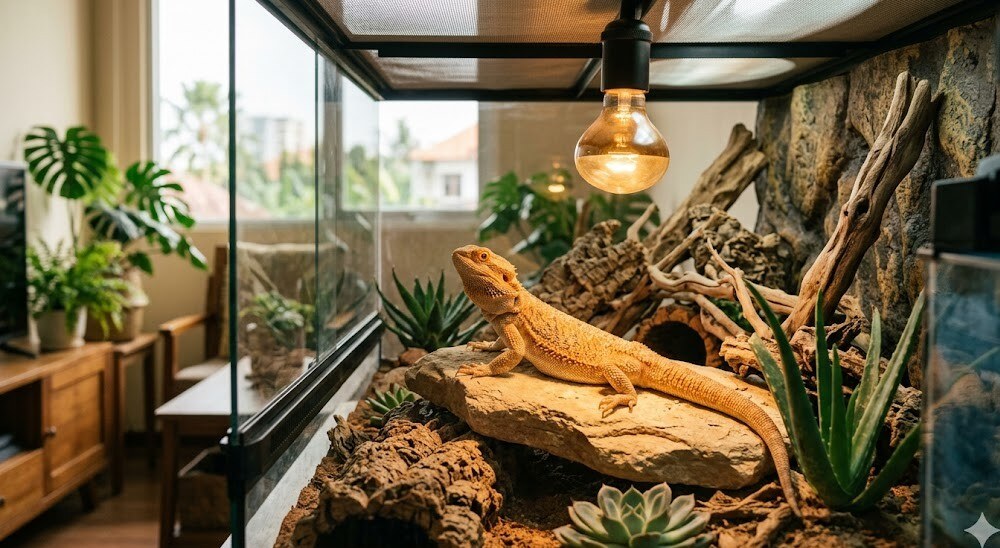
Tortoises are ectothermic, they thermoregulate by moving between warm and cool areas of the enclosure. The enclosure must have a clear gradient:
- Basking spot: 32–35°C, the area under the heat lamp for basking and digesting food
- Cool area: 22–25°C, a shaded area for resting and hiding
- Night temperature: must not go below 18°C, tropical tortoises (Sulcata, Indian Star) should ideally not go below 22°C even at night
- Use a digital thermometer at two points (basking + cool) to monitor, don't guess
Other important accessories
- A hide / shelter, at least 1 in the cool area, large enough for the tortoise to fully enter and turn around
- A shallow soaking bowl (depth only up to the plastron / chest), for drinking and soaking the body, change the water daily
- A humidity gauge, tropical tortoises (Sulcata, Indian Star) need 50–70%, Mediterranean ones (Russian, Hermann's) prefer drier at 30–50%
- Rocks / branches that are safe for climbing and naturally wearing down the nails
Land tortoise diet
This is the area most often gotten wrong by new owners in Indonesia. The land tortoise is a strict herbivore, not an omnivore, not a fish eater, not an eater of cheap commercial pellets. A wrong diet = shell pyramiding + MBD + long-term kidney problems.
Ideal diet composition
- 80% high-fibre greens and weeds, the main base, high variety
- 10–15% vegetables low in starch
- 0% (or very minimal) fruit, land tortoises are evolutionarily not adapted to high sugar
- 0% animal protein, Sulcata, Russian, Hermann's, and Indian Star are all strict herbivores. Excess protein causes too-rapid growth → pyramiding + kidney problems
- Commercial pellets: avoid those meat-based or high in fat. If using them, choose a herbivore tortoise-specific pellet (Mazuri Tortoise Diet is one recommended by the exotic community), a maximum of 5% of the total diet
Recommended greens
- Kale (in variety, not every day because of oxalate)
- Collard greens
- Dandelion (leaves + flowers), much sought after by tortoises, high in fibre and calcium
- Hibiscus leaves (leaves + flowers, very good)
- Young papaya leaves
- Sweet potato leaves
- Mulberry leaves
- Banana leaves (a little, as a treat)
- Grape leaves
- Calendula, nasturtium, viola flowers (if available)
- Pak choi (a little, in rotation)
- Romaine or lollo rosso lettuce (a little, not iceberg which is low in nutrition)
Vegetables (small portion, occasional)
- Grated carrot (a little, because it is high in sugar)
- Chayote, ripe pumpkin
- Cucumber (only a little, high water content can cause diarrhoea)
- Bell pepper (bright colours)
- Broccoli (small florets, not excessive)
What is not allowed at all
- Meat, fish, eggs, dog food, cat food, animal protein causes pyramiding + kidney failure
- Bread, rice, pasta, biscuits, simple starches that are not natural for a tortoise
- Excessive fruit (banana, mango, watermelon, grapes), sugar causes gut dysbiosis, diarrhoea
- Milk, yoghurt, cheese, reptiles lack the lactase enzyme
- Spinach, rhubarb in large amounts, very high in oxalate, interferes with calcium absorption
- Avocado, toxic to many reptiles
- Onion, scallion, toxic
- Iceberg lettuce, almost 0 nutrition, just water
- Generic commercial pellets (dog/cat/rabbit), the wrong formulation for herbivore tortoise physiology
Calcium supplementation
Even with a good varied greens diet, indoor tortoises often need extra calcium:
- Cuttlebone, place it in the enclosure, the tortoise will gnaw it itself when needed
- Calcium powder without vitamin D3 dusted thinly over greens 2–3× per week (if outdoor with sunlight UVB) or more often if full indoor
- A reptile multivitamin 1× per week (don't over-supplement, a vitamin A overdose is dangerous)
Common land tortoise problems
1. Shell pyramiding
Pyramiding is a condition where the scutes (the boxes of the shell) grow upward like pyramids instead of flat and smooth. Very common in captive Sulcata and Indian Star in Indonesia. Main causes:
- A diet too high in protein and calories
- Enclosure humidity that is too low (especially Sulcata babies, which actually need high humidity, contrary to the "savanna = dry" assumption)
- Inadequate UVB
- Too-rapid growth
Pyramiding that has already formed cannot be removed, but it can be stopped with husbandry correction. If you see a baby tortoise's shell starting to rise in the middle of the scutes = it is time to re-audit the diet, humidity, and UVB.
2. MBD (Metabolic Bone Disease)
MBD is a condition where the bones and shell soften due to a deficiency of calcium or vitamin D3. Clinical signs:
- A soft shell when pressed (a healthy carapace is hard)
- Weak legs, difficulty walking, legs dragging
- A soft or deformed jaw
- Tremors or seizures
- Stunted growth
MBD is an emergency, go to an exotic vet immediately for serum calcium evaluation, diet + supplementation correction, and possibly injectable calcium. Without intervention, MBD progresses until it is fatal.
3. Respiratory infection (RI)
Signs: noisy breathing (wheeze, clicks), discharge from the nose or eyes, frequently open-mouth breathing, lethargy, refusal to eat. Common causes: an enclosure that is too cold or drops in temperature at night, the wrong humidity, poor ventilation, or handling stress. RI needs antibiotics from an exotic vet, it cannot be "left to heal on its own."
4. Intestinal impaction
Swallowed substrate (especially sand, small gravel), or a diet too dry without enough drinking. Signs: no defecation for several days, lethargy, a swollen belly, refusal to eat. Needs exotic vet evaluation (X-ray, warm-water soaking therapy, sometimes surgical).
5. Internal parasites
Wild-caught tortoises almost always have worms and protozoa. A routine faecal exam with an exotic vet in the first year after adoption is highly recommended for early detection and proper deworming (don't just give cat/dog dewormers, the wrong dose can be toxic).
Why a tortoise needs an exotic vet
Reptiles have anatomy, physiology, and drug responses that differ greatly from mammals. Reptiles call for species-specific experience to handle correctly.
Some risks of handling without reptile expertise:
- Antibiotics or antiparasitic drugs with a wrongly extrapolated dose (reptiles metabolise far more slowly)
- Anaesthesia not adjusted for reptile respiratory anatomy (tortoises have no diaphragm, incorrect anaesthesia can be fatal)
- Not recognising signs of dehydration or ascites specific to chelonians
- Misinterpreting blood work (reptile normal ranges are very different from mammals)
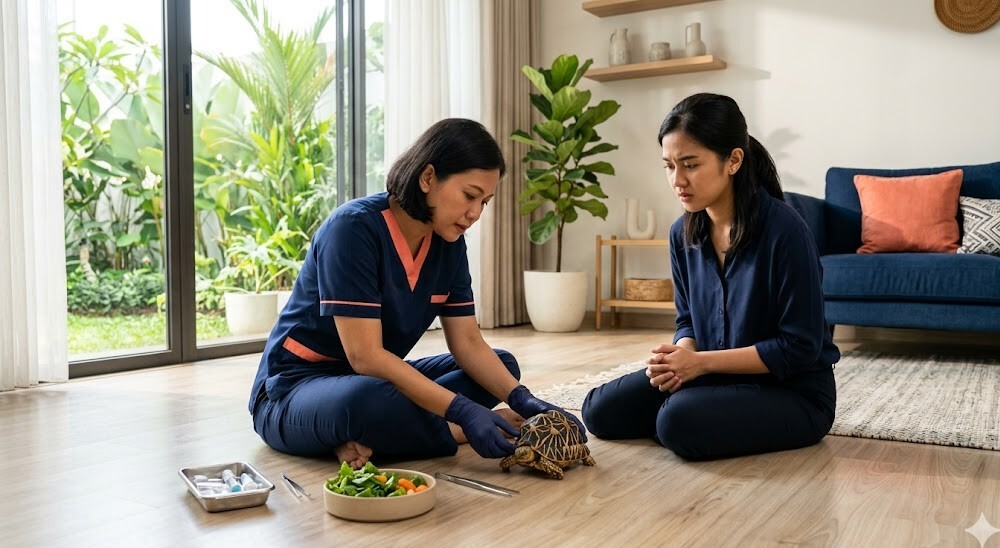
For land tortoise owners in Greater Jakarta, an exotic vet house call can be a very good choice, a large tortoise (an adult Sulcata weighing dozens of kg) is very difficult to bring to a clinic, and transport stress can worsen a sick animal's condition.
FAQ
How long does a land tortoise live?
Very long compared to other pets: Sulcata 50–80 years, Indian Star 30–80, Russian 40–50, Hermann's 50–75, Aldabra 100–150+. There are many cases of tortoises living longer than their owners, consider a succession plan (who will care for it once you can't). This is a multi-generational commitment, not a short-term pet.
I live in an apartment, can I keep a land tortoise?
You can, but it is very limited to small types (Russian, Hermann's, Indian Star juvenile) with a complete indoor setup (UVB lamp, heat lamp, a large enclosure of at least 120×60 cm, a soaking bowl, a hide). A Sulcata is not suitable for an apartment, they grow large and need outdoor space. Think through the long-term commitment before adopting.
Why won't my tortoise eat?
The most common causes: (1) the enclosure is too cold (a tortoise won't eat if its body temperature is below optimal, check the basking spot thermometer), (2) adjustment stress after a change of environment (give it 1–2 weeks), (3) inadequate UVB (which affects appetite), (4) internal parasites, (5) respiratory infection, (6) intestinal impaction. If it goes more than 5–7 days without eating + lethargy + other signs, consult an exotic vet immediately. A sick tortoise can skip meals for weeks before other signs appear, don't ignore it.
Does a land tortoise need to bathe or swim?
It does not swim (it is not a terrapin), but routine soaking (soaking in shallow warm water up to the plastron / chest) is highly recommended, especially for baby Sulcata and Indian Star. Soaking for 15–20 minutes, 2–3× per week, in warm water (28–30°C) helps hydration, defecation, and the skin. For adults, provide a permanent soaking bowl in the enclosure, and the tortoise will enter it itself when needed.
Can Prabasa Vet make a house call for a tortoise?
Yes. The tortoise is actually one of the animals that benefits most from a house call service because of its size (an adult Sulcata is very heavy), transport stress, and the need for direct husbandry evaluation in its own enclosure. When you message on WhatsApp, mention the tortoise type, approximate size/age, the condition you are concerned about, and your area, our team will find a partner vet with experience handling reptiles.
Closing
Keeping a land tortoise can be very rewarding, they are calm, long-lived, and have a unique personality that develops over the years. But they are not the "low-maintenance pet" their reputation suggests. A correct initial setup (a spacious enclosure, safe substrate, a UVB + heat gradient, an 80% varied greens diet) and access to an exotic vet when their condition worsens are investments that pay for themselves with a healthy tortoise living its full multi-decade lifespan. If you are just starting out or considering adoption, don't stop at the market seller's information alone, learn the reptile husbandry standards already established in the international community.
Need a consultation or to schedule a vet house call for your tortoise? Contact us via WhatsApp, mention the tortoise type, size/age, the condition you are concerned about, and your area, and our team will find a partner vet with experience handling reptiles.
Medical references used in this article
This article was compiled with reference to the following sources, verified per clinical statement:
- Girling SJ, Raiti P (eds). BSAVA Manual of Reptiles 2nd ed. British Small Animal Veterinary Association, chapters on chelonian husbandry, nutrition, and common diseases (MBD, pyramiding, respiratory infection)
- Mader DR, Divers SJ (eds). Mader's Reptile and Amphibian Medicine and Surgery 3rd ed. Elsevier, chelonian husbandry, UVB requirements, diet management, parasites, reptile anaesthesia
- ARAV (Association of Reptile and Amphibian Veterinarians), clinical guidelines on tortoise husbandry, early MBD detection, and faecal exam protocol
- LafeberVet exotic pet care references, tortoise diet (80% greens rationale), substrate safety, lighting protocols
- CITES Appendix listings, legality of the Indian Star (Appendix I), Aldabra (Appendix II), and other protected chelonian species
This article is general guidance based on reptile husbandry and exotic medicine principles. For your tortoise's specific condition, especially signs of a soft shell, difficulty breathing, or not eating for more than a week, a consultation with an exotic vet is the right step.