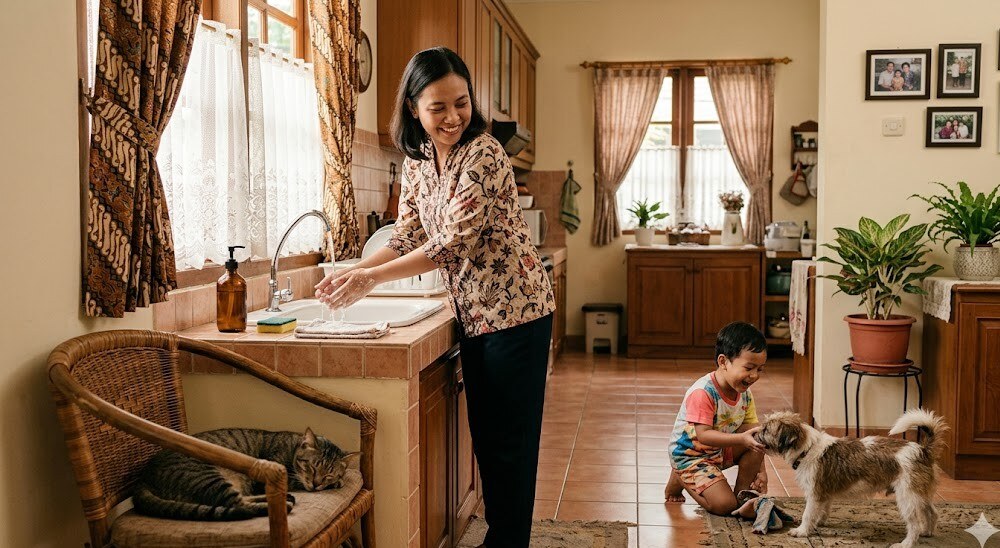

"I'm 5 months pregnant, and at home we have 2 dogs and 1 cat who have been part of the family for years. Many people advise me to give the dogs and cat to someone else before the baby is born 'for safety'. But I feel terrible, they are already family. Is there a safe way to keep them together without putting the baby at risk?" This question is common as a first baby approaches. The "give them away" advice often comes from well-meaning relatives or the internet, but it is not always necessary or even optimal. With adequate preparation 2-3 months before the birth, many families can transition smoothly, with pet and baby co-existing safely, even forming a lifelong bond.
This article is a comprehensive guide for couples expecting their first baby with pets at home: why pre-birth preparation is crucial (rather than reacting once the baby is already home), gradual socialization to baby sounds and objects, sustainable routine adjustment, home safety setup, safe pet-baby interaction dynamics by baby's age, and when to seek professional behavior help.
Why preparation 2-3 months pre-birth is crucial
A common mistake: waiting until the baby is home before starting to adjust the pet. The negative implications:
- The pet associates negative changes with the baby's arrival, attention drops suddenly, new areas become off-limits, the routine changes → frustration, anxiety, sometimes behavioral regression
- New parents' stress increases, if the pet has problems in the middle of post-partum recovery + newborn care = a stressful situation for everyone
- No time to troubleshoot a behavioral issue if one comes up
- The pet is not desensitized to new stimuli (the sound of a crying baby, baby gear, the smell of baby products) → extreme reaction on first exposure
The optimal approach: start prep 2-3 months pre-birth, with gradual adjustment so that by the time the baby is home, the environment and routine are already familiar to the pet.
Gradual socialization to baby stimuli
1. Baby sounds
- Find recordings of baby sounds (crying, cooing, gurgling) on YouTube or an app
- Start playing at very low volume while the pet is in a positive state (mealtime, play, treats)
- Gradually increase the volume over 2-4 weeks
- Reward the pet for staying relaxed → builds a positive association
- If the pet shows stress signs (panting, pacing, hiding), lower the volume and repeat the gradient
2. Baby smells
- Start using baby lotion, baby shampoo, and baby powder on your hands before the baby is born
- Once the baby is born at the hospital, have your spouse/family bring home a blanket or item the baby has worn → expose it to the pet under supervision before the baby comes home
- Reward relaxed sniffing with treats and a calm voice
3. Baby gear
- Set up baby furniture (cot, stroller, baby swing, etc) gradually over the weeks before the birth
- Let the pet investigate under supervision, sniff, explore, and reward if it stays calm
- Declare some areas off-limits now, rather than waiting for the baby to arrive, especially the baby's cot. Use a baby gate, redirect the pet when it enters off-limits areas, and reward staying in its own area
4. New movement patterns
- Use a baby carrier or a dummy baby (a doll the weight of a baby) during activities, the pet gets used to you holding something at your chest/arms
- Practice routines like "sitting on the sofa with the baby carrier while the pet is beside you", pre-rehearse the scenarios that will actually happen
Routine adjustment, do not stop attention abruptly
One of the biggest mistakes: the pet gets 100% attention pre-baby, then suddenly 30% post-baby. The pet associates this dramatic drop with the baby → resentment, anxiety, or acting out.
Pre-birth adjustment (start 6-8 weeks before the due date)
- Gradually reduce intensive one-on-one attention to a realistic post-baby level (still quality, but shorter duration or split up)
- Establish an "alone time" routine, the pet learns to enjoy a snack in its own room or an enrichment toy while the owner is in another area
- Train independent skills, settle on a mat, stay calm with a puzzle toy
- Brush up on basic obedience, sit, stay, go to bed, leave it. This will be very useful once the baby is here
- Crate training if not done yet, for pets that accept a crate. Useful for separation when guests visit or when you need to focus on the baby
- Walk schedule, build a schedule that is sustainable post-baby, perhaps with help from family or a dog walker
Post-birth, first weeks with the baby home
- Calm introduction, when the baby comes home from the hospital, let the pet sniff the baby from a distance first, under supervision. Reward calm behavior
- Maintain the core routine as much as possible, mealtime, walk time, cuddle time (shorter is OK)
- Positive association with the baby, the pet gets a treat or attention while the baby is in the same area. Baby = positive things
- Do not punish the pet for natural curiosity, redirect if needed, but avoid harsh corrections that associate the baby with something negative
- Carve out one-on-one time with the pet daily, even 10-15 minutes, this keeps the bond
- Recruit help, family or a dog walker to maintain the pet's needs during post-partum recovery
Home safety setup
- Baby's cot: off-limits for all pets, train this before the baby is born. Use a baby gate or a closed door. Cats in particular are often drawn to the baby's warmth, they can accidentally smother or settle on the chest of a baby who cannot yet adjust position
- Never leave the pet alone with the baby, NEVER, regardless of how "friendly" the pet has been. Even the gentlest dog or cat can react unpredictably. Attentive adult supervision is mandatory at all times when pet and baby are in the same area
- Baby toys vs pet toys, keep them separate and obvious, similar textures can confuse a dog. Pet squeaky toys vs baby squeaky toys: make them visually distinct
- Pet feeding area, litter box, water station, keep them accessible and safe from a baby who has started crawling. A baby reaching into a litter box or food bowl can trigger resource guarding even in a normally calm pet
- A quiet pet door / pet area, the pet needs its own space to recharge when the baby is crying intensely or the house is busy
- Vaccines + parasite prevention up-to-date, a baby has a developing immune system, so the pet should be on a monthly flea/tick + heartworm + deworming protocol
- Trim the pet's nails regularly, an accidental scratch when the baby reaches for the pet can cause injury
- Address fleas and ticks aggressively, a baby with thin skin is more vulnerable to bite reactions
Pet-baby interaction dynamics by age
0-6 months, immobile baby
- Pet and baby have no direct interaction, the baby is too small, the pet is at a supervised distance
- Goal: the pet accepts the baby's presence without stress or reactivity
- Reward calm proximity, redirect intense curiosity
6-12 months, baby starts to crawl and reach
- The trickiest period, the baby is suddenly mobile and unpredictable, often reaching out to grab the pet
- Pulling fur, poking eyes, grabbing the tail, a normally calm pet can snap reflexively
- 100% supervision when the baby is mobile in the pet's area
- Give the pet an escape route, a high perch (cats), a separate room (dogs) that the baby cannot access
- Start teaching the baby the basics of "gentle petting" (supervised, hand-over-hand with a parent)
1-3 years, active toddler
- Toddlers have no impulse control, they can pull, kick, or jump on the pet
- Strict supervision remains
- Educate the active toddler: "dogs and cats have feelings", "pet gently with one hand", "respect it when the cat/dog walks away"
- Give the toddler an appropriate role, help give treats (the owner does the feeding), help fill the water bowl
- The pet has its own area the toddler is not allowed to enter
3+ years, preschool and beyond
- Can learn more sophisticated boundaries and responsibilities
- Can be taught to read basic pet body language, "cat's tail upright = happy, tail flicking = unhappy"
- Still supervise during unstructured interaction
Common concerns and myth busting
"Toxoplasma, you must give up the cat if pregnant"
- Not true in most cases. Toxoplasma transmission to humans most often happens via undercooked meat, not direct contact with cats
- An indoor cat that eats commercial cat food + no raw birds or mice = negligible transmission risk
- A pregnant woman can simply: not handle the litter box (delegate to a partner), wear gloves and wash hands if she must, wash fruits and vegetables well, and avoid undercooked meat
- Check with your obstetrician about toxoplasma serology testing if you have a specific concern, there is no automatic need to give up the cat
"Dogs/cats trigger allergies in babies"
- Current research shows that exposure to pets at a young age actually REDUCES the risk of allergy and asthma (the hygiene hypothesis)
- Exception: if the baby has a documented allergy (severe eczema that flares with exposure, positive allergy testing), discuss with a pediatric immunologist
- The majority of families with dogs/cats from the start have children who are fine
"A jealous dog/cat becomes aggressive toward the baby"
- Pets do not have the concept of "jealousy" the way humans do, but they can experience stress from routine changes + reduced attention
- The manifestation is often not direct aggression, but behavioral changes (inappropriate elimination, destructiveness, withdrawal)
- Prevention is via gradual prep and routine adjustment
- If there is genuine aggression toward the baby (warning signs such as growling, snapping), safety is a high priority, and immediate consultation with a behaviorist is needed
When to seek professional help
Consult a veterinarian or certified behaviorist if:
- The pet shows aggression (growling, snapping, bite warnings) toward the baby or family members during the transition
- The pet has persistent stress signs (anorexia, inappropriate elimination, withdrawal, destructiveness) that do not resolve with routine adjustment
- The owner is unsure about interpreting body language
- There is a prior history of behavioral issues that could be exacerbated by a new stressor
- Multiple pets with complicated dynamics
Pets and babies FAQ
My dog snapped at a neighbor's small child 2 years ago. Must I give it up?
Not automatically "must give up", but it is a high-risk situation. Consult a veterinary behaviorist before the baby is born for assessment and a plan. Some cases can be managed with strict structure + management; in some cases rehoming may be safer. Do not trial-and-error with a baby.
My cat likes to sleep on my chest. Is a newborn at risk?
Yes. Cats are often drawn to a baby's warmth, they can accidentally cover the face of a baby who cannot yet adjust position → suffocation risk. Make the baby's cot absolutely off-limits via a closed door or baby gate. Train this before the baby is born.
Can a cat and baby sleep in the same room?
The same room is OK if the baby is in a separate cot with proper rails. The cat must not have access to the cot. Keep the baby's room door closed or use a mesh cover over the cot. Watch especially during the first days the baby is home.
My dog is 10 years old and very calm. Do I still need to prep?
Yes. Even a calm dog needs to adjust to new stimuli (intense crying sounds, smells, a new routine). Plus a senior dog with arthritis can be stressed when the baby crawls and reaches in ways that cause pain. Prep is still important, even if on a lighter scale.
How long is the ideal prep period?
At least 2 months before the due date, ideally 3 months. Plus continue intermittent adjustment after the baby comes home. Behavior adjustment takes time.
Summary
Preparing dogs and cats for a new baby requires proactive prep 2-3 months before the birth, not reacting once the baby is already home. The main components: gradual socialization to baby stimuli (sounds, smells, baby gear), sustainable routine adjustment (reduce attention gradually, not abruptly), home safety setup (cot off-limits, always supervised interaction, never leave the pet alone with the baby), and understanding the dynamics by the baby's age.
Common myths: Toxoplasma does not automatically require giving up the cat (hygiene measures are enough in most cases), pet exposure at a young age actually reduces allergy risk (the hygiene hypothesis), and pets are not automatically aggressive toward babies but can become stressed if the adjustment is abrupt.
The majority of families with dogs/cats can transition smoothly to a new baby with adequate prep. Pets and babies growing up together often form a precious lifelong bond. The key: always strict supervision, prep early, and address concerns with a professional if there is any warning sign.
Are you pregnant and need to discuss preparing your home pets for a new baby? Contact us on WhatsApp for an initial consultation and, if needed, a referral to a veterinary behaviorist for your specific situation.
Read also: Dog Park Etiquette, Dogs Afraid of the Clinic, Pet Care Guide.
Medical references used in this article
This article was compiled with reference to the following sources, verified per clinical statement:
- AVMA (American Veterinary Medical Association) Pets and Babies resource, home safety setup, supervision guidelines, vaccine + parasite prevention requirements when a baby is present, realistic Toxoplasma transmission risk
- AAHA Family with Pets Guidelines, recommendations for transitioning to family expansion, behavioral adjustment protocol, when to refer to a veterinary behaviorist
- ACVB (American College of Veterinary Behaviorists) educational material, pet-baby risk assessment, gradual behavioral preparation, intervention protocol for dogs/cats with a reactive history
- Yin S. Low Stress Handling, Restraint and Behavior Modification, pet body language, stress signals, timely intervention, basic obedience training for family pets
- Strachan DP., Hay fever, hygiene, and household size. BMJ 1989 + follow-up studies, the hygiene hypothesis, pet exposure in early childhood reducing allergy/asthma risk, current epidemiologic evidence updates
This article is a general guide based on standard veterinary behavior and family pet care sources (AVMA, AAHA, ACVB). For your family's specific situation, especially with pets that have a history of behavioral issues, multiple pets, or a baby with a special medical condition, consulting a veterinarian and, if needed, a veterinary behaviorist is the right step before the baby is born.