
Moving house is one of the most stressful events for a pet, often harder than owners imagine. For us humans, moving house means excitement about starting a new chapter. For cats and dogs, moving house means losing the scent territory they have built up over years, being exposed to an unfamiliar environment full of new sounds and smells, and a disruption of the routine that has made them feel safe all this time. Many subtle medical cases (anorexia, inappropriate urine elimination, vomiting, hiding for weeks) that appear after a move can actually be minimized with the right preparation.
This article is a guide for you who are about to move house with a cat or dog, why moving is extremely stressful, what preparation to do 1-2 weeks before the day itself, the moving-day protocol, setting up a "safe room" in the new home, the stress signs you must recognize, and when to consult a vet. Disclaimer: a general guide based on international feline behavior + canine welfare guidelines, not a substitute for a direct consultation with a veterinarian for your pet's specific condition.
Why moving house is extremely stressful for pets
For humans, "home" is largely an emotional and practical concept. For a cat/dog, "home" is a very physical scent territory, they recognize home through:
- The pheromones they leave in corners (a cat's cheek rubbing, a dog's urine marking) over years
- Familiar sounds, the sound of doors, the footsteps of household members, the AC, the traffic outside
- Familiar smells, the scent of everyone in the household, food, detergent, the garden
- A spatial map in their brain, where the litter box, food bowl, safe area, and high spots for surveying are
- Time routines, when we come home, when they are fed, when we sleep
When you move, all of these references disappear at once. The pet has no context of "we are moving soon", what they experience is their world suddenly changing completely. No wonder many pets show stress signs for days or even weeks after a move.
Cats are generally more sensitive than dogs to territory changes (cats are a territorial species, dogs are more social). But dogs are also vulnerable, especially when older, dogs with a history of separation anxiety, or dogs that were recently adopted.
Preparation 1-2 weeks before moving day
1. Microchip + ID update
Moving day is one of the highest-risk moments for a pet to run off or escape, both during loading at the old home and unloading at the new one. Make sure:
- The microchip ID is registered with a current address and active mobile number, if the microchip has not been updated since a previous move, now is the time to update the database
- A collar tag with the pet's name + your mobile number, even for an indoor cat (because moving house = high escape risk)
- A recent photo, keep a recent face + body shot on your phone. If the pet escapes, a recent photo is the most important asset for a poster + local community posts
2. Health check before moving
Ideally 1-2 weeks before the day, do a baseline check with a vet:
- Confirm core vaccines are up-to-date (especially if moving across cities/provinces with a different disease prevalence)
- Discuss it if your pet has a history of severe anxiety, in some cases the vet may suggest a mild sedative for moving day only (off-label, under veterinary supervision, not over-the-counter)
- Refill routine medications (if there is a chronic condition), don't run out in the middle of a hectic move
- If moving to a new city, ask for a vet recommendation in the new area or look for a house call service first
3. Pheromone diffuser in the old home (and the new one)
Synthetic pheromone products such as Feliway (for cats) or Adaptil (for dogs) can help reduce stress during the transition period. How to use:
- Install a diffuser in the old home 7-10 days before the move (to acclimate)
- After moving, install a diffuser in the safe room of the new home right after unpacking, replacing the one removed from the old home
- Can be combined with a pheromone spray in the carrier on moving day
- Pheromones do not work instantly and do not 100% resolve severe anxiety, treat them as a support tool, not a magic solution
4. Maintain the routine during packing
When boxes start filling up and the house becomes chaotic, many owners forget that pets are very sensitive to routine changes:
- Keep feeding at the same time, don't miss it or shift the time because you're busy packing
- Keep up play sessions / walk routines if possible, even brief, this is predictability
- Provide one safe corner in the old home that is not hit by the packing chaos, place a bed, hide spot, and toys in a room that is still intact for the pet to retreat to
- DO NOT force interaction with the movers, some pets will hide when strangers are around; just let them, don't pull them out
5. The day before: pack the pet's items last
- Litter box, food bowl, bed, toys, carrier, pack last, unpack first at the new home
- Keep some familiar items UNWASHED before the move, familiar scent is the main comfort. The old, unwashed bed is actually better than a clean new bed
- Label the carrier with a name + mobile number, if it is left behind or lost during truck loading, recovery is easier
- Limit food 3-4 hours before the journey if the pet is prone to motion sickness (especially cats and small dogs)
Moving day, protocol to minimize risk
Transport carrier mandatory, secure leash mandatory
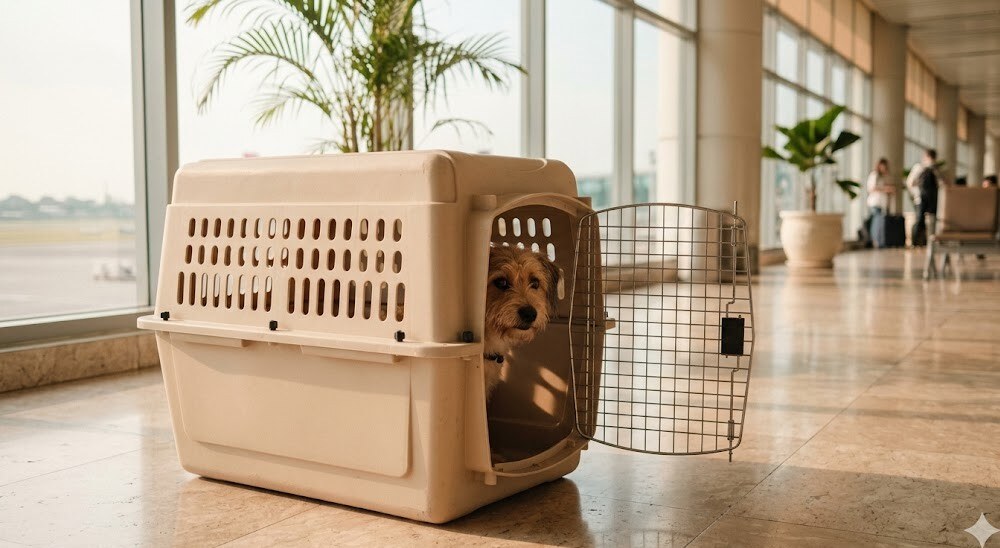
- Cats must be in a carrier, hard-sided with good ventilation, DO NOT let a cat loose in the car. Stress + an unfamiliar environment = a cat can panic and bolt when the car door opens
- Small dogs in a carrier or seat-belt harness; large dogs in a seat-belt harness or a familiar crate. Leash always on during loading/unloading
- DO NOT open the carrier or remove the leash during loading at the old home and unloading at the new home, this is the highest escape-risk moment. Even a normally calm pet can panic in the chaos of a move
Car AC + air supply
- Turn on the AC if the weather is hot, pets are far more vulnerable to heat stress than humans, especially brachycephalic breeds (Persian, Pug, Bulldog)
- Stop every 2 hours for extra ventilation + to check on the pet
- Bring a small water bottle + a foldable bowl, offer water at every stop
- NEVER leave a pet in a car without AC, even for 5 minutes, a car's temperature in Indonesia's daytime can rise above 50°C within minutes; heat stroke is fatal
Stay calm even amid the chaos
Pets are very sensitive to their owner's emotions. If you panic, shout at the movers, or are tense, the pet will read it as "there is danger." Try to breathe, move calmly, and periodically check the carrier with a gentle voice.
Arriving at the new home, set up a safe room first
The most common mistake of new arrivals: immediately letting the pet loose to explore the whole new house. This is overwhelming and triggers chronic hiding, anorexia, or inappropriate urine elimination (especially in cats). A better strategy: a safe room first, then gradual expansion over 3-7 days.
Setting up the safe room
Choose one room (ideally one where the pet will eventually spend a lot of time), your bedroom, home office, or a spare room. Close the door. Before letting the pet out of the carrier, set up:
- Litter box (cats), in a corner away from food, using familiar litter from the old home. For cats, provide at least 1 box (the N+1 rule for multi-cat homes)
- A pad / elimination spot for dogs, if the dog is used to going outside and the new home is not ready yet, provide a temporary area in the bathroom
- Food bowl + water bowl, fresh water, the same food brand as the old home (a diet transition can come later, once settled)
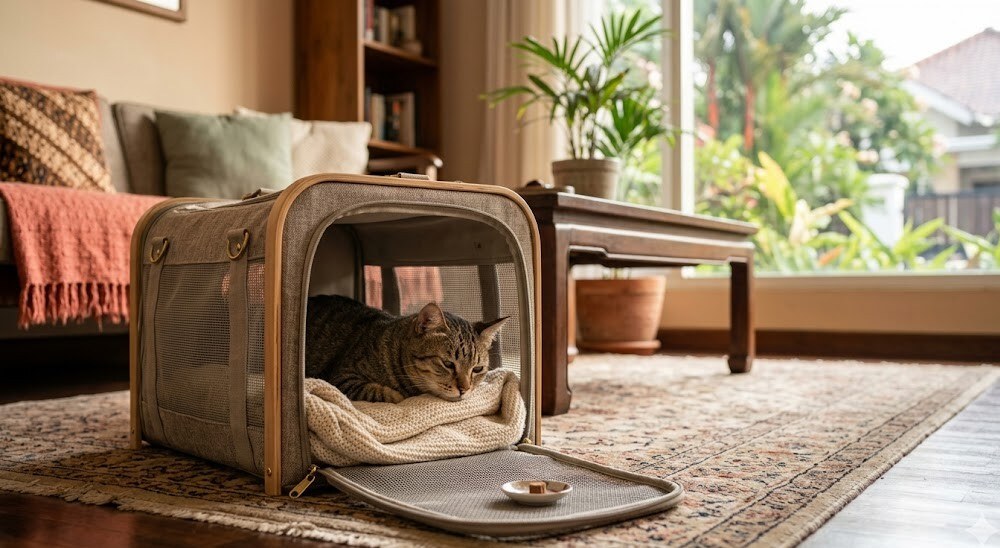
- Familiar bed + blanket, bring the old, unwashed bed from the old home; familiar scent is comfort
- Hide spot / cardboard box, especially for cats, who will spend the first hours in a hiding spot
- Pheromone diffuser, install it as soon as the pet enters the safe room
- Familiar toys, not new toys
How to release from the carrier
- Close the safe room door first, then open the carrier
- DO NOT pull the pet out by force, let it come out on its own when ready. Some cats dash straight to a hiding spot, some explore slowly. Both are normal.
- Sit quietly in a corner, read a book, or step out for a moment, let the pet acclimate without the pressure of interaction
Gradual expansion to the whole house
Once the pet is seen eating + drinking + using the litter box normally in the safe room (usually 24-72 hours, sometimes longer for a shy cat):
- Open the safe room door when the house is quiet (the movers have left), let the pet explore 1-2 new rooms per day, not the whole house at once
- Keep the safe room as a base camp, litter, food, and bed stay there during the first 1-2 weeks. The pet will return on its own if it feels overwhelmed
- Spread scent gradually, rub a soft towel on the cat's face, then rub it in corners of the new house. This helps them claim the territory faster
- After 1 week, gradually move the litter box (cats) or pad (dogs) to its permanent location
Outdoor vs indoor cats, extra considerations
If your cat is usually outdoor (or sometimes outdoor) at the old home, the moving protocol must be stricter:
- Indoor only for a minimum of 2-3 weeks in the new home. A cat let outdoors right away in a new environment is often lost permanently, they try to return to the old home and cannot navigate back
- After 2-3 weeks indoors, if you want to let it outdoors again, start with short supervised outdoor sessions (15-30 minutes) around the door, gradually expanding
- Consider permanent indoor living in the new home if the area is less safe (heavy traffic, predators, neighbors who dislike pets), this is also a good welfare decision in general
For dogs, the outdoor transition is easier because dogs are usually leashed + do not explore independently. But do not let a dog off-leash in a new environment until it is familiar with the layout.
Stress signs you must recognize
Some minor adaptation signs are normal, a pet needs time to settle. But the following signs should be watched and consulted if persistent:
Cats
- Extreme hiding > 5-7 days without eating/drinking/using the litter box
- Anorexia > 24 hours (a cat that does not eat for > 2 days is at risk of hepatic lipidosis, a serious liver condition)
- Repeated vomiting
- Urine elimination outside the litter box (urinating on the bed, carpet, sofa), often a sign of stress
- Excessive vocalization (nonstop meowing, growling, hissing)
- Over-grooming to the point of baldness / skin sores (psychogenic alopecia)
- Persistent diarrhea
- Lethargy, sunken eyes, dehydration
Dogs
- Anorexia > 24 hours
- Repeated vomiting / diarrhea
- Destructive behavior (chewing furniture, scratching at doors), often a sign of separation anxiety appearing in the new environment
- Excessive vocalization (barking/howling when you leave)
- Urine/feces elimination in the house (for a previously house-trained dog)
- Nonstop pacing, unable to settle, panting without exertion
- Sunken eyes, lethargy, dehydration
When you need a vet
Some signs should be consulted with a vet immediately (not waited out as "it will settle on its own"):
- Anorexia > 48 hours in cats (hepatic lipidosis risk), > 24-48 hours in dogs
- Vomiting / diarrhea that does not subside > 24 hours or that contains blood
- Extreme lethargy, unresponsiveness, sunken eyes, pale gums
- Respiratory distress (rapid breathing without exertion, open-mouth breathing in cats)
- Signs of urinary obstruction in cats (especially males), straining in the litter box with no result, vocalizing in pain; this is an emergency
- Severe separation anxiety in dogs, destroying the house, self-injury, nonstop vocalization
For you who have just moved and do not yet have a regular vet in the new city, a house call vet service can be very helpful, the pet does not need additional transport to an unfamiliar clinic that would only worsen the existing stress.
FAQ
How long does a cat/dog usually need to fully adapt after moving?
It varies greatly. Cats generally take 2-6 weeks to fully settle (normal routine returns, willing to explore the whole house, eating/sleeping/playing normally). Some sensitive cats can take 2-3 months. Dogs are usually faster, 1-3 weeks, because they are more social and resilient to territory changes. Senior cats/dogs or those with a history of anxiety can take longer. The key: do not compare with timelines from others on the internet, every pet has its own pace.
Can I give OTC sedatives to a cat/dog for moving day?
DO NOT. Human sedatives (OTC diazepam, sedating antihistamines, sleeping pills) are very dangerous for pets, they can trigger paradoxical excitation, respiratory depression, or toxicity. If your pet has severe anxiety, consult a vet before the move to discuss a prescription sedative specifically for pets (gabapentin, trazodone, etc, off-label with the right dose). Sedatives are also NOT always the answer, many pets are actually more stressed when a sedative blurs their situational awareness.
My cat peed on the bed after moving, why?
Very common after a move, a combination of stress + the familiar scent on your bed (as a way to claim territory with its own scent in a familiar spot) + the litter box possibly not being in a comfortable location yet. Steps: (1) take it to a vet to rule out cystitis (FLUTD), which often appears after stress, (2) add a litter box (provide a minimum of 2 in the new home), (3) clean the soiled area with an enzymatic cleaner (not bleach, which actually draws the cat back), (4) temporarily block access to the bed, (5) pheromone diffuser, (6) wait 2-4 weeks to settle. If it persists > 1 month, consult a behavior consultant or behavior vet.
My dog became destructive after moving, is it separation anxiety?
Very likely, moving house is a common trigger for severe separation anxiety, especially in dogs that previously had no issues. The old home was a familiar "safe haven"; the new home is unfamiliar + you leave = panic. Steps: (1) gradual desensitization (start by leaving for a few minutes, return, gradually extend), (2) intensive enrichment (puzzle feeder, filled Kong, mental stimulation toys), (3) enough exercise before you leave (a tired dog = calmer), (4) Adaptil pheromone, (5) consult a vet if severe, sometimes temporary medication (fluoxetine, clomipramine) can help alongside training. Do not punish a dog that is destructive due to anxiety, that is a reaction to stress, not "naughtiness."
I moved to a small apartment and my cat/dog is from a large house, will they be stressed?
Absolute size matters less than environmental enrichment and routine. A cat in a small apartment can be happy with vertical territory (cat tree, perches), window access (for bird watching), toy rotation, and quality play sessions. A dog in an apartment can be happy with a minimum of 2 walks per day (enough duration + sniffing time), mental stimulation, and socialization. What is more stressful: a large space but an owner who is gone all day + zero enrichment. Quality > quantity of space.
Can Prabasa Vet do a home visit for a pet that has just moved?
Yes, and this is one of the scenarios where a house call is ideal, a pet already stressed from a move does NOT need to be transported again to an unfamiliar clinic that would only worsen the situation. The vet comes to the new home, observes the pet's condition in a natural setting (post-move), suggests husbandry tweaks if needed, and does a baseline check + treatment if there is a medical concern. When you message us on WhatsApp, mention: when you moved, from where to where, the pet's condition you are worried about, and your area, our team will schedule a suitable partner vet.
Closing
Moving house with pets does not have to be a nightmare, but it should not be taken lightly either. Preparation 1-2 weeks beforehand (ID update, health check, pheromones, maintaining the routine), a safe moving-day protocol (carrier, leash, car AC, don't let them loose), and setting up a safe room in the new home with gradual expansion is an investment that pays for itself with a much smoother transition.
Most importantly: respect your pet's pace. They have no context of "we are moving", what they experience is their world suddenly changing. Give it time, give it consistency, and do not compare timelines with others.
Need a consultation or to schedule a house call vet for a pet that has just moved? Contact us via WhatsApp, mention when you moved, the pet's condition you are worried about, and your area, and our team will find a suitable partner vet for your pet's condition and your schedule.
Read also: Adopting an Adult Cat From a Shelter: Adaptation Tips, Air Travel With Pets: Crate Rules and Safety, Pet Care Guide, House Call Vet.
Medical references used in this article
This article was compiled with reference to the following sources, verified per clinical statement:
- ISFM (International Society of Feline Medicine) Indoor Cat Initiative + Feline Stress Guidelines, environmental needs, scent transfer protocol, pheromone evidence, signal interpretation
- AAFP (American Association of Feline Practitioners) Cat Friendly Practice Guidelines, minimizing transport stress, safe room setup, urinary stress signs (FLUTD)
- AAHA (American Animal Hospital Association) Canine and Feline Behavior Management Guidelines, separation anxiety protocols, behavior modification, prescription medication for behavior
- BSAVA Manual of Canine and Feline Behavioural Medicine 2nd Edition, feline adaptation timeline, multi-cat household conflict management, separation-related behavior in dogs
- Karen Pryor Academy + AVSAB (American Veterinary Society of Animal Behavior), humane training principles, anti-punishment based modification, agency-based bonding
- ASPCA Moving with Pets resources, practical pre-move + day-of + post-move checklist, ID + microchip update protocol
- Plumb's Veterinary Drug Handbook 7th Edition, anxiolytic dosing for situational anxiety (gabapentin, trazodone), antiemetics for motion sickness, veterinarian-supervised use
This article is a general guide based on international feline/canine welfare and behavior medicine guidelines. For your pet's specific condition, including severe anxiety, anorexia > 24 hours, inappropriate urine elimination, or separation anxiety, consulting a veterinarian is the right step.