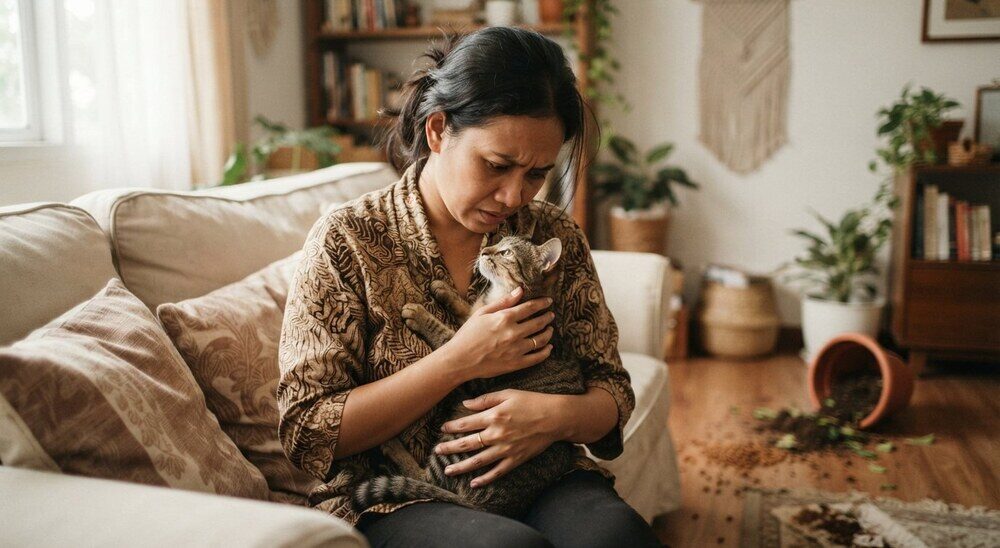

The short version: mild, stable complaints where the pet still eats and drinks, stays active, and breathes normally can usually be monitored at home first, often with a consultation or a home visit. But signs like difficulty breathing, seizures, inability to urinate (especially male cats), pale or blue gums, non-stop vomiting or diarrhoea, or severe trauma are emergencies that need a 24-hour clinic right away. When in doubt, do not wait. Message the Prabasa vet team on WhatsApp for a quick assessment.
One of the most stressful moments for an owner is when a pet suddenly feels unwell and you have to decide: monitor at home, or rush to find a clinic? This guide helps you judge more calmly, without over-panicking but also without delaying something dangerous.
The core principle: assess stability, not just the symptom
What matters most is not merely "which symptom" but "how stable and how fast it is worsening". A mildly lethargic pet that still eats and stays active is very different from one crashing within hours. Look at the trend over the last few hours: improving, stable, or worsening?
Usually fine to monitor at home first
The following can often be observed at home while you consult or schedule a visit, as long as the pet keeps eating and drinking, stays active, and breathes normally:
- Vomiting or diarrhoea once or twice but the pet stays bright and keeps drinking.
- Slightly reduced appetite for a day, with no other symptoms.
- Mild itching, occasional sneezing, or slightly watery eyes.
- Mild tiredness after heavy activity that improves with rest.
- A small, clean scrape that is not bleeding heavily.
For things like these, a Prabasa vet can often help via an initial consult, and if needed come to your home to examine further so you do not have to go out.
Go to a 24-hour clinic immediately, do not delay
The following signs are emergencies. If they appear, prioritise getting your pet to a full-facility clinic as fast as possible:
- Difficulty breathing, fast and heavy breaths, open-mouth breathing in cats, blue or pale gums.
- Seizures or loss of consciousness.
- Inability to urinate, especially a male cat going back and forth to the litter box with nothing and straining, an emergency that can be fatal within hours.
- Non-stop vomiting or diarrhoea, especially with blood or severe weakness.
- A suddenly enlarged, hard belly with restlessness and unproductive retching, especially in large dogs.
- Bleeding that will not stop or severe trauma (hit by a vehicle, a fall from height, a bad bite).
- Pale or white gums, a possible sign of internal bleeding or shock.
- Difficulty giving birth, prolonged straining with no offspring.
- Suspected poisoning, ingesting chocolate, human medication, rat poison, or toxic plants.
In these situations, time is precious. Home-visit services are not designed to replace an emergency unit with resuscitation equipment, hospitalisation, and emergency surgery.
Common home mistakes
A few things to avoid while waiting or caring at home:
- Do not give human medication without a vet's guidance. Many are dangerous to pets. For example, paracetamol can be fatal to cats even in small amounts, and some human painkillers are dangerous to dogs. Never guess a dose.
- Do not force food or water on a severely weak or breathless pet, as it risks choking.
- Do not delay just to "see how it is tomorrow" with the emergency signs above. Some conditions worsen very fast.
How to decide quickly
If you are torn, ask these three questions:
- Is the breathing normal and are the gums a healthy pink? If not, that is an alarm.
- Is the pet still responsive and able to stand? If very weak or unconscious, that is an alarm.
- Is it improving, stable, or worsening over the last few hours? If worsening fast, do not wait.
If any answer is worrying, treat it as an emergency and find a 24-hour clinic. If all three are reassuring, there is usually room for a calm consult and assessment.
Not sure? Ask before you decide
Often all you need is a quick assessment from a vet to know whether this can wait at home or needs a clinic now. For stable complaints, a Prabasa vet can examine at home so you do not have to move an uncomfortable pet.
Unsure about the condition? Message Prabasa Vet on WhatsApp and describe the symptoms. We will help judge whether it can be monitored at home, needs a vet visit, or must go to a 24-hour clinic right away. For emergencies needing full equipment, we will steer you straight to the nearest clinic for your pet's safety.