
Seeing your beloved cat start to change, her belly rounding, her appetite growing, her manner turning more affectionate, it is natural to wonder: is she pregnant? That mix of joy and worry is very human. The good news is that most cats go through pregnancy smoothly when they get the right nutrition and environment. This article helps you recognise the signs, understand how long it lasts, care for her, and most importantly, know when the situation needs a vet.
Quick summary (TL;DR)
- Typical early signs: enlarged, reddened nipples (around the third week), the heat cycle stopping, and increased appetite.
- Cat gestation averages around 63 to 65 days, or roughly 9 weeks. A range of 61 to 70 days is still considered normal.
- Pregnant and nursing cats need high-energy food, usually a dedicated kitten formula.
- Prepare a quiet, warm, enclosed birthing spot about one to two weeks before the expected due date.
- Call a vet right away if the cat strains hard for more than 20 to 30 minutes with no kitten emerging, or if there is foul-smelling or dark-coloured discharge.
Signs a cat is pregnant
Cats do not show all the signs at once. They appear gradually as the pregnancy progresses. Here are the ones seen most often.
Early signs (the first 2 to 4 weeks)
- Enlarged, reddened nipples. Around 15 to 18 days after mating, a cat nipples usually look pinker, larger, and more prominent. This is often the earliest clue you can observe.
- The heat cycle stops. A female that used to meow loudly, roll around, and raise her hips (signs of heat) suddenly stops. This is often a signal that fertilisation has occurred.
- Increased appetite. As her body works harder, many cats start eating more.
- Occasional nausea. Some cats seem slightly listless or briefly refuse food early on, similar to nausea in people. It usually passes quickly.
Mid to late signs (week 5 onward)
- A rounding belly. After about 5 weeks, the belly starts to look clearly larger and fuller. Do not press on the belly to check, as it can injure the kittens.
- Weight gain. Steady weight gain is normal and expected.
- A calmer, more affectionate manner. Many pregnant cats become more clingy, more fond of being held, or instead seek out quiet spots.
- Nesting behaviour. As birth approaches, the cat starts seeking hidden corners, closets, or boxes to prepare a birthing spot.
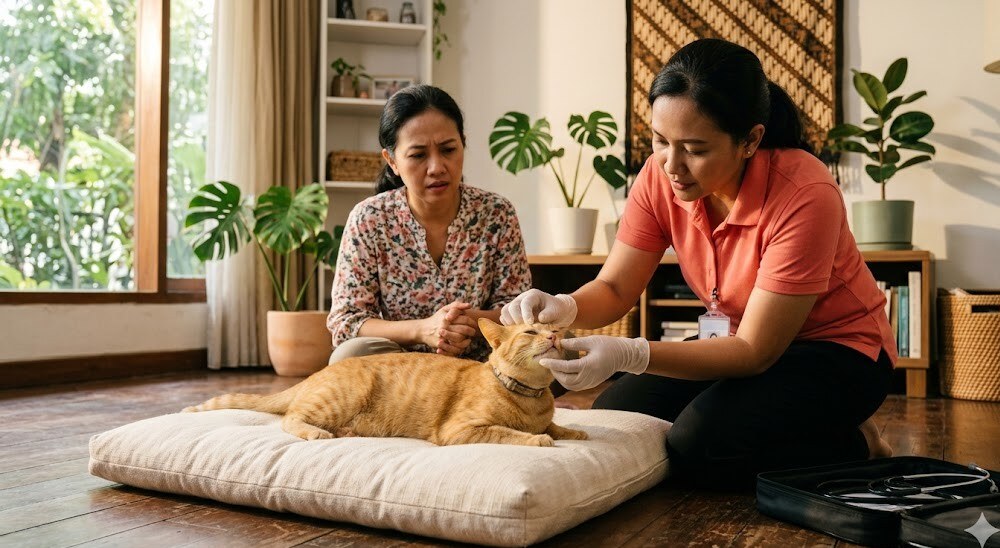
Important to understand: these signs can resemble other conditions, for example false pregnancy or even belly enlargement from illness. The surest way to confirm pregnancy is an examination by a vet, through palpation by experienced hands, an ultrasound that can detect pregnancy from around the third week, or an X-ray after the kittens bones have formed (usually around day 45) to estimate the number of kittens. You can request an at-home pregnancy check so the cat is not stressed by travel.
How long is a cat pregnant?
Cat gestation averages around 63 to 65 days, or roughly 9 weeks, counted from mating. A range of 61 to 70 days is still considered normal. Because a cat can mate several times during heat, the exact date of fertilisation is often hard to pin down, so the due date really is a range, not a single date.
What to watch for: if the pregnancy passes about 70 days with no signs of birth, it is best to have her examined by a vet, because a pregnancy that runs too long can signal a problem.
Caring for a pregnant cat at home
Nutrition
A cat energy needs rise sharply during pregnancy, especially in the second half, and rise even higher while nursing. General safe guidance:
- Switch to high-quality food. A dedicated kitten formula, or food formulated for pregnancy and nursing, is generally more energy- and protein-dense, which the mother and her kittens need. Make the food switch gradually so her digestion is not upset.
- Increase the portions gradually as the pregnancy advances. In the final weeks and while nursing, many mothers need to eat quite often, and some are allowed to eat freely.
- Always provide clean water within easy reach.
- Do not give supplements on your own. Adding calcium or other supplements without a vet guidance can actually be harmful. Proper nutrition is better discussed with a vet according to your cat condition.
Medication, vaccines, and dewormers
This is an area where mistakes are common. Certain medications, vaccines, and dewormers are not safe to give during pregnancy and can harm the kittens. Do not give any medication, including over-the-counter ones, without consulting first. If your cat needs protection before or after pregnancy, a vet can put together a safe schedule.
Environment and activity
A pregnant cat can still go about normal activity, but avoid high jumps or rough play near the end of the pregnancy. Keep the home calm and warm. Stress and commotion can leave her uneasy.
Preparing for the birth
About one to two weeks before the expected due date, prepare a birthing box: a clean box or container lined with soft cloth, with walls tall enough, placed somewhere quiet, warm, dim, and away from foot traffic. Introduce it early so the cat feels it is her spot. Do not be surprised if she still chooses her own favourite corner. What matters is that the place is safe and clean.
Signs a cat is approaching labour include:
- Becoming restless, pacing, or on the contrary withdrawing to her nest.
- A drop in appetite in the last 24 hours.
- Frequently licking the genital area.
- A slight drop in body temperature before labour begins.
- Meowing more often or seeming to seek your attention.
Once labour begins, let the cat work on her own as much as possible in a quiet spot. Your presence from a distance is enough. Most cats give birth without needing help.
When to call a vet
Most births go smoothly, but some situations should not wait. Contact a vet or a 24-hour emergency clinic right away if you see any of these signs of difficult birth (dystocia):
- Straining hard for more than 20 to 30 minutes with no kitten emerging.
- Weak contractions but no progress for several hours, even though there are clearly still kittens inside.
- Too long a gap between births (more than a few hours) while signs suggest there are still kittens to come.
- Foul-smelling, pus-like, or green or dark discharge without a birth following.
- A kitten stuck in the birth canal that does not come out within a few minutes.
- The mother appears very weak, in severe pain, or feverish.
- The pregnancy has passed about 70 days with no sign of birth.
Do not try to pull out a stuck kitten yourself, as it risks injuring both the mother and the kitten. Situations like these are emergencies that need a vet as soon as possible.
After the birth, keep monitoring the mother
In the days to weeks after birth, watch the mother for signs of: fever, foul-smelling discharge from the genitals, mammary glands that are red, hot, or painful, and trembling, seizures, or excessive restlessness that can signal a calcium disorder. All of these need a vet examination. Also make sure every kitten is nursing and active.
We can come to your home
Taking a pregnant or newly delivered cat to a clinic often stresses her, and stress is not helpful in this sensitive time. Prabasa Vet is a home-visit vet service covering the Greater Jakarta (Jabodetabek) area. We can come to confirm the pregnancy, check the mother health, and give nutrition guidance right in the place where your cat feels most comfortable. If you want to make sure everything is going well, or you are unsure about a sign, you do not have to wait until you are in a panic.
You can message Prabasa Vet on WhatsApp to ask questions, check schedules, and book a house call vet for cats visit. The initial consultation is free of charge. For serious cases such as a cat struggling to give birth or another emergency, we will honestly tell you if your cat would be better referred to a clinic with surgical facilities, for the safety of the mother and her kittens.
Notes & references
This article is educational and general in nature, and does not replace a direct examination by the vet handling your cat. The gestation length, the age range for detecting pregnancy, and the signs of difficult birth mentioned are general ranges commonly cited in feline health literature and can vary between individuals. Any medication, vaccine, dewormer, or supplement during pregnancy must be on the guidance of a vet. If signs of an emergency appear, do not delay seeking medical help.