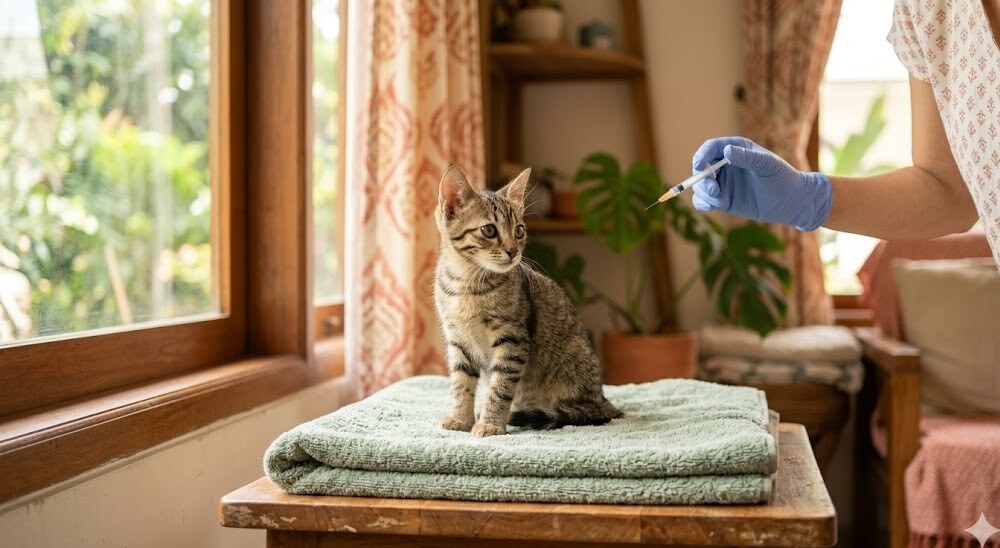

A question that comes up more and more often in consultations: "Doc, my furkid was vaccinated last year, does it really need another booster this year, or can we check the titer first?" This is a good question and shows an owner who is aware of the modern medicine discussion. The short answer: a titer test is a valid option for core vaccines in adult dogs/cats that have already been fully vaccinated, but there's important context to understand before deciding.
This article discusses titer testing objectively: what is actually measured, when it makes sense to do it, when routine revaccination is still better, cost + labs in Indonesia, and what the international guidelines say (WSAVA 2024, AAHA, ISFM). Disclaimer: this is general guidance based on international guidelines, not a replacement for a direct consultation with a veterinarian for your specific furkid.
What a titer test is and what it actually measures
A titer test is a blood examination that measures the level of specific antibodies in the animal's bloodstream against a particular disease, usually a core disease such as distemper-parvo-hepatitis in dogs (DHPP) or panleukopenia-rhinotracheitis-calicivirus in cats (FVRCP).
The logic: if the animal has protective antibodies in its blood, it means the immune system "remembers" being exposed to that pathogen (via a previous vaccine or natural infection) and theoretically will respond quickly if it encounters it again. Protective antibodies = a proxy for immunity.
What's important to understand:
- The titer measures humoral immunity (antibodies), not cellular immunity (T-cells). For core viral diseases such as distemper and parvo, antibodies are indeed the most relevant protection, so a titer test is informative enough. For bacterial vaccines such as Leptospira or Bordetella, the antibody titer does not correlate well with clinical protection, so a titer test is not recommended for bacterial vaccines.
- A titer result = a snapshot of the present. It can change over time (gradually declining), so a protective titer today is no absolute guarantee for next year.
- The "protective" threshold is based on laboratory convention, not an absolute biological cut-off. Different labs sometimes have different cut-offs, be sure to read the lab report's interpretation.
When a titer test makes sense, and when it doesn't
Per the WSAVA 2024 Vaccination Guidelines, a core-disease titer test in adult dogs/cats is a valid option for:
- Adult dogs/cats that have completed the puppy/kitten vaccination series + 1 booster at 12-16 months of age (per the WSAVA protocol)
- Owners who want an evidence-based decision rather than automatically revaccinating every year for core disease
- Furkids with a history of a vaccine reaction previously (urticaria, anaphylaxis), a titer test gives data before deciding to re-expose to a vaccine
- Senior furkids where the benefit-risk of automatic revaccination needs to be weighed
- Immunocompromised furkids or those with an autoimmune condition where every immune stimulus needs to be justified
What is NOT suitable for a titer test:
- Puppies/kittens that haven't completed the vaccine series, the basic protocol must finish first
- The rabies vaccine, in Indonesia rabies is a government regulation (zoonosis), so the rabies revaccination schedule is fixed by law; a rabies titer is not a legal substitute for routine vaccination
- Non-core vaccines such as Leptospira, Bordetella, Lyme, the titer doesn't correlate well with protection, so routine revaccination is still recommended according to exposure risk
- Furkids that will board/travel/dog show where the facility requires a certificate of active vaccination (not a titer)
How a titer test works and its workflow
Practical steps if an owner chooses a titer test:
- Consult the vet first, review the furkid's vaccination history, health condition, exposure risk (indoor only vs frequent trips to the park, multi-pet household, etc.). The vet helps evaluate whether a titer makes sense for the specific situation.
- Blood sample collection, usually 1-3 ml of blood from a vein. This can be done during a home visit or at the clinic. The furkid doesn't need to fast for a simple titer test.
- Choose the panel to test, most common for dogs: distemper (CDV) + parvovirus (CPV) + adenovirus (CAV). For cats: panleukopenia (FPV) + herpesvirus (FHV) + calicivirus (FCV). Note that for cats, only FPV has a solid titer-protection correlation; FHV and FCV titers are less reliable.
- Lab processing, the sample is sent to a laboratory with testing capability. In Indonesia, several referral veterinary labs accept samples; there are also in-clinic rapid titer test kits (such as VacciCheck for dogs) with results in ~20 minutes. Ask your vet about availability in your area.
- Interpreting results, the report is usually: "Protective" / "Borderline" / "Non-protective" or a titer number (for example CDV ≥ 1:32 = protective per that lab's cut-off). Discuss with the vet, don't self-interpret because there are nuances (vaccinated yesterday will appear super high; a furkid with an acute infection can also appear high but for a different reason).
- Follow-up:
- A protective result for core viral → core revaccination can be deferred, retest next year
- A non-protective / borderline result → revaccination recommended
- Still continue rabies vaccination + non-core according to the regulator/risk profile schedule
Cost and availability in Indonesia
The on-the-ground reality in Indonesia as of 2026:
- Titer testing is still relatively niche compared to in the US/UK/Australia, not all clinics routinely offer it
- The cost is generally higher than a single dose of booster vaccine, a combination of sample collection + sending to a lab + interpretation. The cost range varies depending on the lab and panel
- An in-clinic rapid kit (if available) is faster (20 minutes) and sometimes more economical for a single panel, but it closes off the option of an external lab
- For owners in Jabodetabek, some referral labs accept samples from partner clinics; ask your vet for the nearest referral
An honest note: for a single indoor furkid with low exposure risk, the cost of a titer test can be equal to or exceed the cost of revaccination. The economic justification for a titer test makes more sense if you have a multi-pet household, a senior furkid, or a furkid with a history of reactions.
Pros-cons of titer test vs automatic routine revaccination
Arguments for a titer test:
- An evidence-based individual decision, rather than revaccinating "just in case," a titer gives concrete data on whether revaccination is needed
- Reduces over-vaccination, several studies suggest the duration of immunity of core vaccines in dogs/cats can last years (3-7+ years for distemper/parvo/panleukopenia), not exactly 12 months
- Reduces the risk of a vaccine adverse event, although rare, a vaccine reaction can occur (urticaria, rare anaphylaxis, injection-site sarcoma in cats, very rare but serious)
- Suitable for medically fragile patients, senior, autoimmune, or immunocompromised furkids where every immune stimulus needs to be justified
Arguments against a titer test (or for routine revaccination):
- Cost, can be more expensive than a booster vaccine directly for a single panel
- Limited availability in Indonesia, not all clinics can facilitate it yet
- A protective titer today is no guarantee for next year, periodic retesting is needed, so the cost is cumulative
- It doesn't replace the rabies + non-core vaccine, the owner still needs a schedule for other vaccines
- Boarding/travel facilities generally still require a vaccination certificate, not a titer report
- For a healthy young furkid with a low-cost vaccine, the simplicity of routine revaccination is often more practical
WSAVA position: a titer test is a valid option equivalent to routine revaccination for core viral disease in adult dogs/cats. Both are medically defensible. The choice depends on owner preference, access, and the furkid's condition.
What the international guidelines say
The WSAVA 2024 Vaccination Guidelines state that core vaccines in dogs (CDV, CPV-2, CAV) and cats (FPV) provide a long duration of immunity, likely 3+ years or more in the majority of individuals who are properly primed. Recommendation: after completing the puppy/kitten series + 1 booster at 12-16 months of age, core revaccination no more often than every 3 years for adult dogs/cats, or use a titer test for an informed decision.
The AAHA Canine Vaccination Guidelines and ISFM/AAFP Feline Vaccination Guidelines give consistent recommendations: a core vaccine every 3 years or a titer-based approach for adult dogs/cats is an acceptable option. Non-core vaccines (Leptospira, Bordetella, FeLV, etc.) remain annual according to exposure risk, there is no titer-based recommendation for bacterial vaccines.
Rabies: consistent with each country's regulations. In Indonesia, rabies is a zoonosis with regulatory control, so the rabies vaccine schedule is not substituted by a titer test for legal compliance.
Titer test FAQ for dog/cat vaccines
Can a titer test be used for the rabies vaccine?
Technically there is a rabies titer test (RFFIT / FAVN), usually used for international travel (import/export requirement). But for routine rabies vaccination in Indonesia, a rabies titer is not a replacement for the regular vaccine, Indonesian regulations still require an active rabies vaccine on schedule. Discuss with the vet if there's a specific international travel context.
Can a titer test be used for a puppy that just completed its vaccines?
Yes, and it's sometimes done to verify the puppy truly developed antibodies after the puppy vaccine series (especially if there's a concern about maternal antibody interference). But the majority of puppies that complete the WSAVA protocol don't need a routine titer, the vaccine protocol is already designed to overcome maternal antibodies at 16+ weeks of age. Consult the vet if there's a specific case (for example a parvo outbreak in the area, a puppy from a mom with an unclear history, etc.).
How long do titer test results take?
It depends on the method. An in-clinic rapid test (if available) is about 20-30 minutes. A sample sent to an external lab usually takes 3-7 working days. Ask the vet or clinic about the specific turn-around time.
If the titer result is borderline, do I have to revaccinate?
Discuss with the vet. Borderline doesn't automatically mean not protected, it means the data is ambiguous. Other factors considered: the furkid's exposure risk (indoor only vs frequent contact with other animals), general health condition, whether the vaccine history is complete or not, and whether there's an autoimmune concern. Many vets will recommend revaccination for borderline because the cost is low + the safety margin is high, especially if there's exposure risk.
Can Prabasa Vet facilitate a home-visit titer test?
Yes. We can coordinate blood sample collection during a home visit, send it to a referral lab, and discuss the interpretation of the results + a follow-up plan (revaccination or retest next year). Before scheduling, we usually review the furkid's vaccine history and exposure profile via WhatsApp first to make sure a titer test is a sensible choice for your situation, sometimes direct revaccination is more practical and economical, sometimes a titer truly makes sense. Contact us for a case-by-case discussion.
Closing
A titer test is a valid modern option for core viral disease in adult dogs/cats that have completed their basic vaccinations, not a gimmick, and not a magic bullet either. It provides concrete data for a revaccination decision, reduces over-vaccination for furkids that are already protected, and is especially useful for furkids with a history of reactions, seniors, or the immunocompromised.
But a titer test is not a universal replacement for all vaccinations: rabies remains on the regulator's schedule, non-core vaccines (Leptospira, Bordetella, FeLV) remain according to exposure risk, and for a healthy young furkid with a low-cost vaccine, the simplicity of routine revaccination is often more practical and economical.
Discuss with your veterinarian whether a titer test makes sense for your specific furkid, there is no one-size-fits-all answer, and the decision depends on a combination of the furkid's history, exposure risk, lab access in your area, and your preference as the owner.
Want to discuss whether a titer test is right for your furkid, or schedule a home visit for vaccination/titer? Contact us via WhatsApp, mention the type of animal, its age, and vaccine history, and our team will help evaluate.
Read also: Adult Cat Vaccination: Schedule, Cost, and What's Needed, Dog Vaccination Schedule: Puppy + Adult, Pet Vaccine Side Effects: Normal vs Concerning, Pet Care Guide.
Medical references used in this article
This article was prepared with reference to the following sources, verified per clinical statement:
- WSAVA Vaccination Guidelines Group 2024 , core vs non-core classification, duration of immunity of core vaccines, the position of the titer test as a valid option for core viral disease
- AAHA (American Animal Hospital Association) Canine Vaccination Guidelines, recommendation of 3-yearly or titer-based for core canine vaccines, non-core guidance according to exposure
- ISFM/AAFP Feline Vaccination Guidelines, recommendation of core feline vaccine + FPV titer option; the nuance of less reliable FHV/FCV titers
- Day MJ, Horzinek MC, Schultz RD, Squires RA. WSAVA Guidelines for the vaccination of dogs and cats, the main foundation of the global protocol
- Plumb's Veterinary Drug Handbook 7th edition, adjuvant, vaccine pharmacology, adverse event profile
- Schultz RD. Duration of immunity for canine and feline vaccines: a review (Vet Microbiol), basis for the long DOI of core vaccines
- Greene's Infectious Diseases of the Dog and Cat, chapter on vaccination + titer testing methodology
- Litster A, Nichols J, Volpe A, et al. Prevalence of positive antibody test results for canine parvovirus and canine distemper virus following vaccination, basis for the titer-protection correlation
This article is general guidance based on international guidelines. For your specific furkid's condition, including vaccine history, health condition, exposure risk, and lab availability in your area, consulting a veterinarian is the right step. A titer test is not a replacement for individual medical advice.