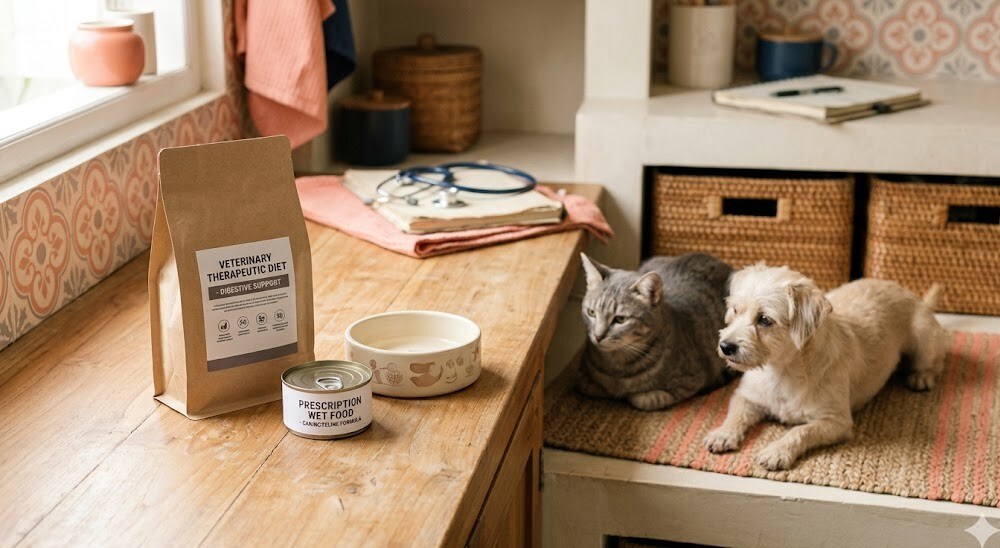

"My cat is 6 years old and has only ever had kibble. But they say cats need wet food too, do I need to switch?" Or: "My dog is overweight, the vet recommended a diet, is wet food or dry food more suitable?" Questions about food format, wet vs dry, come into our team almost every week. Many owners are confused because every brand claims their format is "the best", when the real answer depends on the specific situation of the animal and household.
This article lays out the difference in composition between wet vs dry, the advantages of each format, the mixed feeding approach that often turns out to be the sweet spot, a decision framework per condition (kitten, senior, CKD, diabetes, obesity), how to read an AAFCO label so you are not trapped by marketing claims, and when to consult a vet before switching.
Understanding the composition: wet food vs dry food
The most fundamental difference between wet and dry food is not the ingredients, but the moisture content. This determines nearly all the trade-offs that follow:
| Parameter | Wet food (canned/pouch) | Dry food (kibble) |
|---|---|---|
| Moisture | 70-85% (average 75%) | 6-12% (average 10%) |
| Calories per gram | 0.8-1.2 kcal/g | 3.5-4.5 kcal/g |
| Protein (dry matter basis) | 35-55% | 25-45% |
| Carbohydrates | Generally low (3-15%) | Generally higher (20-50%) |
| Price per calorie | 3-5x more expensive | More economical |
| Shelf life after opening | 24 hours in the fridge | 4-6 weeks (sealed tightly) |
| Palatability | Generally preferred (strong aroma) | Varies by brand |
Important to understand: if you compare labels directly (as-fed basis), wet food looks "lower in protein" than kibble. But that is misleading, because 75% of the weight of wet food is water. Always compare on a "dry matter basis" (nutrient label ÷ (100% − moisture) × 100) for an apple-to-apple comparison. Premium wet food is actually generally higher in protein and lower in carbohydrates than premium kibble.
Advantages of wet food: why it is often recommended for cats
Wet food has several advantages that are highly relevant especially for cats, and these are not marketing claims, but clinical consensus from the WSAVA Global Nutrition Committee + AAFP/ISFM Cat Friendly Practice Guidelines:
1. Hydration contribution, crucial for cats
Cats have a physiologically low thirst drive, they evolved as desert carnivores who got most of their water from fresh prey (~70% moisture). In a modern home with kibble (10% moisture), cats often do not drink enough to compensate for this deficit.
Consequences of chronic subclinical dehydration in cats:
- Chronic kidney disease (CKD), one of the most common diseases in senior cats (age 10+). Marginal hydration accelerates the progression of declining kidney function.
- FLUTD (Feline Lower Urinary Tract Disease), concentrated urine triggers struvite/oxalate crystals, cystitis, and in male cats: urinary blockage (an emergency condition).
- Constipation, dry, hard stool, common in senior cats.
Observational studies show that cats consuming wet food as part of their diet have a larger urine volume, more dilute urine (lower specific gravity), and a lower risk of FLUTD. For cats with a history of FLUTD or CKD, wet food is often not optional, but part of the therapy.
2. Palatability and appetite stimulation
Wet food is generally more aromatic because of the water and fat content that releases volatile compounds at room temperature. Useful for:
- Picky cats or picky eaters
- Senior cats with a declining sense of smell
- Post-illness cats with a reduced appetite
- Small/toy breed dogs that need eating stimulation
- Animals with dental problems (easier to eat)
3. Lower in carbohydrates, relevant for cat diabetes
As obligate carnivores, cats do not need dietary carbohydrates, they have a limited metabolic pathway for digesting starch. Wet food is generally 3-15% carbohydrate (some high-protein wet foods are even <5%), whereas kibble is often 20-50% because it requires starch as an extrusion binder.
For cats with diabetes mellitus, the AAFP/ISFM 2022 Practice Guidelines recommend low-carb wet food as a dietary cornerstone, some diabetic cats can achieve insulin remission with a combination of a low-carb wet diet + early insulin therapy.
4. High volume per calorie, helps weight management
Wet food being low in calories per gram means a cat/dog can eat more volume before reaching the daily calorie target. Useful for animals that are "always hungry" but need weight control, a feeling of fullness with fewer calories.
Advantages of dry food: when kibble makes more sense
Dry food is not an "inferior" format, it has practical advantages relevant to many situations:
1. Cost-effective
For the same calorie cost, kibble can be 3-5x more economical than wet food. For households with multiple cats/dogs or a large dog (Golden, Labrador, Husky) needing 1500-3000 kcal/day, this price difference is significant over the long term.
2. Free-feeding compatible
Kibble can be left in the bowl all day without spoiling (as long as it stays dry and not exposed to humidity). Suitable for:
- Owners who are often away from home
- Cats that prefer to eat many small meals (natural grazing pattern)
- Dogs with a flexible feeding schedule
Note: free-feeding is not suitable for obese animals, it makes calorie tracking difficult and over-eating common.
3. More accurate calorie tracking and portion control
For weight management, kibble with a measuring cup provides more predictable portion control. 1/2 cup of kibble (~50g) = ~200 kcal consistently. Whereas wet food varies 60-100 kcal per small can, requiring you to check the label.
For obese dogs/cats needing precise calorie restriction, portion-controlled kibble + a digital measuring cup is often more practical.
4. Practical for travel and boarding
No fridge needed, easy to re-portion into a ziplock, no smell, easy to bring while traveling. For animals that frequently board or travel, kibble is far more practical.
5. Slight dental benefit, often overrated
The "kibble cleans teeth" claim is often promoted by kibble brands. Reality: the dental benefit of standard kibble is minimal, most kibble shatters quickly when bitten and provides no meaningful mechanical cleaning. What truly has a dental effect is special dental kibble with a large shape and fibrous texture (VOHC-accepted such as Hill's t/d, Royal Canin Dental), not ordinary kibble.
Even so: dental kibble is not a substitute for routine tooth brushing or dental cleaning by a vet once plaque/tartar has formed.
Mixed feeding: the sweet spot for many cats and dogs
Rather than forcing a choice of one format, the mixed feeding approach often provides the benefits of both formats. Common patterns we often recommend:
Pattern for cats
- Morning: wet food (1 small can 70-85g or equivalent to 1/3-1/2 of the calorie needs), helps hydration early in the day
- Evening: wet food (another small can), helps evening hydration
- Throughout the day: kibble grazing (the remaining calories, measured), for a natural multiple-small-meals feeding pattern
For cats that do not like sudden transitions: start with a ratio of 75% kibble + 25% wet, gradually shift to 50/50 or 25% kibble + 75% wet over 2-4 weeks.
Pattern for dogs
- Base: measured premium kibble (2/3 of the total daily calories), use as the main meal
- Topper: wet food or fresh-cooked (1/3 of the calories), mix with the kibble for flavor variety + added moisture
This approach is cost-effective for large dogs (kibble base) while still getting moisture + a palatability boost (wet topper).
Advantages of mixed feeding
- Additional hydration without the full cost of a wet-only diet
- Variety of flavor and texture prevents food aversion if the animal has to switch for a medical reason
- Flexibility: you can adjust the ratio per condition (sick → add wet, traveling → switch to full kibble temporarily)
- Both formats are AAFCO-complete-and-balanced so there is no nutritional deficit as long as the brand is reputable
Format choices per specific condition
The following is a decision framework based on the animal's condition, not a rigid rule, but a starting point for discussion with your vet:
Kitten and puppy (growth phase, 0-12 months)
Both wet and dry are OK as long as the label states "complete and balanced for growth" or "all life stages" per AAFCO. Considerations:
- Wet food: better palatability, kittens/puppies newly transitioning from mother's milk more easily accept wet
- Dry food: practical for free-feeding, kittens need frequent small meals, kibble can be available throughout the day
- Best practice: mixed, wet 2x/day + kibble grazing
- For large/giant breed puppies: choose kibble with a "for large breed growth" label (controlled calcium ratio, critical for bone growth)
Senior cats and dogs (generally 7+ for cats, 7+ for dogs)
Seniors generally benefit from a wet format because:
- Sense of smell and taste decline → wet is more aromatic
- Dental/periodontal disease is more common → wet is easier to chew
- Risk of marginal dehydration is higher (especially cats with subclinical CKD)
- Some senior animals lose interest in kibble they used to like
Recommendation: shift gradually toward more wet food after age 7-10, especially if there is weight loss or a change in appetite.
Cat CKD, wet mandatory
For cats diagnosed with chronic kidney disease, wet food is not optional. Per ISFM/IRIS Guidelines for Stage 2-4 CKD:
- Adequate hydration = the primary management to slow progression
- Wet food with moderate protein + restricted phosphorus (prescription renal diet such as Hill's k/d, Royal Canin Renal, Purina NF) is the standard of care
- If the cat refuses the wet renal diet, try several variants (loaf vs gravy vs pate), warm it briefly to amplify the aroma, mix with a little familiar topper
See also: CKD in Senior Cats: Signs, Stages, and Renal Diet Choices.
Cat diabetes mellitus, low-carb wet preferred
Per the AAFP/ISFM Diabetes Guidelines: low-carb wet food (<10% carbohydrate on a dry matter basis) is the dietary cornerstone for diabetic cats. Some low-carb prescription wet brands: Hill's m/d, Royal Canin Diabetic, Purina DM. Combined with early insulin therapy, this often achieves remission in certain cases.
Cat FLUTD/cystitis, wet is important
For cats with a history of FLUTD, idiopathic cystitis, or urine crystals: wet food to dilute the urine + a specialized urinary diet (Hill's c/d, Royal Canin Urinary, Purina UR), both are available in wet as well as dry, choose wet if you can for the hydration benefit.
Cat/dog obesity, portion-controlled dry is generally easier
For weight loss, portion precision is important. Kibble with a digital measuring cup + calorie tracking is more predictable. But you can still use a mixed approach: portion-controlled kibble as the base + a little wet for satisfaction.
Note: do not reduce the portion too drastically (max 1-2% of body weight per week for dogs, 0.5-1% for cats). A crash diet can trigger hepatic lipidosis in cats (a serious condition).
How to read an AAFCO label so you are not trapped by marketing
Pet food labels are full of marketing claims, it is important to know which are regulated vs which are merely marketing. Per AAFCO (Association of American Feed Control Officials), which is the standard in many countries including Indonesia:
Nutritional Adequacy Statement, must be present
Look for a sentence that states:
- "Formulated to meet the nutritional levels established by the AAFCO Cat/Dog Food Nutrient Profiles for [life stage]", the formulation meets the minimum nutritional standard
- "Animal feeding tests using AAFCO procedures substantiate that [product] provides complete and balanced nutrition for [life stage]", it has passed a feeding trial (stronger than merely formulated)
The life stage that must be stated: growth (kitten/puppy), maintenance (adult), or all life stages. For animals in the growth phase, DO NOT buy food whose label is only "maintenance", growth nutritional deficit.
Guaranteed Analysis, compare on a dry matter basis
This section lists minimum protein, minimum fat, maximum fiber, maximum moisture. For an apple-to-apple comparison between wet vs dry, convert to a dry matter basis:
Formula: nutrient dry matter = nutrient label ÷ (100 − moisture %) × 100
Example: wet food labeled 10% protein, moisture 78%. Dry matter protein = 10 ÷ (100 − 78) × 100 = 45%. Compare with kibble labeled 30% protein, moisture 10%. Dry matter protein = 30 ÷ 90 × 100 = 33%. It turns out this wet food is higher in protein than the kibble, even though the as-fed label looks lower.
Ingredient list, ordered by weight (pre-cooking)
Ingredients are listed from highest to lowest weight before cooking. Because wet meat is high in water, "chicken" in first position on a kibble label can be misleading, after cooking, its water evaporates and its protein contribution is lower than "chicken meal" that is already dry processed.
More informative: look at the main protein source + carbohydrate source + whether there are excessive fillers (corn, wheat early on a budget kibble label = not an absolute deal-breaker, but an indicator of lower quality).
Marketing claims that are NOT regulated
Be careful with these claims, they have no strict legal AAFCO definition:
- "Natural", a loose definition, most pet food can use this label
- "Holistic", no regulated standard
- "Human grade", there is an AAFCO definition but enforcement is weak
- "Premium" / "Super premium" / "Gourmet", marketing only, no quality threshold
- "Grain-free", not automatically better; FDA 2018-2024 monitoring associated grain-free with dilated cardiomyopathy (DCM) in certain dogs
Storage and handling
Wet food
- Before opening: store at room temperature, watch the expiry date (average 2-3 years shelf life)
- After opening: in the fridge, max 24 hours. Transfer to a sealed container (a special wet-food can lid or a small pyrex)
- Do not leave wet food in the bowl at room temperature >2 hours (Indonesia is warm), risk of bacterial contamination
- Before serving from the fridge: warm it briefly (microwave 3-5 seconds or add warm water), cats/dogs often refuse cold food
Dry food
- Store in an airtight container after the original packaging is opened, air exposure accelerates fat oxidation (rancid smell)
- Ideally consume it within 4-6 weeks after opening
- Avoid storing in a humid place (tropical Indonesia), mold can grow, especially aflatoxin in corn/peanut-based kibble
- Check the smell when pouring into the bowl, fresh kibble has a light smell, a rancid smell = already expired even if not past the date
Ingredient quality > format
One important point that is often missed: premium kibble from a reputable brand is generally better than cheap generic wet food. Format is not the only determinant, ingredient quality + AAFCO compliance + brand track record are equally or more important.
Kibble brands with a solid track record (Royal Canin, Hill's Science Diet, Purina Pro Plan, Orijen, Acana, Nutram, Iams) generally use controlled-quality ingredients, conduct feeding trials, and have a strong QA process. Generic store wet food with no AAFCO statement, unclear ingredients, and a new brand with no track record, this is not an upgrade from premium kibble.
Priority: (1) AAFCO compliance for the animal's life stage → (2) brand reputation + feeding trial → (3) ingredient quality → (4) wet/dry format → (5) price. Format becomes a consideration after the quality basics are confirmed.
FAQ on wet food vs dry food
My cat has only ever had kibble its whole life and is healthy, do I need to switch?
Not automatically. If the animal is asymptomatic, has an ideal BCS, normal annual labs (especially BUN/creatinine + USG >1.035 for hydration), and drinks enough water (visible drinking), you may continue kibble. But still consider introducing some wet food (mixed) as hydration insurance for the next decade, especially approaching age 7-10 when the risk of CKD/FLUTD rises. Transition gradually over 2-4 weeks to avoid GI upset.
My dog does not like wet food, what now?
Dogs generally do not need wet food as mandatorily as cats (dogs have a normal thirst drive, hydration via drinking water is OK). If your dog prefers kibble and drinks enough water, AAFCO-compliant premium kibble is a valid choice. But for a senior dog, a dog with dental problems, or a dog with a declining appetite, try a little wet food topper (1-2 tablespoons) on top of the kibble to boost palatability.
Wet food causes diarrhea, why?
If you switch from kibble to wet suddenly, the GI tract has not adapted. Temporary diarrhea of 3-7 days during the transition is common. Solution: gradual transition over 7-14 days, start with 25% wet + 75% kibble, gradually increase the wet proportion. If diarrhea persists after 2 weeks of a proper transition, it is likely an ingredient sensitivity, try another brand with a different protein source or consult your vet.
Wet food makes teeth dirty, is that true?
Partly true, wet food leaves more residue on the teeth than kibble. But standard kibble does not really clean teeth (it shatters quickly when bitten). The proper solution for dental health: routine brushing 3-7x/week with pet toothpaste, VOHC-accepted dental treats, or dental cleaning by a vet once plaque has formed. Food format is not the main determinant of dental health.
Can I use cat wet food for a dog (or vice versa)?
Not ideal long-term. Cat wet food is generally higher in protein and taurine (essential for cats), but the nutrient balance differs from what a dog needs. Dog wet food is generally lower in protein and not fortified with taurine, a cat consuming dog food long-term risks taurine deficiency (cardiomyopathy). Always use species-specific food per the AAFCO statement.
Expensive vs cheap brand, is the difference significant?
Yes, generally significant. Premium brands (Royal Canin, Hill's, Purina Pro Plan, Orijen, Acana, etc.) invest in research, feeding trials, ingredient quality control, and QA. Budget store brands are generally only "formulated to meet AAFCO" without a feeding trial, with variable ingredient quality. For a healthy adult animal: a mid-tier brand is generally sufficient, where wet food typically costs more per serving than kibble. For an animal with a medical condition: a prescription diet is often mandatory, more costly but an essential part of the therapy.
When to consult a vet before/after a diet switch
- Before switching an animal with a medical condition (CKD, diabetes, FLUTD, IBD, allergy)
- For a BCS evaluation before a weight loss/gain diet
- If there is persistent diarrhea/vomiting after a switch >2 weeks
- For a kitten/puppy in the growth phase, choose the right AAFCO-compliant growth food per breed size
- For a multi-cat household where one cat needs a prescription diet, a separate feeding strategy
- If the animal refuses to eat >24 hours (cat) or >48 hours (dog), this can indicate an underlying medical issue
If you are in Greater Jakarta and need a nutrition consultation specific to your animal's condition without the hassle of going to the clinic, Prabasa Vet's house call vet service can assess the BCS, evaluate the current diet, and recommend a plan right at home.
Summary
- Wet food (75% moisture, low calories per gram): best for cats (hydration is crucial), seniors, CKD, diabetes, FLUTD, and palatability for picky eaters
- Dry food / kibble (10% moisture, calorie-dense): cost-effective, free-feeding compatible, accurate calorie tracking, practical for travel, slight (often overrated) dental benefit for special dental kibble
- Mixed feeding: the sweet spot for many animals, wet 1-2x/day + kibble grazing for cats, kibble base + wet topper for dogs
- Per condition: kitten/puppy OK with both (wet more palatable), seniors shift toward wet, CKD wet mandatory, cat diabetes low-carb wet, obesity portion-controlled dry generally easier
- Read the AAFCO label: look for "complete and balanced for [life stage]", compare nutrients on a dry matter basis, be careful of unregulated marketing claims
- Quality > format: premium kibble > generic wet food. Priority: AAFCO compliance → brand reputation → ingredient quality → format → price
Have a specific question about the food format choice for your cat/dog? WhatsApp Prabasa Vet for a free consultation. Mention the species, age, BCS, medical condition (if any), and current diet. Our team will help evaluate and recommend a suitable plan.
Read also: Cat Nutrition by Life Stage: Kitten, Adult, Senior, Dog Nutrition by Size: Small, Medium, Large, Giant Breed, Raw Food Diet (BARF) for Dogs and Cats: Pros-Cons, Safety, and Risks. See also Prabasa Vet's pet care guide.
Medical references used in this article
This article was prepared with reference to the following sources, verified clinical sentence by sentence:
- WSAVA Global Nutrition Committee. Global Nutritional Assessment Guidelines (Freeman LM et al, JSAP 2011), assessment framework + body condition + dietary history as the 5th vital assessment
- AAFP/ISFM (American Association of Feline Practitioners / International Society of Feline Medicine). Cat Friendly Practice Guidelines, cat hydration, low thirst drive, the role of wet food in preventing FLUTD/CKD
- AAFP/ISFM. Consensus Statement on Diabetes Mellitus in Cats, dietary recommendation of low-carb wet food as the cornerstone of diabetes management
- Hand MS, Thatcher CD, Remillard RL, Roudebush P, Novotny BJ (eds). Small Animal Clinical Nutrition 5th edition, chapters on hydration, dietary water requirement, format comparison
- AAFCO (Association of American Feed Control Officials). Cat Food Nutrient Profiles + Dog Food Nutrient Profiles, minimum nutrient requirement per life stage, regulatory framework for label statements
- IRIS (International Renal Interest Society). CKD Staging Guidelines, dietary recommendation per stage including wet food for hydration support
- FDA Center for Veterinary Medicine. Investigation of Potential Link between Certain Diets and Canine Dilated Cardiomyopathy (ongoing 2018-2024), grain-free diet caution
This article is general guidance based on the consensus of international veterinary organizations + standard textbooks. For an evaluation of your specific animal's diet, including medical conditions and household situation, consulting a vet is the right step. The food format choice is one component of care, not a substitute for a thorough medical evaluation.