
"Doc, my Persian cat threw up a hairball again this week, is that normal or is something wrong?" This question comes up often in Prabasa Vet's WhatsApp chats, usually from owners of long-haired cats (Persian, Maine Coon, Ragdoll) who are first-time owners and get startled the first time they see a cylinder-shaped vomit full of fur.
The short answer: a hairball 1-2x per week in an adult long-haired cat is usually normal, it is the natural mechanism for clearing the fur swallowed during grooming. But if the frequency becomes high (>2-3x per week), or there are repeated retching attempts that produce nothing, or the cat suddenly refuses food and is lethargic, those are different signals, and could point to an obstruction that needs veterinary evaluation.
This article covers what a hairball is medically, why long-haired cats are more prone, the difference between a normal hairball and a concerning one, prevention that actually works (consistent routine brushing + hairball control diet + hairball remedy paste with veterinary guidance), and what NOT to do (the cooking-oil and olive-oil myth that still circulates).
What a hairball is, trichobezoar from a medical perspective
A hairball, or in medical terms a trichobezoar, is a clump of fur swallowed by a cat during self-grooming that is not digested in the gastrointestinal tract. A cat's tongue has a distinctive structure, papillae shaped like little hooks (filiform papillae) that work like a natural comb. When a cat licks its body, these papillae catch loose fur, and that fur gets swallowed.
Keratin fur cannot be digested by digestive enzymes. In a healthy cat, most of the swallowed fur passes out in the feces (you may notice the cat's stool sometimes looks "stringy", that is the fur). The rest accumulates in the stomach and is expelled by vomiting, with the characteristic elongated cylinder shape (not round), because as it rises through the narrow esophagus, the fur and gastric fluid form a cylinder following the esophageal diameter.
So a hairball is not a "disease", it is the output of a system doing its job. The problem is excessive frequency or fur that gets stuck and cannot pass (obstruction).
Why long-haired cats get hairballs more often
Several breeds with long coats plus a thick undercoat are far more prone than ordinary domestic short-hair cats:
- Persian, extra-long fur plus a very thick undercoat, almost constant shedding. One of the most hairball-prone breeds.
- Maine Coon, medium-long fur, dense undercoat especially during transitional seasons, very furry tail and ruff (neck collar).
- Norwegian Forest Cat, thick double coat similar to the Maine Coon, an evolutionary adaptation to the cold Scandinavian climate.
- Ragdoll, semi-long coat, finer, but still a significant volume of fur swallowed during grooming.
- Himalayan, a Persian × Siamese hybrid, long fur like a Persian.
- Birman, Turkish Angora, Siberian, all semi-long to long coats, similar risk level.
Add to this the fact that cats groom diligently (most cats, really). Behavioral studies show that adult cats spend roughly 10-30% of their total waking time on self-grooming. Multiply that by a high-shedding long-haired breed and the volume of swallowed fur becomes significant.
Other factors that can increase frequency:
- Transitional season (shedding season), even though tropical Indonesia has no distinct spring/autumn, indoor cats can still shed based on exposure to artificial light and air conditioning. High-shedding periods mean more frequent hairballs.
- Skin condition, cats with allergies, dermatitis, or external parasites (fleas, mites) tend to over-groom itchy areas, swallowing more fur.
- Stress grooming, some cats respond to stress with excessive grooming (psychogenic alopecia), especially on the belly or hind legs.
- Senior cat, older cats sometimes have slower GI motility, so swallowed fur is retained longer in the stomach before being expelled.
NORMAL vs CONCERNING hairball, the difference you must understand
Signs of a normal hairball in a long-haired cat
- Frequency 1-2x per week, or less, adult long-haired cat, during active shedding season. Short-hair cats can be even less frequent (once every few weeks).
- Characteristic elongated cylinder shape, not round (the name "hairball" is actually a misnomer; it is round in the stomach but cylindrical in the vomit).
- Clearly visible fur content, sometimes mixed with a little gastric fluid or leftover food.
- The cat appears normal after vomiting, returns to being active, eats normally, behavior unchanged.
- No loss of appetite, lethargy, or weight loss.
CONCERNING signs, do not ignore
- Sudden significant rise in frequency, a cat that is usually 1x per week suddenly becomes 3-4x per week. This can indicate over-grooming (stress, allergy, skin issue) or declining GI motility.
- Repeated projectile vomiting WITHOUT a hairball coming up, hard retching, a "hek hek hek" sound, but all that comes out is a little fluid / foam / nothing. This can indicate an obstruction, a large bezoar stuck at the pyloric outlet or in the intestine; this is an emergency.
- Anorexia (refusing food) >24 hours, especially together with unproductive vomiting, very suspicious for obstruction.
- Constipation / straining to poop, a bezoar can pass from the stomach into the intestine, then get stuck there and block the feces. The cat goes in and out of the litter box with no result.
- Lethargy + signs of dehydration, dry / pale gums, skin tent (pinch the skin at the scruff, slow to return).
- Abdominal distension, the belly looks large / firm on gentle palpation.
- Significant weight loss within 2-3 weeks.
Important note: "the cat is vomiting" ≠ always a hairball. Several serious conditions can look similar, gastritis, IBD, pancreatitis, GI lymphoma in senior cats, other foreign bodies (string, plastic). If the vomiting pattern changes significantly or there are concerning signs, do not assume "ah, just another hairball", get a veterinary evaluation first.
Prevention #1 , Routine brushing (the most effective)
This is the highest-yield intervention. The logic is straightforward: the fur we comb out is fur that will not be swallowed during self-grooming. Routine brushing can reduce hairball volume by up to 60-80% in consistently groomed long-haired cats.
Realistic frequency
- Persian + Himalayan, ideally daily. Their thick undercoat mats quickly if skipped for a few days, and mats are not just cosmetic, they can become a gateway for skin fungus and cause stress when they have to be shaved out later.
- Maine Coon, Norwegian Forest, Siberian, 3-4x per week is enough for maintenance. During active shedding, increase to daily.
- Ragdoll, Birman, Turkish Angora, 2-3x per week is enough because their coat is finer and less prone to matting.
- Domestic short-hair, 1x per week for maintenance, increasing to 2-3x during active shedding.
Effective tools
- Slicker brush, a fine wire brush with small plastic tips at the ends. Good for the topcoat (outer layer) and for loosening light mats. Popular brands: Hertzko, Safari, Andis.
- Deshedding tool (Furminator or equivalent), a serrated blade that reaches into the undercoat and pulls out loose fur. Very effective for a thick undercoat (Persian, Maine Coon). Note: do not over-use (≤1x per week), because daily use can over-thin the undercoat and irritate the skin. Use gentle hand pressure, the blade is sharp, and pressing hard can abrade the skin.
- Fine-tooth comb, a finishing pass, to check whether any mats or debris remain in the fold areas (armpits, behind the ears, base of the tail).
- Pin brush, a gentler alternative for Ragdolls / cats sensitive to a slicker.
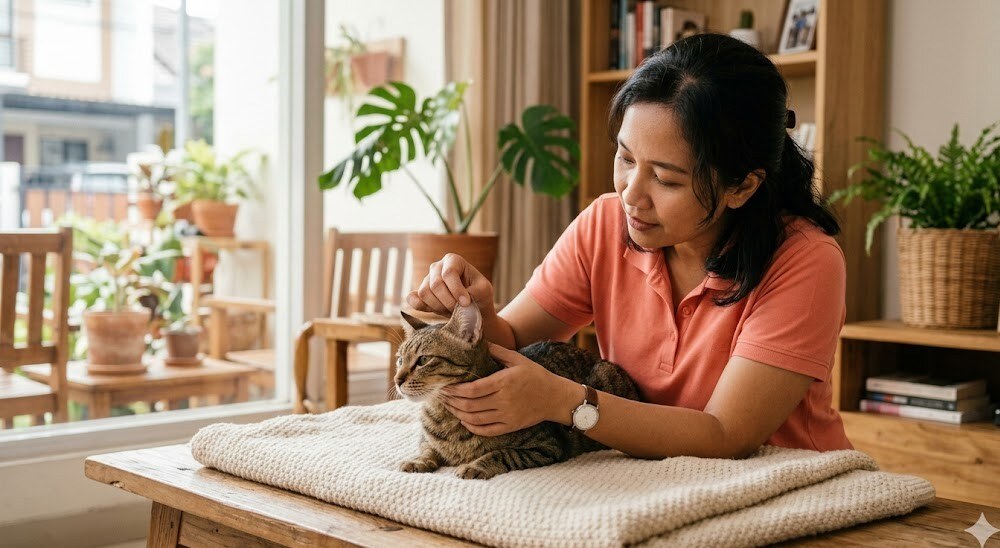
Technique: brush in the direction of fur growth (head to tail, top to bottom). Start with areas the cat tolerates first (head, neck, back), then move to sensitive areas (belly, hind legs, tail). Keep sessions to 10-15 minutes while talking softly and giving a treat afterward. Do not force it if the cat protests, take a break, continue tomorrow.
Areas that mat most often, must be checked
- Behind the ears + under the chin (the cat cannot groom these areas with its tongue, so mats form here)
- Front armpits + rear "armpits" (mats here are very painful if left)
- Inner thigh folds
- Base of the tail + around the anal area (long-hairs often get a "sanitary trim" for hygiene)
If there is a large mat already formed and stuck to the skin, do not force the comb, it can tear the skin. Shave it slowly with blunt scissors or an electric clipper, or take the cat to a professional groomer / vet clinic.
Prevention #2 , Hairball control diet
Many pet food brands formulate special diets for hairball control. The mechanism: high fiber (especially insoluble fiber such as cellulose and beet pulp) that helps fur move from the stomach through the intestine into the feces, rather than accumulating in the stomach until it has to be vomited.
Products commonly available in Indonesia:
- Hill's Science Diet Adult Hairball Control, dry or wet, a standard formulation for adult cats.
- Royal Canin Indoor Long Hair, dry, a special formula for indoor + long-haired cats, balancing hairball control and nutrient density.
- Royal Canin Hairball Care, a hairball-specific version with more aggressive fiber content.
- Iams ProActive Health Hairball Care, a mid-tier option.
A realistic note: a hairball diet is not a magic bullet. The effect is usually seen after 4-8 weeks of consistent use, with a frequency reduction of ~30-50% (not 100%). The combination of diet + routine brushing gives the best results. Diet alone without brushing in a Persian will still leave significant hairballs.
Consult your vet before switching diets if the cat has another condition (CKD, diabetes, food allergy), because hairball control formulations are sometimes high in fiber, which may not suit certain conditions.
Prevention #3 , Hairball remedy paste (with caveats)
Traditional lubricant pastes are popular in the US/EU market for hairball management. The composition is usually: mineral oil + food-grade petroleum jelly + malt + flavoring. How it works: it lubricates the fur in the stomach so it passes more easily into the intestine and out in the feces, rather than being retained until vomited.
Brands commonly cited in the veterinary literature: Laxatone (Vetoquinol), Petromalt (Sentry), Tomlyn Laxatone. Available at import pet shops or marketplaces, or can be obtained through a vet.
Usage per the label: usually an almond-sized amount, 1-2x per week for maintenance, or more often (daily) during an active hairball episode. It is given by smearing it onto the cat's paw so it licks it off itself (most cats like the taste, sweet malt-flavored), or directly into the mouth.
Safety note, must understand before use
Although this product is OTC in many countries and is often suggested in pet forums, there are several considerations to be aware of:
- Long-term routine use is NOT advised without veterinary consultation. Mineral oil used daily and continuously for years could theoretically interfere with the absorption of fat-soluble vitamins (A, D, E, K). For use during an active hairball episode (1-2 weeks), relatively safe. For long-term daily maintenance, discuss with your vet.
- Aspiration risk if the cat refuses to swallow. Mineral oil is very slippery and has low surface tension, if the cat suddenly head-shakes or jumps while oral paste is being placed in its mouth, the paste can enter the trachea. Aspiration of mineral oil into the lungs can trigger serious and hard-to-treat lipid pneumonia. This is why the method of smearing it onto the paw to be self-licked is safer than force-feeding by mouth.
- Do not combine with other oral medications in close timing, mineral oil can interfere with drug absorption in the intestine. Space doses at least 2-3 hours apart.
- Do not use on a cat already suspected of obstruction, the paste helps fur pass through, but if there is a full obstruction, the paste can actually make it worse. Confirm with a vet first (palpation + ultrasound if needed) before giving paste to a cat that refuses food and is suspected of obstruction.
- Do not use "hairball gel" products with unclear composition, some generic local brands have poor QC, with reports of contaminants. Stick to established brands (Laxatone, Petromalt) or go through a vet.
The safe consensus: hairball paste may be used occasionally during an active hairball episode (1-2 weeks, at label frequency), but do not make it a lifelong routine without veterinary discussion. For long-term maintenance, brushing + diet are more important than paste.
Prevention #4 , Adequate hydration
Cats are notoriously poor drinkers (an evolutionary legacy from their desert-cat ancestors). Chronic dehydration = slower GI motility = swallowed fur retained longer in the stomach = more frequent hairballs.
Hydration strategies:
- Wet food (can/pouch) as a routine part of the diet, wet food is ~70-80% water, far more hydrating than dry food (10% water). Ideally 50/50 wet+dry, or wet as 1-2 meals per day.
- Multiple water stations around the house, cats are more inclined to drink if water is easily accessible in several places. Place water bowls in different areas (away from the litter box, away from the food bowl, cats usually prefer water that is not near food/feces).
- Water fountain, many cats prefer running water over still water (an evolutionary instinct: running water = fresher). Brands: Catit, PetKit, PetSafe Drinkwell. If budget is tight, change the bowl water 1-2x per day to keep it fresh.
- Shallow, wide bowl, many cats avoid deep bowls because their whiskers touch the bowl walls ("whisker fatigue"). Use a shallow ceramic bowl or plate.
Prevention #5 , Cat grass as natural fiber
Cat grass (usually wheatgrass, barley, or oat seedlings) is often sold at pet shops in small pots. Outdoor cats often "nibble" grass on their own, a natural behavior partly thought to provide extra fiber and help clear fur via vomiting or feces.
The realistic benefit: extra fiber for an indoor cat with no access to grass. Not a substitute for brushing or diet, but a nice-to-have, especially for thick-coated Persians / Maine Coons.
Make sure the cat grass sold is organic and pesticide-free. Place it in an accessible area and let the cat decide when to nibble. Some cats are interested, some are indifferent.
DO NOT, the cooking-oil and olive-oil myth
Still circulating in DIY pet-care forums: "give the cat a spoonful of cooking oil / olive oil to lubricate the hairball." Stop. This should not be done.
- Not effective, cooking oil is a triglyceride that is DIGESTED by intestinal lipase and absorbed into the blood as an energy source. It is not an inert lubricant that stays in the intestinal lumen like mineral oil. So cooking oil is absorbed, not used to lubricate the fur.
- Olive oil is the same, still a triglyceride that is absorbed, with no mechanical lubricant effect. Plus many cats dislike the taste, so force-feeding = aversion.
- Aspiration risk, same as with paste, liquid oil forced into the mouth of a resisting cat can enter the lungs. Lipid pneumonia from aspiration of vegetable oil is also a real risk, although theoretically triglycerides are cleared faster than mineral oil.
- Excess calorie load, 1 teaspoon of oil = ~40 kcal. For a 4 kg cat that needs ~200 kcal/day, a teaspoon of oil = an extra 20% of RER with no other nutritional value. Routine use = obesity + pancreatitis risk.
If a lubricant is truly needed, use a product actually formulated for it (Laxatone / Petromalt, mineral oil based, inert in the GI tract). Or better: focus on sustainable brushing + diet + hydration.
When to see a vet, checklist
- Suspected obstruction, repeated unproductive vomiting (retching without result) >12-24 hours, anorexia >24 hours, abdominal distension, the cat looks depressed or hides
- Persistent constipation >2-3 days + straining in the litter box with no result
- Sudden significant rise in hairball frequency from baseline, can indicate over-grooming (look for the cause: stress, allergy, parasites) or declining GI motility (senior cat, underlying GI condition)
- Weight loss + frequent hairballs, can indicate malabsorption or a chronic GI condition (IBD, lymphoma, hyperthyroidism in seniors)
- Hairballs + recurrent diarrhea, can indicate food allergy or IBD manifesting in both the upper and lower GI tract
- First-ever hairball in a young kitten (<6 months), kittens generally do not produce significant hairball volume, so a large hairball at a young age can indicate parasites or an unsuitable diet
The workup a vet typically performs: a detailed history (frequency, duration, diet/environment changes, other pets), physical examination (abdominal palpation to check for a mass or distension, body condition score), and if obstruction is suspected → abdominal radiograph ± barium contrast or ultrasound to visualize the bezoar. Treatment of mild obstruction is sometimes enough with fluid therapy + lubricant; severe obstruction requires an endoscopic or surgical procedure (rare but possible).
FAQ on hairballs in long-haired cats
My Persian threw up a hairball 3x in one week, is that already concerning?
3x per week in a Persian during active shedding season can still be considered the upper end of the normal range, but it is best to audit: how diligent is the brushing, is a hairball control diet already in use, does the cat look well otherwise (eating well, normal activity)? If everything is OK and this is a temporary pattern during shedding season, monitor it. If the pattern persists or rises again to 4-5x per week, get a veterinary evaluation to eliminate a behavioral over-grooming cause and check GI motility.
My cat is retching hard repeatedly but nothing comes out. Can I wait until tomorrow to see a vet?
If the retching with the characteristic posture (neck extended, abdomen contracting hard, a "hek hek hek" sound) repeats within 1-2 hours with no result and the cat looks distressed → do not wait. This could be an obstruction. For the Greater Jakarta area, contact us on WhatsApp for a quick consultation, we will help triage whether you need a referral to the nearest 24-hour emergency clinic or whether a home visit evaluation is possible.
I already brush daily but my Persian still gets hairballs, what else can I do?
Audit the brushing technique, does it really capture the undercoat (a Furminator/deshedding tool, not just the topcoat)? Are the difficult areas (behind the ears, armpits, inner thighs) covered? Add a hairball control diet if not already, plus hydration (wet food). If after 6-8 weeks of combining everything there are still hairballs >2-3x per week, get a veterinary evaluation, sometimes there is an underlying skin condition triggering over-grooming that we are not aware of.
Is it OK to give Laxatone every day as a preventive?
For long-term daily maintenance, it is best to discuss with a vet first (see the safety note in the "Prevention #3" section). Use during an active hairball episode (1-2 weeks) per the label is OK. For permanent routine prevention, brushing + diet is far more sustainable and without the risk of chronic mineral oil exposure.
Does a 4-month-old Persian kitten already need routine brushing?
Yes, and in fact this is the prime time for desensitization. Start gently with 5-10 minutes a day using a soft comb (pin brush or a gentle slicker), associate it with treats + soft talking, so that as an adult the cat is already used to being brushed daily. Young kittens generally do not produce a meaningful hairball volume, the focus early on is to build the habit + maintain coat health.
My cat is long-haired but indoor only, does it still need flea / mite antiparasitics?
Indoor only is still at risk of external parasites (fleas can come in on our shoes, clothes, through windows; mites from contact with other animals during boarding or vet visits). Skin parasites trigger itchiness → over-grooming → more frequent hairballs. Monthly topical antiparasitics are still recommended; consult a vet for a suitable product and schedule.
Summary
Hairballs in long-haired cats (Persian, Maine Coon, Ragdoll, Norwegian Forest, Himalayan) are generally a natural process, cats swallow fur during self-grooming, most of it passes in the feces, and the rest is expelled via vomiting as a cylinder of fur. A frequency of 1-2x per week in an adult long-haired cat is usually normal.
The most critical things to remember:
- Normal hairball = a fur cylinder, the cat appears normal afterward, frequency 1-2x per week
- CONCERNING = repeated unproductive vomiting, anorexia >24h, lethargy, abdominal distension → suspect obstruction, see a vet
- Prevention #1 = routine brushing (daily for Persians, 3-4x/week for Maine Coons, etc.) using a slicker + Furminator + fine-tooth comb
- Prevention #2 = hairball control diet (Hill's, Royal Canin), effect over 4-8 weeks of consistency
- Prevention #3 = hairball paste (Laxatone, Petromalt), OK during an active episode, be careful with long-term daily use, aspiration risk if the cat resists
- Prevention #4 = adequate hydration (wet food + multiple water stations + fountain)
- Prevention #5 = cat grass as extra natural fiber (optional)
- DO NOT use cooking oil / olive oil, not effective (absorbed by the intestine, not an inert lubricant) + aspiration risk + excess calorie load
- Audit the cause of over-grooming if hairballs suddenly increase (stress, allergy, parasites, skin condition)
Want to discuss your cat's hairball pattern or need a direct evaluation at home (check skin condition, abdominal palpation, diet discussion)? Contact us on WhatsApp, send the cat's breed + age, hairball frequency, other signs you have seen (vomiting, eating, body weight), and a photo of the cat if there are any areas of shedding or hot spots. The Prabasa Vet team will help with an initial evaluation and recommend the next steps.
Read also: Dental brushing for cats and dogs: safe methods, frequency, and which paste to use, Claw trimming for cats and dogs: safe methods, tools, and avoiding injury, Ear cleaning for cats: safe methods, frequency, and signs of otitis, Cat diarrhea and vomiting: causes and management, Complete pet care guide.
Medical references used in this article
This article was prepared with reference to the following sources, verified per clinical sentence:
- ACVIM (American College of Veterinary Internal Medicine), guideline on the approach to chronic vomiting in cats, differential diagnosis of hairball vs gastritis / IBD / obstruction
- ISFM (International Society of Feline Medicine) Cat Friendly Practice, guideline on grooming + handling of long-haired cats, desensitization approach for Persians / Maine Coons
- AAFP (American Association of Feline Practitioners) Senior Care Guidelines, considerations on declining GI motility in senior cats, hairball management in older cats
- Plumb's Veterinary Drug Handbook 7e, mineral oil monograph (safety profile, aspiration risk, drug interactions, duration of use), considerations on fat-soluble vitamins with chronic use
- Eckstrand C et al., literature on self-grooming behavior in adult cats, percentage of waking time spent grooming, factors in stress-induced over-grooming
- Cannon M., review of hairballs / trichobezoars in domestic cats, normal vs abnormal frequency, prevention strategy
This article is general guidance based on international guidelines from ACVIM, ISFM, AAFP, and standard veterinary textbooks. For evaluation of your specific cat's condition and selection of the right product, consulting a veterinarian is the right step.