
"My dog suddenly started panting really heavily after a midday walk around Pondok Indah. It was only 15 minutes. His gums were red, he was weak and wouldn't get up. Is this normal in hot weather?" This is not normal, it can be an early sign of heat stroke, and in Jakarta with its consistently tropical climate of 30-34°C plus 70-85% humidity, cases like this are more common than many owners realise.
Heat stroke is one of the most fatal emergencies when it is caught too late, and one of the most preventable when you know the patterns. This article is a practical guide for pet owners in Jakarta: why dogs and cats are vulnerable, the signs you need to recognise, the correct first aid (and what you must NOT do), plus prevention strategies for everyday life in the Jakarta climate.
Why dogs and cats are vulnerable to heat stroke, especially in Jakarta
Dogs and cats do not have sweat glands like humans. Their primary cooling mechanism is panting, evaporation of water from the tongue and upper airway. This system works well enough in cool, dry climates, but has serious limitations in Jakarta:
- High humidity (70-85%), when the air is already saturated with water vapour, evaporation from the tongue becomes inefficient. Panting becomes a weak cooling mechanism
- Consistently high ambient temperatures, daytime Jakarta rarely drops below 30°C. Pets get no natural recovery window like they would in a climate with cool nights
- Hot asphalt, during the day, Jakarta asphalt can reach 50-60°C. A dog walked at midday burns its paw pads while its body absorbs radiant heat from below
Breeds that are extra vulnerable
Some breeds have a much higher heat stroke risk and need extra care in Jakarta:
- Brachycephalic (flat-faced): Pug, French Bulldog, English Bulldog, Boston Terrier, Shih Tzu, Pekingese on the dog side, and Persian, Exotic Shorthair, Himalayan, British Shorthair on the cat side. Their short, narrow upper airway makes panting far less efficient. Some brachycephalic dogs can overheat within 5-10 minutes of light activity in midday Jakarta
- Double-coated dog breeds: Husky, Samoyed, Golden Retriever, Pomeranian, their double coat acts as ideal insulation for cold climates, which is counter-productive in Jakarta
- Senior pets (7+ years) and small puppies/kittens (<6 months), thermoregulation is not yet, or no longer, optimal
- Obese pets, body fat acts as insulation and limits lung capacity for panting
- Pets with chronic heart or respiratory disease, their compensatory capacity is already reduced
Normal body temperature vs heat stroke
Knowing your pet's normal body temperature is important for recognising an emergency:
- Normal temperature for dogs and cats: 38.0-39.2°C (rectal)
- Fever (mild hyperthermia): 39.5-40.0°C
- Serious heat stress: 40.0-40.5°C
- Heat stroke, emergency: above 40.5°C (and especially above 41°C)
- Organ failure risk: above 42°C (damage to the brain, kidneys, liver, and coagulation begins within minutes)
If you cannot measure rectal temperature at home, look at the combination of clinical signs (below). The overall condition you observe in your pet matters more than a single thermometer reading.
Clinical signs of heat stroke you must recognise
Early signs (early heat stress), still treatable quickly
- Intense, non-stop panting, not mild breathlessness after a run, but rapid, deep panting that persists for 5+ minutes even after the pet has rested
- Excessive drooling (hypersalivation), thick, heavy drool, sometimes frothy
- Bright red gums (previously pink), a sign of vasodilation as the body tries to shed heat
- The pet seeks cool surfaces, lying on tile floors, near the AC, in deeply shaded spots
- Weakness, slow movements, or refusing to continue activity
Later signs (established heat stroke), emergency, go to a 24-hour clinic immediately
- Gums changing colour from bright red to pale or bluish-purple, a sign of shock and circulatory failure
- Slowed capillary refill time (press the gum briefly; if the pink colour does not return within 2 seconds = a problem)
- Vomiting or diarrhoea, sometimes with blood (gastrointestinal damage)
- Confusion, disorientation, the pet seems not to recognise you
- Progressive weakness until unable to stand
- Muscle tremors or seizures
- Collapse, loss of consciousness
- Bleeding from the nose, gums, or in the urine, a sign of coagulation disorder (DIC)
Established heat stroke is an absolute emergency that requires a 24-hour clinic. Do not wait until morning, do not wait for your usual vet's hours. A pet with a body temperature above 42°C for more than 30-60 minutes is at serious risk of permanent organ damage, even after it appears to "recover".
Common causes in Jakarta that are often overlooked
1. Dogs left in cars, FATAL WITHIN 15 MINUTES
This is the number one and most tragic cause of heat stroke because it is 100% preventable. A car parked in Jakarta with an outside temperature of 32°C can reach an interior temperature of 50-60°C within 15-20 minutes, even with the windows cracked open, even parked in the shade, even if you are "just popping into" the minimarket.
A car AC left running while parked is not reliable, the compressor can cycle off and the temperature can rise quickly without you noticing when you are not inside. The rule: NEVER leave a dog or cat in a parked car, even for just 5 minutes, even when the weather feels "not too hot".
2. Midday walks on hot asphalt
Jakarta is already hot after 9-10 in the morning. Asphalt reaching 50-60°C burns a dog's paw pads (test: place the back of your hand on the asphalt for 5 seconds, if you can't stand it, neither can your dog) and the radiant heat from below heats the body quickly. The combo of hot asphalt + high temperature + humidity = a recipe for heat stroke.
3. Excessive exercise during the day
A dog used to running or doing sport in a cool climate needs to fully acclimatise in Jakarta. Even a fit dog should not exercise intensely in the middle of the day in the Jakarta climate. Working dogs or dogs taken on tropical hikes are at very high risk.
4. Pets outdoors without shade or water
A dog left on a terrace or in the yard during the day without continuous shade and clean water within reach = at serious risk. Shade must be genuinely shaded throughout the day (the sun shifts), and water must stay fresh (not stale and hot).
5. Brachycephalic + stress + heat
A Pug, Bulldog, or Persian that is stressed (for example when meeting another dog, or when taken to the clinic) while in hot conditions can decompensate very quickly. Many brachycephalic heat stroke cases happen when the dog is excited or anxious, not during physical activity.
Heat stroke first aid, what you MUST and MUST NOT do
What you MUST do
- Move to a cool place immediately, an air-conditioned room, shade with a fan, a tile floor. Keep away from sources of radiant heat
- Wet the body with cool (not cold) water, use ordinary tap water (around 25-28°C) on the body, especially the neck, armpits, groin, paws, and belly. You can use damp towels that you keep swapping, or gently pour water over the body. Cool water is more effective than ice water because it does not cause vasoconstriction
- Turn on a fan directed at the pet once it is wet, evaporation of water from the skin = effective cooling
- Offer small amounts of drinking water if the pet is still conscious and able to swallow. Do not force it
- Measure rectal temperature if you can, important information for the vet. Stop aggressive cooling once the temperature drops to around 39.5°C (continuing risks hypothermia)
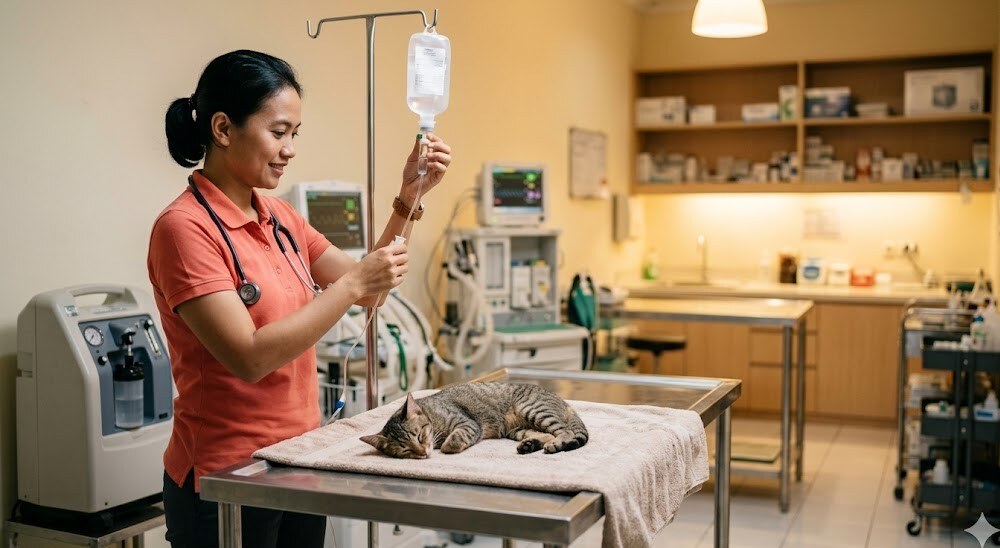
- Head straight to a 24-hour clinic, on the way, keep cooling with damp towels in the car with the AC on. Heat stroke requires IV fluid evaluation, monitoring for organ damage (kidneys, liver, coagulation), and sometimes a plasma transfusion. Even if the pet "appears to recover" after cooling, internal damage may already have occurred and may only manifest 24-72 hours later
What you MUST NOT do
- DO NOT use ice water or an ice bath, a sudden temperature change causes vasoconstriction (peripheral blood vessels narrowing), which actually traps heat in the internal organs. Cooling too quickly also risks thermal shock and cardiac arrhythmia. Ordinary cool water (25-28°C) is far safer
- DO NOT force the pet to drink water if it is unconscious or weak, risk of aspiration (water entering the lungs = life-threatening aspiration pneumonia)
- DO NOT cover the pet with layered wet towels without a fan, towels covering the body fully without airflow actually trap heat like a sauna
- DO NOT give human fever medication (paracetamol, aspirin, ibuprofen), these are toxic to dogs and cats, especially cats
- DO NOT wait to see whether it improves at home if there are signs of established heat stroke (pale/purple gums, collapse, confusion, seizures), every minute, organ damage continues
- DO NOT confuse heat stroke with "ordinary tiredness", a pet that has collapsed from heat stroke needs a 24-hour clinic, not rest at home
Heat stroke prevention for everyday life in the Jakarta climate
Schedule outdoor activity
- Dog walks: before 7am or after 6pm. Avoid the middle of the day entirely (10am - 4pm)
- Check the asphalt temperature with the back of your hand before walking, if you can't stand 5 seconds, the asphalt is too hot for your dog
- Bring water and a foldable bowl for walks longer than 10 minutes
- Choose shaded routes, parks with a tree canopy (Taman Suropati, Hutan Kota Srengseng, Taman Honda Tebet in the morning) are safer than open sidewalks
Conditions at home
- AC or a fan available for the room where the pet spends time, especially for brachycephalic, senior, or medically vulnerable pets. This is not a luxury for sensitive breeds, it is a medical necessity in the Jakarta climate
- Clean water in several locations, changed at least 2-3 times a day to keep it fresh
- A tile floor as a lying-down option, pets know how to cool themselves on cool surfaces if given access
- A cooling mat for brachycephalic or senior pets (a gel mat that absorbs body heat), a cheap investment that helps a great deal
- Avoid bathing with hot water, cool water is better in Jakarta
Safe transport
- NEVER leave a pet in a parked car even for 5 minutes, even with windows open, even with the AC running
- The car must already be cool before the pet gets in, turn on the AC for 5-10 minutes first
- For long journeys, bring water and stop every 1-2 hours so the pet can drink and get out briefly (in the shade)
- Avoid travelling with the pet during the day unless urgent, morning or evening is safer
Breed-aware care for brachycephalic pets
If you have a Pug, Bulldog, Persian, or another flat-faced breed, be extra careful:
- Minimal outdoor activity and only at cool times
- Home AC is almost essential during the day
- Body weight must be ideal, overweight + brachycephalic = compounded heat stroke risk
- Consider a BOAS (Brachycephalic Obstructive Airway Syndrome) evaluation with your vet, some brachycephalic dogs have a very narrowed airway and need surgical intervention to function normally
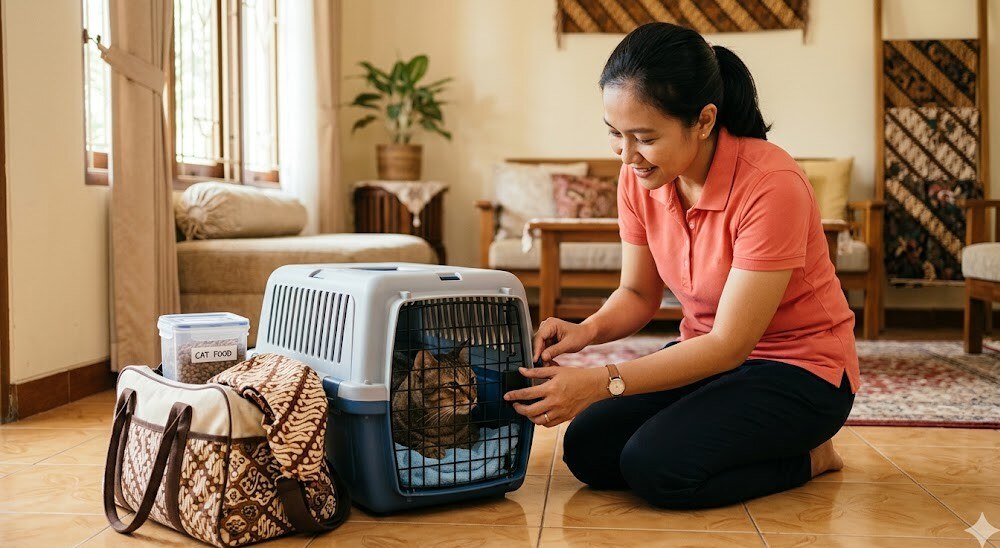
- A carrier or pet bag for short trips (small dogs) so they don't have to walk on hot asphalt
FAQ on heat stroke in Jakarta
My cat is always indoors in an air-conditioned home. Is it still at risk of heat stroke?
The risk is much lower, but not zero. Scenarios that are still risky: the AC turning off during a daytime power outage, a cat trapped on a balcony or in a non-AC room, a cat with compromised breathing (Persian, asthma) that becomes stressed. If the power goes out during the day and the home has no AC, move the cat to a well-ventilated room, lightly wet its paws and belly, and offer water.
My dog is a flat-faced breed (Pug). Can I take it out to relieve itself or for walks?
Yes, but with strict limits: only very early in the morning (before 7) or at night (after 7), maximum 10-15 minutes, in shaded areas, bring water. Avoid the middle of the day entirely, and avoid intense exercise at any time. Many Pug owners in Jakarta learn that "walks" for their dog are best done short and frequent rather than as one long session.
I see a dog in a parked car at the mall. What should I do?
If the dog still looks okay (not panting heavily, still responsive): note the licence plate + location + time, report to mall security to page the owner, or leave a note. If the dog looks distressed (heavy panting, weak, red/purple gums): ask security to break the window if the owner cannot be found within 5 minutes. 15 minutes of heat stroke in a car can be fatal. Photograph the situation for documentation.
My pet seems to have recovered after I cooled it at home. Do I still need to see the vet?
Yes, very important. Heat stroke causes internal damage (kidneys, liver, coagulation) that often only manifests 24-72 hours later. A pet that "appears to recover" but then develops acute kidney injury 2 days later is a recurring pattern. Bloodwork (BUN, creatinine, liver enzymes, coagulation) within 24 hours after heat stroke is strongly recommended so that early intervention is possible.
When can I exercise my dog again after recovering from heat stroke?
Wait for your vet's instructions, usually a minimum of 7-14 days of complete rest, then light activity with close monitoring. A dog that has had heat stroke has a 2-3x higher risk of another episode for life, because its thermoregulation threshold has dropped. Its outdoor activity schedule needs to be permanently adjusted to be more conservative.
Summary
Heat stroke is a fatal emergency when caught late, but most cases can be prevented with awareness of the Jakarta climate + breed-aware care:
- Jakarta's tropical climate + high humidity make panting less efficient, pets are far more vulnerable than in cool climates
- Brachycephalic, senior, obese, and double-coated breeds = extra high risk, needing more conservative care
- Early signs (non-stop panting, drooling, red gums, seeking cool surfaces) = move to a cool place + cool with cool water immediately
- Established signs (pale/purple gums, collapse, confusion, seizures) = a 24-hour clinic is absolutely required, do not wait
- First aid: cool place + cool water (not ice) + fan + offer a drink if conscious + go to the clinic. NO ice bath, NO forced drinking, NO human medication
- Prevention: outdoor schedule in the morning/evening only, NEVER leave in a parked car, AC/fan at home, clean water available, breed-aware care
- After heat stroke: bloodwork evaluation by the vet is essential even if the pet appears recovered, organ damage can manifest 24-72 hours later
If your pet has early signs of heat stress and you need a quick second opinion, our initial consultation is free via WhatsApp, send a photo/video of your pet's condition and we'll help assess whether you need to head to a clinic right away or whether it can be managed at home first. For established heat stroke, don't wait for a consultation, go straight to the nearest 24-hour clinic.
Read also: Pet Emergency Guide, Signs of a Cat Emergency You Should Not Delay, Senior Dogs 7+ Years: Changes and Senior Care.
Medical references used in this article
This article was prepared with reference to the following sources:
- ACVECC (American College of Veterinary Emergency and Critical Care) Heat Stroke Guidelines
- Bruchim Y et al. Heat stroke in dogs, pathophysiology and management. The Veterinary Journal 2017 (review article)
- AAHA Brachycephalic Patient Care Guidelines, risk stratification + climate-aware management
- BSAVA Manual of Canine and Feline Emergency and Critical Care 3rd ed, heat stroke chapter (cooling protocol + DIC monitoring)
This article is a general guide for the tropical Jakarta climate. For your pet's specific condition, especially if it is a brachycephalic breed or has a chronic illness, consulting a veterinarian for a personalised prevention plan is the right step.