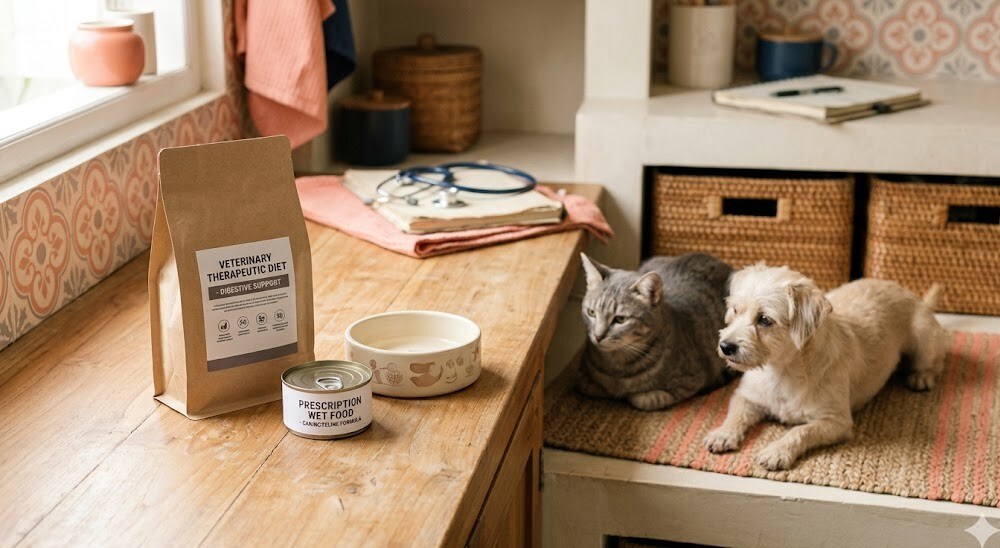

"I switched my cat's kibble brand a week ago, yesterday it started having diarrhea. Is there a connection?" Or: "My puppy was adopted 3 days ago, the breeder gave brand X, I have brand Y stocked at home. How do I switch safely?" Questions about food transition come into our WhatsApp chat regularly. In short: yes, there is a direct link between how you switch food and diarrhea/vomiting. Most GI upset after a food change isn't because the new brand is bad, but because the transition was done too quickly.
This article explains why a gradual transition is needed, the standard 7-day protocol used by most veterinary nutritionists, the 14-day protocol for sensitive stomachs, the signs the GI is not tolerating it, conditions that mandate a transition (life stage, medical diet, recall, elimination), an adjunct probiotic supplement, and when to consult a veterinarian.
Why a gradual transition is needed, the gut microbiome needs time to adapt
The digestive tract of dogs and cats is not just "a tube that digests food", there is an ecosystem, the gut microbiome, with billions of bacteria that help ferment nutrients, synthesize vitamins (especially vit K, B complex), and modulate immunity. The composition of these microbes is tuned to the substrate (nutrient type) that comes in consistently.
When food is changed suddenly, especially with a different nutrient profile (a different protein source, a different carb-fat ratio, a different fiber content), the old microbes haven't died yet, and the new microbes haven't grown dominant. The results:
- Suboptimal fermentation → gas, bloating, loose stool
- Osmotic shift in the gut lumen → acute osmotic diarrhea
- Transient mucosal irritation → temporary vomiting
- Anorexia → the pet refuses to eat due to GI discomfort
Studies in dogs show a prevalence of GI upset (diarrhea or vomiting) of 30-50% after a sudden food change without a transition protocol, a number that can actually be prevented with a gradual switch. In cats, the prevalence can be even higher because the feline GI tract is relatively more sensitive.
The key thing to understand: the gut microbiome needs 5-14 days to adaptively shift its composition to a new diet. This is the scientific basis for the 7-day transition protocol that is the veterinary standard.
The 7-day protocol, the standard for healthy adult pets
The most common and practical protocol for healthy adult pets with no history of GI sensitivity:
| Day | Old food | New food | Notes |
|---|---|---|---|
| Day 1-2 | 75% | 25% | Minor introduction, initial observation |
| Day 3-4 | 50% | 50% | Half-and-half, the gut microbiome begins adapting |
| Day 5-6 | 25% | 75% | New dominant, old as the accompaniment |
| Day 7+ | 0% | 100% | Full transition complete |
Practical implementation:
- Calculate your pet's total daily portion (e.g., a 4 kg cat needs ~50 g kibble/day)
- Day 1-2: total portion 50 g = 37.5 g old kibble + 12.5 g new kibble, mixed into one bowl
- Day 3-4: 25 g old kibble + 25 g new kibble
- Day 5-6: 12.5 g old kibble + 37.5 g new kibble
- Day 7+: 50 g new kibble only
If switching from kibble to wet food (or vice versa), the principle is the same but the amounts are adjusted to the calories per gram of each format. See Wet Food vs Dry Food for Cats and Dogs: Pros-Cons, Hydration, and When to Choose Which for the conversion.
The 14-day protocol, the slow version for sensitive stomachs
For pets with a history of GI sensitivity (prone to diarrhea, prone to vomiting, subclinical IBD, post-illness recovery), extremely brand-loyal cats that resist switching, or seniors with reduced GI motility, the protocol is extended to 14 days:
- Day 1-3: 85% old + 15% new
- Day 4-6: 70% old + 30% new
- Day 7-9: 50% old + 50% new
- Day 10-12: 30% old + 70% new
- Day 13-14: 15% old + 85% new
- Day 15+: 100% new
For extreme cases (super-selective cats that clearly reject the new food), it can even be stretched to 21 days with small increments (10% every 3 days). A big effort for a sustainable transition.
Observe daily, what to monitor
During the transition period, monitor the following parameters every day:
Stool
- Consistency, use the Fecal Score Chart (scale 1-7, ideal 2-3 = firm but moist). Loose stool (score 5-7) = warning sign.
- Frequency, normal: dogs 1-2x/day, cats 1x/day. More than this = a significant change.
- Color, brown is normal. Pale, black tarry, or green = needs attention.
- Presence of blood or mucus, always a warning sign requiring a medical evaluation.
Vomiting
- An occasional hairball vomit in cats is OK
- Vomiting more than 1-2x within 24 hours after the new food = a warning sign
- Bloody or coffee-ground colored vomit = an emergency
Appetite + energy
- The pet still excited at mealtime? Good.
- The pet refusing to eat for more than 1 day (cat) or 2 days (dog) = a warning sign
- Lethargy, hiding, or behavior change = needs an evaluation
Gas + scooting
- Excessive gas + a different smell = suboptimal fermentation
- Scooting (dragging the rear) + anal gland issues can be related to stool that is too loose
If there are signs the GI is not tolerating it, what to do
If signs of intolerance appear (loose stool >2 days, vomiting, anorexia, excessive gas, scooting), do not proceed to the next step. The options to consider:
Slow down or hold
Hold at the current ratio (e.g., 50/50) for an extra 3-5 days. Give the gut microbiome a longer time to adapt. The stool should return to firm within 3-5 days if it is a mild adaptive issue.
Switch back to the previous step
If diarrhea appears at the 50/50 ratio, go back to 75/25 (75% old + 25% new) for a week. Then try moving up a step again.
Return fully to the old food
If diarrhea/vomiting persists despite slowing down and switching back, return the diet 100% to the old food for at least 1-2 weeks to reset the GI. Consult a veterinarian for an evaluation of:
- Is this an intolerance to the specific new brand (a particular ingredient or protein source)?
- Is there an underlying issue (GI parasite, food allergy, subclinical IBD) that has just been revealed by the stress of the diet change?
- Is it necessary to choose a new brand with a different profile?
Try a novel-formula bridge approach
For repeated failed switches, it can sometimes help to use a "bridge diet", a commercial sensitive-stomach diet (Royal Canin Gastrointestinal, Hill's i/d, Purina EN) for 7-14 days in the middle of the transition as a "rest" before continuing to the target brand.
Conditions that mandate a transition (when you must change food)
Not all transitions are optional. Some conditions generally require a switch:
1. Life stage change
- Puppy → Adult, usually 12 months for small/medium breeds, 18-24 months for large/giant breeds. Puppy diets are high in protein + fat + special growth Ca, not suitable for adult maintenance (risk of obesity, urolithiasis).
- Kitten → Adult, 12 months. Kitten diets are high in calories + protein, adults need maintenance.
- Adult → Senior, usually 7+ years for dogs, 10+ years for cats. Senior diets are often moderate protein with restricted phosphorus (renal support) + fat adjusted for a metabolic decrease.
See also: Cat Nutrition by Life Stage: Kitten, Adult, Senior, Dog Nutrition by Size: Small, Medium, Large, Giant Breed.
2. Medical condition, prescription diet
- CKD (chronic kidney disease), switch to a renal prescription diet (Hill's k/d, Royal Canin Renal, Purina NF)
- Urinary stones / FLUTD, switch to a urinary diet (Hill's c/d, Royal Canin Urinary, Purina UR)
- Diabetes mellitus, switch to a low-carb diabetic diet (Hill's m/d, Royal Canin Diabetic, Purina DM)
- IBD / chronic GI, switch to a hypoallergenic or highly digestible diet
- Weight management, switch to an obesity-management diet
- Liver disease, switch to a hepatic support diet
For a prescription diet, the transition often starts right when the diagnosis is made, the standard gradual 7-10 days applies. Some acute conditions (acute pancreatitis, post-surgery) may need a faster switch with a commercial sensitive diet as a bridge.
3. Food recall
Rare but it happens. If the brand you use is recalled due to contamination or a formulation issue, a switch is necessary. For an emergency like this, a gradual transition is still recommended but compressed (5-7 days) to balance safety and speed.
4. Allergy / intolerance, elimination diet
For diagnosing a food allergy, switch to a novel protein or hydrolyzed protein diet for a trial of 8-12 weeks. See also: Food Allergy in Cats: Signs, Trigger Proteins, and the Elimination Diet.
Shortcuts that don't work, anti-patterns
Some "tricks" that owners often try but generally fail or are risky:
Cold turkey switch (changing 100% suddenly)
Works sometimes for pets with a strong adaptive gut, but 30-50% of cases end in diarrhea/vomiting. Not worth the risk except in an emergency (food recall + no stock of the old food).
Hide the new food under the old food
Cats generally figure it out, their sense of smell is far sharper than humans'. They will eat the "roof" of old food, then leave the new food. Dogs sometimes can be fooled, but it is still not sustainable.
Starve the pet so it will eat
DO NOT. For cats especially, anorexia >24-48 hours can trigger hepatic lipidosis, a serious condition where the liver is overwhelmed processing the fat mobilized by the body due to fasting. It ends in hospitalization with tube feeding. Dogs are relatively more tolerant but it is still not a healthy strategy.
Mix with an enticing sauce or topper (cats)
If the topper is sustainable long-term (e.g., wet food as a topper for the new kibble), it's OK. But if you use a non-balanced treat, the pet ends up addicted to the topper and still won't eat the new kibble when the topper runs out.
Probiotic supplement, a helpful adjunct
A probiotic (a live microbe supplement) can speed up and stabilize gut microbiome adaptation during the transition. Not mandatory for healthy pets, but very useful for:
- Pets with a history of GI sensitivity
- Switching between diets with very different profiles (e.g., raw → kibble, or allergen → hydrolyzed)
- Post-antibiotic (disrupted gut flora)
- Stress occurring alongside the switch (boarding, moving, the arrival of a new pet)
Probiotic brands we often recommend
- Purina FortiFlora, the Enterococcus faecium SF68 strain. Powder sachet, sprinkled onto food. Studies support it for acute diarrhea in dogs/cats. Dose: 1 sachet/day for 7-14 days.
- Proviable-DC (Nutramax), a multi-strain probiotic + prebiotic blend. Capsule. For dogs/cats with a more complex GI history.
- VetriScience Vetri Mega Probiotic, a multi-strain alternative. Powder or capsule.
Human yogurt is NOT a substitute for a veterinary probiotic. Human strains are not calibrated for the pet GI tract, plus many yogurts contain sugar or sweeteners (xylitol, toxic to dogs). Use a pet-specific product.
Probiotic duration: 7-14 days during the transition is enough for the majority of cases. For pets with chronic IBD, a long-term probiotic can be part of management, but that is a medical context that requires a discussion with a veterinarian.
Food transition FAQ
My cat completely refuses the new kibble, what do I do?
Some cats are extremely brand-loyal, taste preference forms early as a kitten and is resistant to change. Strategies: (1) extend the transition to 21 days with a 10% increment every 3 days, (2) slightly warm the new food (microwave 3-5 seconds) to amplify the aroma, (3) add a small amount of wet food topper on top of the kibble for masking, (4) try a different flavor variant of the same brand. If after 3 weeks it still refuses, the brand may genuinely not suit your cat's preference, try a comparable brand. Don't starve the cat, risk of hepatic lipidosis.
My dog eats anything, does it still need a gradual transition?
Yes, still. A dog that "isn't fussy" about taste doesn't mean its gut microbiome is also super-fast to adapt. About 30% of dogs that switch cold turkey still get GI upset even while eating enthusiastically. A gradual 7-day transition is a small insurance to avoid a relatively big problem.
Can the transition be synced with another schedule (boarding, vaccination, moving)?
Better not. Stress (boarding, travel, the arrival of a new pet) on its own already triggers GI upset in many pets. The combination of stress + a food switch multiplies the risk. Ideally: complete the transition at least 1-2 weeks before or after a major stress event.
How long does it take to return to normal if I switch wrong and there is diarrhea?
For mild acute diarrhea due to a sudden switch without an underlying issue, it usually resolves 3-7 days after returning to the old food or after slowing the transition. If the diarrhea persists >7 days, or there is blood/mucus, repeated vomiting, anorexia, or lethargy, consult a veterinarian. There may be another underlying issue (parasites, IBD, food allergy) that has just been revealed.
I did a 7-day transition, all was fine. But 2 weeks later it started having diarrhea. Related?
It may still be related, it may not. Some intolerances or food allergies take longer to manifest (it can be days to weeks). Record: when the symptoms started, how long, the frequency, the stool color. Consult a veterinarian with a detailed timeline for an evaluation.
Can I transition while using antibiotics or other medication?
Antibiotics disrupt the normal GI flora, so switching food concurrently is more likely to trigger GI upset. Ideally: finish the antibiotics first (+ a minimum of 7 days recovery), then start the switch. If the switch cannot be postponed (e.g., a prescription diet for a medical condition being treated), combining with an adjunct probiotic is highly recommended.
When to consult a veterinarian
- Diarrhea >2 days or repeated vomiting >24 hours despite already slowing the protocol
- Stool that is bloody, black tarry, or with a lot of mucus
- Anorexia (refusing to eat) >24 hours in cats or >48 hours in dogs
- Lethargy, dehydration (dry gums, skin tenting), or significant weight loss
- For pets with a medical condition that requires a prescription diet switch, discuss before starting
- A multi-cat household where one needs a prescription diet, a separate feeding strategy
- For a major life stage transition (puppy/senior, post-surgery, pregnant/nursing), discuss the diet choice
If you are in Greater Jakarta and need a consultation or a direct evaluation at home when your pet has a GI issue after a food switch, the Prabasa Vet house call examination service can assess the condition, evaluate hydration, and recommend a recovery plan, including whether adjunct medical support is needed.
Summary
- A gradual transition is needed because the gut microbiome needs 5-14 days to shift composition; a sudden switch ends in GI upset in 30-50% of cases
- The standard 7-day protocol: Day 1-2: 75/25, Day 3-4: 50/50, Day 5-6: 25/75, Day 7+: 100% new
- The 14-day slow protocol for sensitive stomachs, brand-loyal cats, seniors, or post-illness, a 15% increment every 3 days
- Observe daily: stool consistency, frequency, appetite, energy, gas, vomiting. Signs of intolerance → slow down or switch back a step
- Mandatory transition: life stage change (puppy/kitten → adult → senior), medical diet, food recall, elimination diet for food allergy
- Anti-patterns: cold turkey switch, hide-food trick, starving the pet (risk of hepatic lipidosis in cats), non-sustainable topper
- Adjunct probiotic (FortiFlora, Proviable-DC) for 7-14 days helps gut microbiome adaptation, very useful for pets with a history of GI sensitivity
Have a specific question about the transition protocol for your pet, especially with a medical condition or after a problem post-switch? WhatsApp Prabasa Vet for a free consultation. Mention the type of pet, age, BCS, old and new food, medical conditions (if any), and the timeline of symptoms.
Also read: Cat Nutrition by Life Stage: Kitten, Adult, Senior, Food Allergy in Cats: Signs, Trigger Proteins, and the Elimination Diet, Wet Food vs Dry Food for Cats and Dogs: Pros-Cons, Hydration, and When to Choose Which. See also the Prabasa Vet pet care guide.
Medical references used in this article
This article was prepared with reference to the following sources, verified per clinical sentence:
- WSAVA Global Nutrition Committee. Global Nutritional Assessment Guidelines (Freeman LM et al, JSAP 2011), diet history as the 5th vital assessment + transition recommendation
- AAFP/ISFM (American Association of Feline Practitioners / International Society of Feline Medicine). Cat Friendly Practice Guidelines, feline food transition, GI sensitivity, food aversion management
- Ettinger SJ, Feldman EC, Cote E (eds). Textbook of Veterinary Internal Medicine (ACVIM Small Animal Internal Medicine), chronic diarrhea chapter, dietary management, gut microbiome considerations
- Plumb DC. Plumb's Veterinary Drug Handbook 7th edition, probiotic strains (Enterococcus faecium SF68, multi-strain Proviable), dose, indications for GI upset
- Hand MS, Thatcher CD, Remillard RL, Roudebush P, Novotny BJ (eds). Small Animal Clinical Nutrition 5th edition, dietary transition chapter, AAFCO life stage requirements
- Suchodolski JS. Diagnosis and interpretation of intestinal dysbiosis in dogs and cats. The Veterinary Journal 2016 , gut microbiome adaptation, dysbiosis index, diet-microbiome interaction
- WSAVA Vaccination Guidelines Group + IRIS (International Renal Interest Society), prescription diet timing with a CKD diagnosis, recommendations for a gradual transition to a renal diet
This article is a general guide based on the consensus of international veterinary organizations + standard textbooks. For transitioning the diet of a pet with a specific medical condition, especially a prescription diet for CKD, diabetes, IBD, or a food allergy diagnosis, coordinating with a veterinarian is the right step. The transition protocol is one component of a care plan, not a substitute for a thorough evaluation.