
"Doctor, my cat has been hiding in the AC corner since morning, and now its body is really cold to the touch, weak and not moving, ears like ice. The Jakarta weather dropped a lot earlier and the bedroom AC was running at full speed all last night." A pattern like this, an animal cold to the touch + extreme lethargy + a cold-exposure situation, is a red flag for hypothermia, which is often under-recognized in Indonesia because of the assumption "Indonesia is tropical, how could an animal get cold".
The reality: hypothermia is a real clinical problem in Indonesia, especially for young animals (neonatal puppies/kittens), short-coat breeds that shiver inadequately, small-bodied animals that lose heat quickly, wet animals after rain/bathing that aren't dried promptly, and cases of prolonged exposure to strong AC. This article is a practical guide for owners, what hypothermia is, recognizing early signs, correct first aid (many do it wrong), and when to go to a 24-hour clinic immediately.
What is hypothermia in animals?
Hypothermia is a condition where core body temperature is below the normal limit. Normal range:
- Adult dogs: 37.5–39.2°C
- Adult cats: 38.0–39.2°C
- Neonatal puppies/kittens (0–4 weeks): 34.5–37°C in the first week, gradually rising to the adult range by the 4th week. They cannot thermoregulate perfectly until 4-6 weeks
Severity classification per ACVECC (American College of Veterinary Emergency and Critical Care):
- Mild: 32–35°C, still shivering actively, physiological compensation still working
- Moderate: 28–32°C, shivering begins to stop (reserves depleted), bradycardia, mental depression
- Severe: below 28°C, life-threatening, risk of cardiac arrhythmia, fixed dilated pupils, coma
What must be understood: in moderate-severe cases, the body has stopped shivering because the compensation mechanism is exhausted. An animal that is "calm and quiet" in severe hypothermia is not a good sign, it is a sign of decompensation. Conversely, an animal still shivering actively means it can still compensate.
Causes of hypothermia in Indonesia
Although Indonesia is tropical, animal hypothermia still occurs because of these contexts:
1. Prolonged wetness exposure
- An animal caught in heavy rain + not dried promptly
- An animal that fell into a pool/ditch and was not rescued promptly
- A dog/cat left wet after a bath in an air-conditioned room
- Water evaporating from wet fur causes fast heat loss, even at a room temperature of 25°C, a wet dog can become hypothermic if it stays that way too long
2. Prolonged strong AC for small/short-coat animals
- Chihuahua, Mini Pinscher, Sphynx, Devon Rex sleeping in an AC room at 18-20°C overnight
- Small animals (under 5 kg) have a high surface area/body mass ratio, they lose heat faster than large animals
- Short-coat or hairless breeds don't have enough fur insulation
- Sick animals (anorexia, cancer, geriatric) experience decreased metabolism and impaired thermoregulation
3. Neonatal puppies/kittens
- Young animals under 4 weeks don't have enough brown adipose tissue (BAT) and their shivering reflex is not yet mature
- Totally dependent on the mother + environmental temperature for thermoregulation
- A puppy/kitten separated from the mother, crushed by littermates, or in a strong-AC room = high risk of combined hypothermia + hypoglycemia
- Hypothermia in a neonate also causes GI ileus → cannot nurse effectively → a downward spiral that worsens quickly
4. Post-anesthesia / post-surgery
- Anesthesia suppresses thermoregulation + peripheral vasodilation → heat loss during surgery
- Small animals are at the highest risk because of the high surface area ratio + cold IV fluids + an open surgical field
- A proper clinic uses a warm air blanket or warming pad during and after anesthesia, if the clinic doesn't have this equipment, post-anesthesia hypothermia can occur
5. Severe systemic illness
- Severe sepsis (especially in cats) often presents with hypothermia rather than fever, feline pancreatitis with hypothermia is a poor prognostic sign
- Hypothyroidism in dogs (Addison's, hypothyroid) → drop in metabolism → susceptibility to hypothermia
- Severe hypoglycemia (toy breed puppies, insulin overdose in diabetes) → secondary hypothermia
- Severe trauma with shock → extreme peripheral vasoconstriction + hypoperfusion
Clinical signs of hypothermia, recognize the progression
Mild (32–35°C)
- Active shivering, the body is still compensating, generating heat via muscle activity
- Ears, tail, paws feel cold
- Mild pallor
- The animal seems restless, seeks a warm spot, curls up
- Peripheral vasoconstriction visible
Moderate (28–32°C)
- Shivering stops, reserves depleted (an important sign of decompensation to understand!)
- Severe lethargy, not responding normally
- Bradycardia (heart rate drops)
- Bradypnea (slow, shallow breathing)
- Mental depression, ataxia (wobbly gait), disorientation
- The body feels cold everywhere, not just the extremities
- Mucous membranes pale to cyanotic
Severe (below 28°C)
- Coma or stupor
- Severe bradycardia, risk of atrial fibrillation or ventricular arrhythmia
- Apnea or very shallow breathing
- Fixed dilated pupils
- No response to stimulus
- High mortality without aggressive intervention
First aid at home, what's RIGHT vs WRONG
Many owners mishandle hypothermia out of "instinct", giving hot water, a hairdryer directly on the body, or placing the animal near a stove. This can cause harm. Here is what is correct per ACVECC + BSAVA Manual of Canine and Feline Emergency and Critical Care guidelines:
What's RIGHT
- Check rectal temperature with a digital thermometer, if possible. Without a thermometer, observe clinical signs (shivering = mild, not shivering + weak = moderate/severe, emergency!)
- Move to a warm room (turn off the AC, close the windows)
- Dry the fur with a soft towel if wet, pat dry, don't rub hard
- Wrap in a thick blanket (passive rewarming), let the body recover gradually
- A hot water bottle wrapped in a thick towel (not in direct skin contact) at the belly + axilla + neck, an external heat source
- Offer warm water to drink if the animal is still conscious and able to swallow
- Contact a 24-hour clinic immediately for moderate-severe hypothermia
What's WRONG (don't do)
- Bathing with hot water, causes sudden peripheral vasodilation → cardiac collapse (afterdrop phenomenon)
- A hot hairdryer directly on the body, risk of burns on cold skin with impaired sensation
- Placing near a stove / open flame, burn risk + does not warm the core
- Giving rubbing alcohol ("to warm it up"), alcohol actually causes evaporative cooling, worsening the hypothermia
- Giving hot water to drink, can cause mucosal burns, and the swallowing reflex is suppressed in severe hypothermia
- Delaying the clinic because "it's warm again", hypothermia can relapse + metabolic complications (acidosis, hypoglycemia, coagulopathy) need medical evaluation
When to go to a 24-hour emergency clinic immediately
Moderate-to-severe hypothermia is a medical emergency that needs 24-hour clinic care, NOT a home remedy. Signs that need immediate professional evaluation:
- The animal is not shivering but the body is cold and weak (= moderate-severe)
- Not responding normally, mental depression, or coma
- Bradycardia / shallow / irregular breathing
- Mucous membranes very pale, cyanotic, or prolonged capillary refill time
- A neonatal puppy/kitten with a cold body (combined hypothermia + hypoglycemia is common)
- An animal with an underlying medical condition (suspected sepsis, prolonged anorexia, post-anesthesia)
- A history of extreme cold exposure or drowning
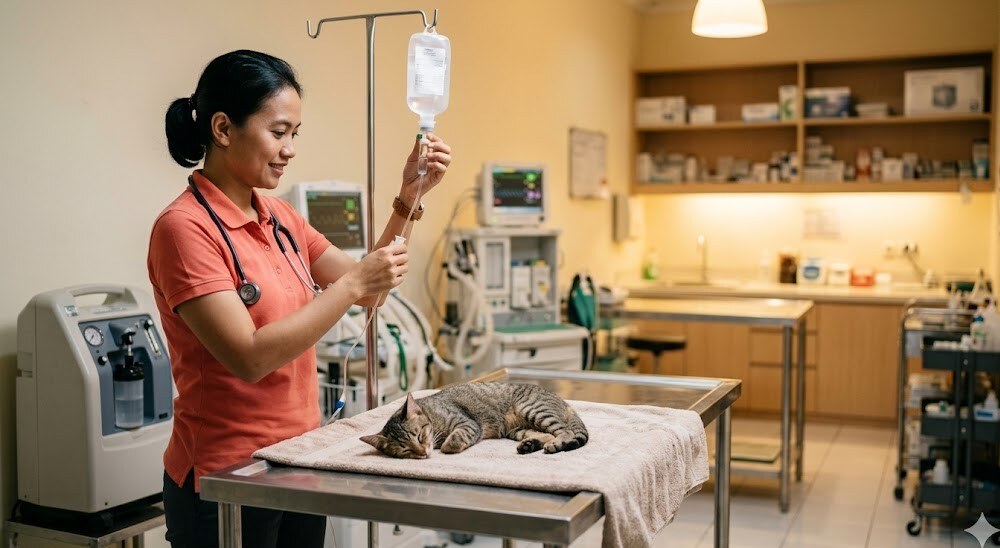
At the clinic, treatment of moderate-severe hypothermia involves warm IV fluids (see the related fluid therapy guide on our blog), a warm air blanket, continuous core temperature monitoring, ECG monitoring (arrhythmia), blood glucose monitoring, and management of complications (acidosis, coagulopathy).
The Prabasa Vet house call service does not replace a 24-hour emergency clinic for moderate-severe hypothermia cases, we can provide an initial consultation via WhatsApp + triage help + referral to the nearest clinic for direct evaluation and hospitalization if needed.
Preventing hypothermia
- Dry completely after a bath or rain, especially short-coat and small animals
- AC settings: not too strong (above 24°C is safe for most animals; warmer for Chihuahua/Sphynx/short-coat, 26-27°C)
- A warm blanket/bed available at home, especially during the rainy season
- Neonatal puppies/kittens: a heat lamp or heating pad (wrapped, on one side of the nest so they can move away if it gets too hot) for an environment of 28-32°C in weeks 1-2, gradually lowered to 24-26°C in weeks 3-4
- Post-anesthesia: make sure the clinic has a warming protocol, ask the vet before surgery
- Senior/sick animals: extra attention to thermal comfort, old and sick animals lose the ability to thermoregulate
FAQ on dog and cat hypothermia
Can hypothermia happen in tropical Indonesia?
Yes, and more often than realized. Not from extreme ambient temperatures like in four-season countries, but from a combination: a wet animal + strong AC + small size + short coat + neonate + underlying illness. The most common cases in practice: neonatal puppy/kitten hypothermia, senior cat anorexia with secondary hypothermia, a wet dog after a bath in an AC room, and post-anesthesia.
How long is a wet animal safe without hypothermia risk?
It depends on the animal's size, coat type, and ambient temperature. A large dog with thick fur (Golden Retriever, Husky) can tolerate being wet longer. A small cat or wet Chihuahua in an AC room at 22°C: mild hypothermia can develop within 30-60 minutes. Practical rule: dry completely within 15-30 minutes after getting wet, especially for small + short-coat animals.
What thermometer should I use to check an animal's temperature at home?
A digital rectal pet thermometer (or a digital human rectal thermometer, you can use that too). Lubricate with petroleum jelly, insert rectally 2-3 cm for adult dogs/cats, 1 cm for a neonate. Hold until it beeps. An ear thermometer is less accurate than rectal for animals. If you don't have a thermometer, observe clinical signs (shivering vs not, level of consciousness, mucous membrane color).
My cat sleeps in an AC room every night, is there a hypothermia risk?
For a healthy adult cat with a medium-long coat (Persian, Maine Coon, Domestic Long Hair), an AC of 22-24°C overnight is generally safe because cats are smart at finding a comfortable position (under a blanket, on the sofa). The risk is higher for: kittens, Sphynx or extreme short-coat, sick senior cats, cats with no access to a warmer spot. Tip: provide a warm blanket or an insulated cat bed as an option, and an AC of 24°C+ is safer than 18-20°C.
My newborn kitten's body is cold, how should I warm it?
Neonatal puppy/kitten hypothermia is an emergency, combined with hypoglycemia + GI ileus it can be fatal within hours. First aid: 1) wrap in a warm towel, 2) a heat lamp or wrapped heating pad on one side of the nest (target environment 30-32°C in week 1), 3) DO NOT give milk until the core temperature recovers (impaired swallowing reflex + GI ileus = risk of aspiration pneumonia), 4) oral glucose (honey or diluted Karo syrup, 1-2 drops on the gums) if hypoglycemia is suspected, 5) go to a 24-hour clinic immediately for warm IV fluids + glucose monitoring + thermoregulation support. Don't delay.
Is a warm wet towel OK for warming?
Not optimal. A warm wet towel will cool down quickly (evaporative cooling) and being wet again causes heat loss. Use a warm dry towel (heat it first in the dryer or iron it inside a thick towel, make sure it's not too hot), wrap the animal's body in that warm dry towel plus a thick outer blanket. A hot water bottle wrapped in a thick towel at the axilla + belly + neck is more effective for central warming.
How much does evaluation and treatment of hypothermia cost at the clinic?
It depends on severity and clinic. Mild hypothermia can be managed outpatient with observation + warming + owner education. Moderate-severe needs hospitalization with warm IV fluids, active warming, monitoring of core temperature + ECG + glucose, and management of complications, so the cost depends on the length of hospitalization and the diagnostics needed. For an estimate that fits your pet's situation, contact Prabasa Vet on WhatsApp for a free initial consultation and referral to the nearest 24-hour clinic.
Summary
Hypothermia in dogs and cats is a real clinical problem in Indonesia, not only in four-season countries. The most common causes: prolonged wetness, strong AC for small/short-coat animals, neonatal puppies/kittens, post-anesthesia without proper warming, and severe systemic illness. Classification: mild (32-35°C, still shivering) → moderate (28-32°C, shivering stops = DECOMPENSATION) → severe (below 28°C, coma + life-threatening).
The correct first aid: passive rewarming with a dry towel + blanket + wrapped hot water bottle, a warm room, contact a 24-hour clinic for moderate-severe. What's WRONG and must be avoided: a hot water bath, a hairdryer directly on the body, rubbing alcohol, or delaying medical evaluation. Moderate-severe hypothermia needs a 24-hour clinic with warm IV fluids, active warming, ECG monitoring.
Prevention: dry a wet animal promptly, set the AC not too strong (above 24°C), prepare a warm blanket/bed for the rainy season, give extra attention to neonates + seniors + post-anesthesia.
Does your animal look unusually cold and weak? See the Prabasa Vet pet care guide or contact us on WhatsApp for an initial triage consultation. For moderate-severe hypothermia (not shivering + cold body + severe weakness), a 24-hour clinic is the right choice, we can help with the referral.
Read also: Signs of a Cat Emergency You Must Not Delay, Heat Stroke in Dogs and Cats: Emergency Signs, Dogs and Cats That Swallowed a Foreign Object: First Aid.
Medical references used in this article
This article was prepared with reference to the following sources, verified per clinical statement:
- American College of Veterinary Emergency and Critical Care (ACVECC), classification of hypothermia mild/moderate/severe based on core temperature, principles of gradual rewarming (passive external rewarming → active external → active core), metabolic complications (acidosis, hypoglycemia, coagulopathy, arrhythmia)
- BSAVA Manual of Canine and Feline Emergency and Critical Care, 3rd edition, hypothermia triage algorithm, contraindications to rapid rewarming (afterdrop phenomenon, peripheral vasodilation → cardiac collapse), warming techniques per severity
- Plumb's Veterinary Drug Handbook, 7th edition, considerations for post-anesthesia drugs that worsen thermoregulation (acepromazine vasodilation, opioid heat loss), drug interactions in hypothermia (drug clearance impaired at low temperatures)
- Silverstein DC, Hopper K. Small Animal Critical Care Medicine, 2nd edition (Saunders/Elsevier), pathophysiology of thermoregulation, neonatal hypothermia combined with hypoglycemia + GI ileus, sepsis-associated hypothermia (especially in cats) as a poor prognostic sign, pediatric warming protocol
- Macintire DK, Drobatz KJ, Haskins SC, Saxon WD. Manual of Small Animal Emergency and Critical Care Medicine, 2nd edition, bedside management of hypothermia (rectal thermometer protocol, warming setup), recognition of decompensation (shivering cessation), when to transfer to an ICU referral
- WSAVA Animal Welfare Guidelines 2018 , animal welfare in thermal stress, pediatric care, post-operative warming standards
This article is a general guide based on the international guidelines of ACVECC and BSAVA. Moderate-severe hypothermia is a medical emergency that needs 24-hour clinic care, NOT a home remedy. The Prabasa Vet house call service does not replace an emergency clinic for high-severity cases, we can help with an initial consultation + referral to the nearest 24-hour clinic.